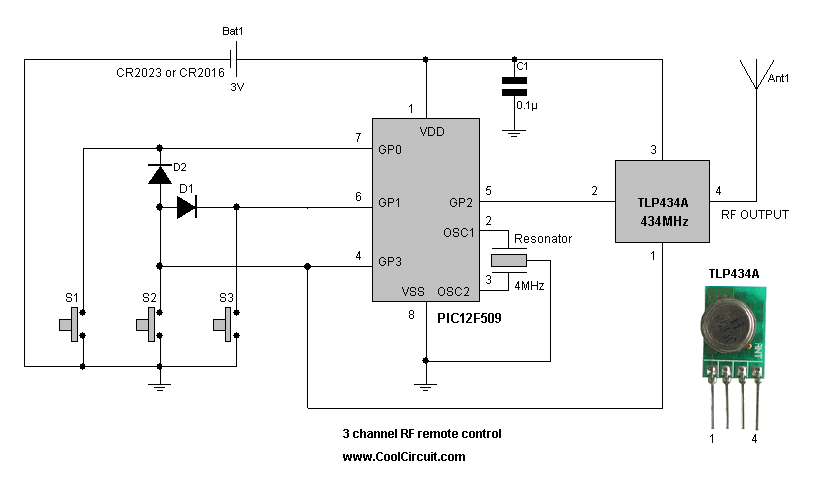
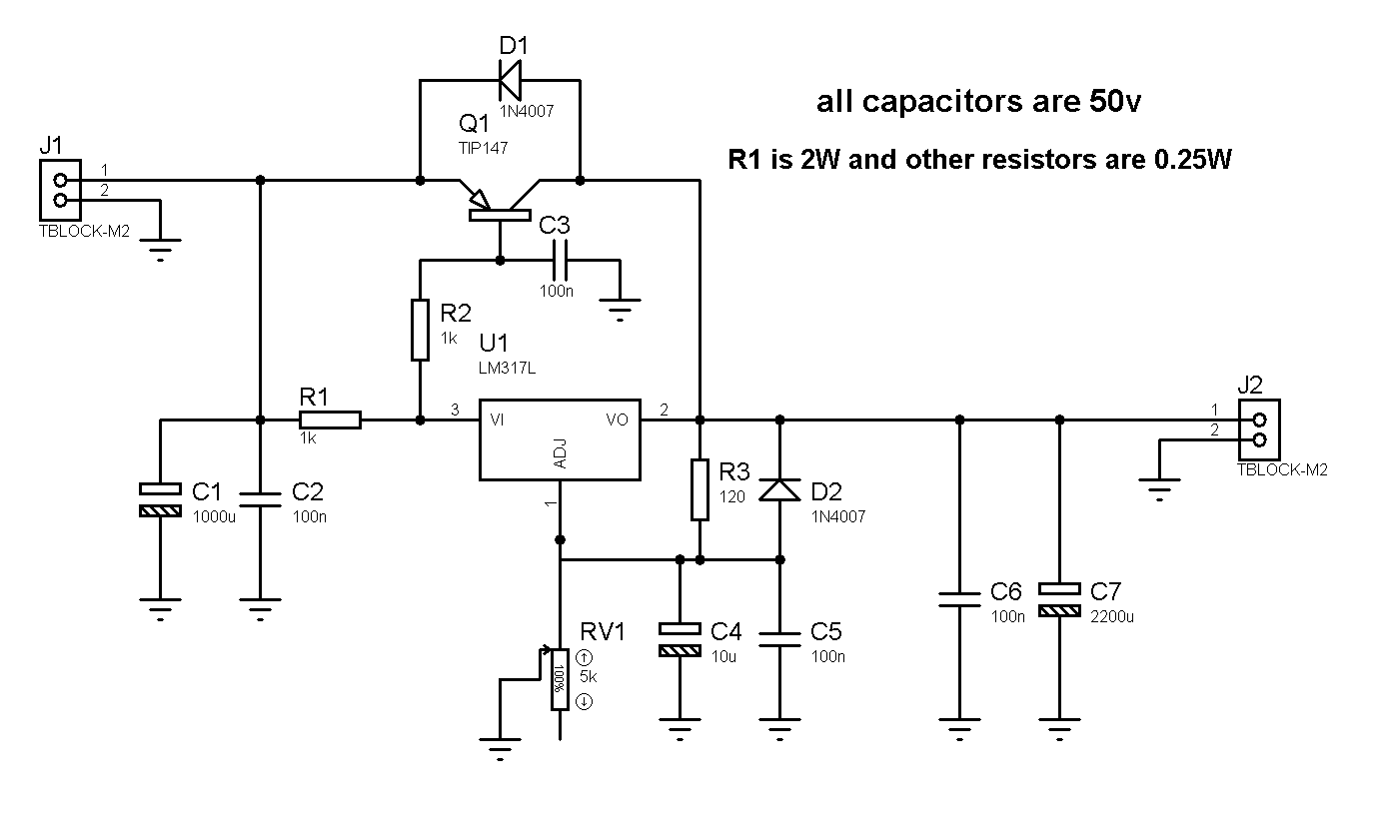
The schematic diagram differs slightly from the final PCB; some pins and unnecessary external interfaces have been removed from the PCB.
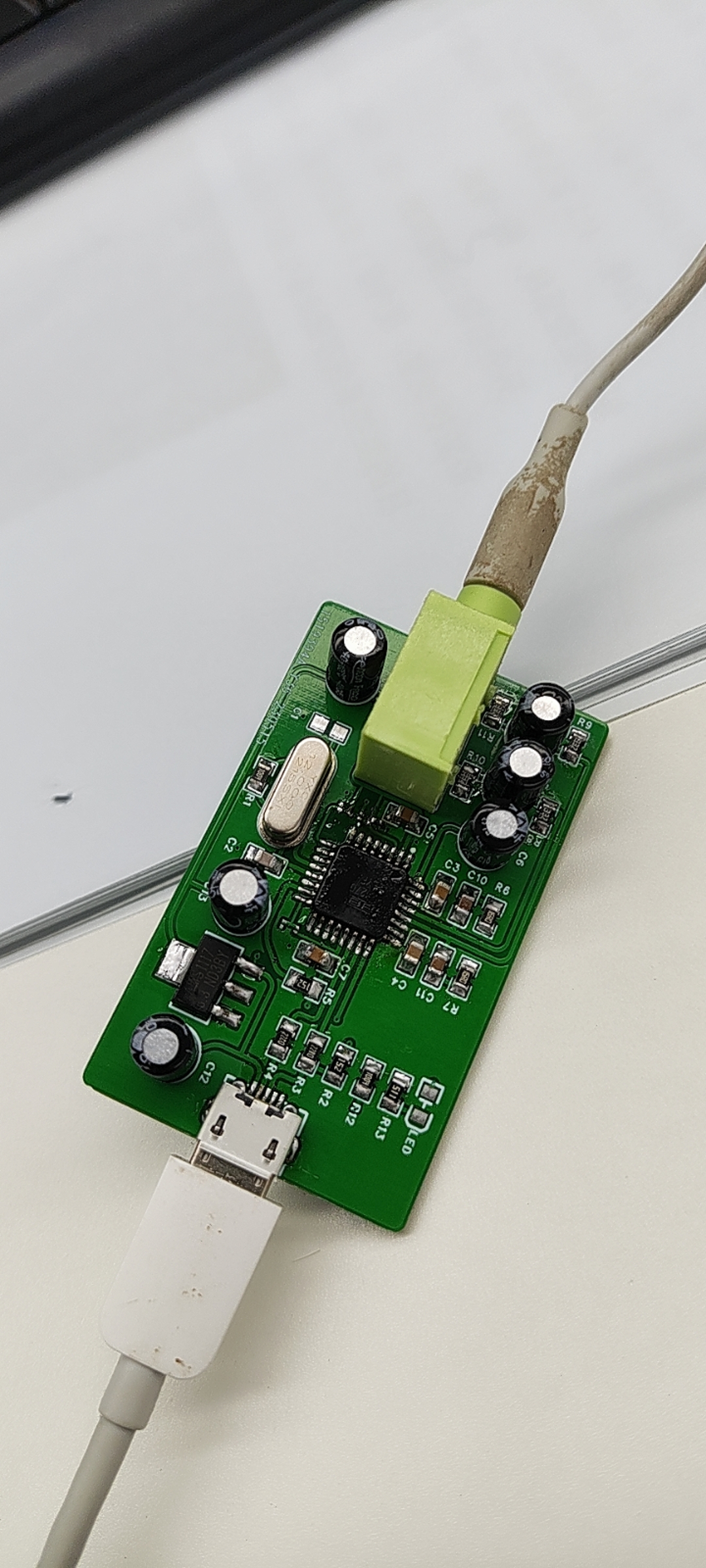
PDF_PCM2707 sound card.zip
Altium_PCM2707 sound card.zip
PADS_PCM2707 sound card.zip
BOM_PCM2707 sound card.xlsx
95990
IP2311: Minimum Size Single-Cell Battery Switch Charging
With USB 5V input, switch charging, charging a single-cell battery, the battery terminal current is approximately 1-1.2A, and the charging power is approximately 5W.
The overall size of the charging circuit is close to that of a single SOP-8 chip
, perfectly resolving the contradiction between the insufficient charging current of the TP4054 and the excessive heat generation of the TP4056.
Function Description:
USB 5V input, switchable charging, charges a single-cell battery, battery terminal current approximately 1-1.2A, charging power approximately 5W.
Ultra-mini size; the overall size of the charging circuit is close to that of a single SOP-8 chip. The SOP-8
IP2311 perfectly addresses the contradiction in small-size products: the TP4054's charging current is too low, and the TP4056's heat generation is too high.
Input voltage:
4.5~5.7V, 18V Max. 4.5V triggers undervoltage protection, automatically reducing charging power.
Output voltage:
4.2/4.3/4.35/4.4V ±0.05V.
Trickle charging :
3.0V ±0.05V .
Full charge cutoff:
60mA (40-100mA). (When the chip output reaches 4.2/4.3/4.35/4.4V, if the battery terminal has not reached it, it switches from constant current charging to constant voltage charging. The higher the internal resistance of the battery cell and wires, the longer the constant voltage charging time.) Two
LEDs .
A red light illuminates during charging, turning green when fully charged.
NTC
does not support
chip over-temperature
protection; it has built-in over-temperature protection up to 140℃.
USB voltage,
USB current,
battery voltage
, battery current
, charging power,
charging efficiency:
4.90V
1.10A
, 3.66V
1.30A ,
5.42W
, 87.60% ;
4.90V
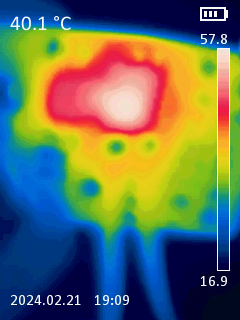
1.10A , 3.85V 1.25A , 5.43W , 88.55 %; 4.90V 1.10A , 4.06V 1.20A, 5.43W , 89.50%. Charging temperature . Schematic diagram, PCB layout, PCB 3D preview, PCB physical image . Download data: https://oshwhub.com/saber.lily?tab=project&page=1. Other design files can be obtained from your supplier.
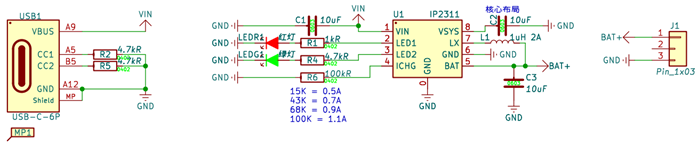
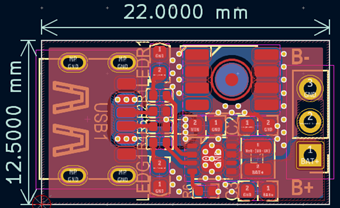
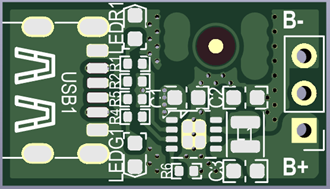
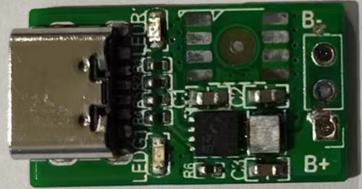
Demo-IP2311_V0.1.pdf
Demo-IP2311_V0.1_240221_bom.csv
Demo-IP2311_V0.1_240221_gerber.zip
IP2311_datasheet_V1.00.pdf
PDF_IP2311: Minimum Size Single-Cell Battery Switch Charging.zip
Altium_IP2311: Miniature single-cell battery switch charger. (zip file)
PADS_IP2311: Minimum Size Single-Cell Battery Switch Charger.zip
BOM_IP2311: Minimum Size Single-Cell Battery Switch Charger.xlsx
95992
DC UPS module powered by lithium battery
Using the MP3428AGL-Z solution, the output is adjustable from 5V to 15V. Without a heatsink, it can withstand 12V 1.5A in a standby test without any problems. The lithium battery has a maximum charging current of 2.5A and includes battery protection.
Supports up to 2.5A lithium battery charging; without heat dissipation, operation is recommended to be below 20W.
The chip supports up to 18V; since the capacitor I used only has a voltage rating of 16V, if the parameters are the same, 15V or even lower is recommended.
It includes a battery protection chip for overcharge, over-discharge, overcurrent, and overload protection.
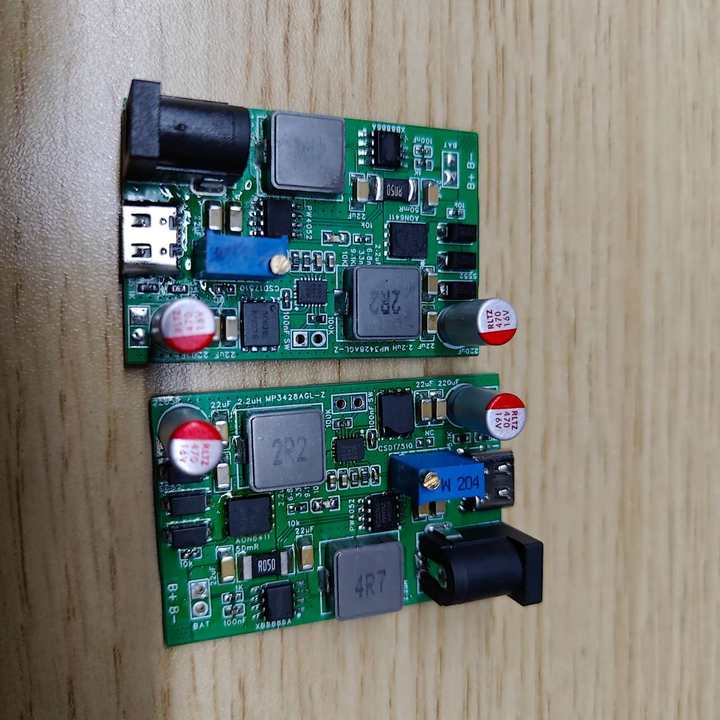
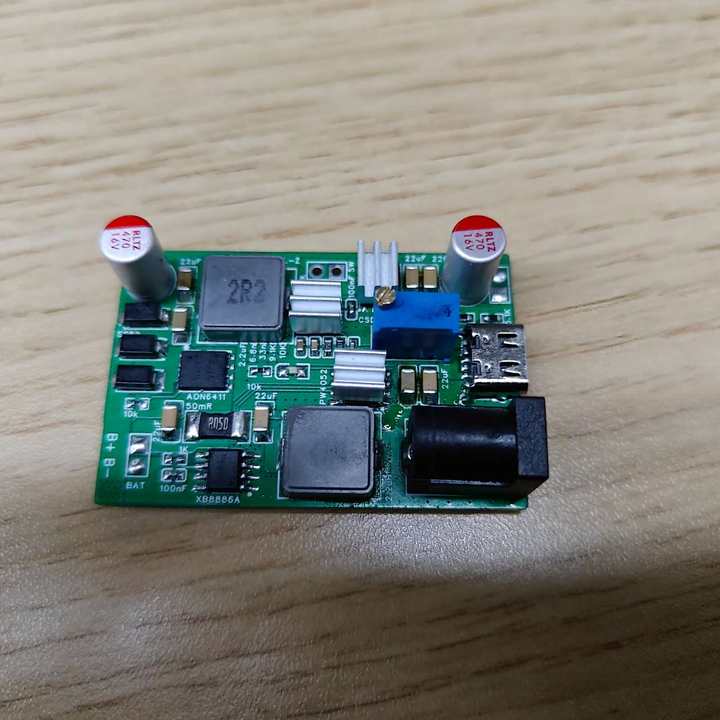
Actual test data without heat dissipation: (Currently, I only have a 5A switching power supply on hand, so I cannot test higher power outputs) Input
Voltage (Board End) Input Current Input Power Output Voltage (Board End) Output Current Output Power Efficiency 3.972V 1.73A 6.87W 12.2V 0.5A 6.1W 88.8% 3.832V 3.49A 13.374W 12.2V 1A 12.2W 91.2% 3.891V 4.84A 18.32W 12.2V 1.4A 17.08W 93.2% Testing Tools: Test method for ATZ9712 electronic load, ZT219 multimeter, and ordinary 30V 5A adjustable power supply : The input (output) voltage is measured using an ordinary multimeter, and the current is referenced from the adjustable power supply current display and the electronic load display parameters.
PDF_DC UPS Module Lithium Battery Powered.zip
Altium DC UPS Module Lithium Battery Powered.zip
PADS_DC UPS Module Lithium Battery Powered.zip
BOM_DC UPS Module Lithium Battery Powered.xlsx
95993
[PD Protocol | High-Quality Design] Mini Heating Platform [Copper Column Plate]
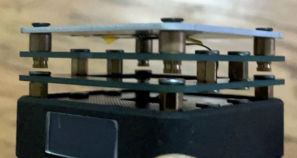
This project originated from the mini heating platform created by Xiao O and Xiao Q. The probes tend to burn out during prolonged electrical conduction, so we combined solutions from other developers and adapted them into a copper pillar conductivity solution.
Original Solution: [PD Protocol | High-Quality Design] Mini Heating Platform - JLCPCB EDA Open Source Hardware Platform (oshwhub.com)
1. The circuit BOM is consistent with the solutions for O and Q, no need to change the BOM or firmware. 2. The PCB needs to be completely redesigned. 3. Probes don't need to be purchased; instead, buy copper pillars and Teflon tubing. (Cheap and free shipping) Copper Pillars: 4*6*5 (10 pieces) Powder Metallurgy Copper Sleeve Oil-Including Bushing Brass Bushing Bearing Inner Diameter 3M 4M 5M 6M 8M 10M 12M 14M 16-60-tmall.com Tmall
Teflon Tubing: 3*4 mm Teflon Tubing Milky White PTFE Tubing Hard PTFE Flexible Hoses Corrosion Resistant Acid and Alkali Resistant High Temperature Polytetrafluoroethylene Tubing -tmall.com Tmall
Countersunk Screws: Iron-plated black Phillips head flathead screws, countersunk bolts, machine-threaded screws, KM electronic small screws M2 M3 M4 M5 M6 - tmall.com (Tmall).
Important note: If you can make countersunk holes for the heated aluminum substrate (you'll need to buy a countersunk drill), buy screws of specification [M3*10, 4.5mm head]. Otherwise, buy screws of specification [M3*12]... otherwise they won't be long enough.
4. Assembly method
is otherwise the same as the original plan, key points...

PDF_[PD Protocol_ High-Quality Design] Mini Heating Platform [Copper Column Plate].zip
Altium_[PD Protocol_ High-Quality Design] Mini Heating Platform [Copper Column Plate].zip
PADS_[PD Protocol_ High-Quality Mini Heating Platform [Copper Column Plate].zip
95997
TL431 heating control board
It enables heating and temperature control of external heating wires or aluminum substrates that control the resistance of wiring.
Principle: Temperature is detected by an NTC sensor, and two TL431 microcontrollers are used to determine the upper and lower temperature limits. Two NOR gates form a latch.
Function: To achieve range-based temperature control.
Operating Conditions: 5V power supply from a Vivo phone charger (the power supply to the external heater should not exceed the output power of the phone charger). Phenomenon: Two LEDs on the board indicate whether the current temperature exceeds the set upper and lower temperature limits. Issue
: The safety of the pre-amplifier power supply needs to be verified by the user. Power from a phone power bank is generally safer, but the power consumption must be carefully monitored.
8KB2(R4J6%M$MO36WVR%N2I_tmb.jpg
PDF_TL431 heating control board.zip
Altium_TL431 heating control board.zip
PADS_TL431 heating control board.zip
BOM_TL431 Heating Control Board.xlsx
95999
electronic








 京公网安备 11010802033920号


 177-710-1-100CS4J5-24RDN