
Universal high-power AC input: Friendly to the public or a trap?
Source: InternetPublisher:newrudeman Keywords: PFC high power AC input Updated: 2025/10/10
Most reliable power supplies (including tolerances) can be divided into two voltage categories: low-line or high-line. Modern electronics typically use direct current (DC) rather than alternating current (AC). This difference in current requires a power supply to make the energy usable; the input range the power supply needs to support directly impacts cost and performance.
Designing a power supply to operate over a "universal input range" (85-265 VAC) can be useful for certain applications that are brought to different regions, such as mobile phone chargers or laptop power supplies. Many manufacturers want the convenience of a universal input supply so that they can reduce product variation and component count for sourcing purposes; however, using a separate supply can prove to save money.
Another argument for having separate products involves regulations for each region. Just like different voltage levels, each region has its own set of regulatory specifications that must be tested and certified—it wouldn't make much sense to certify a product designed only for use in the US for use in Europe. Furthermore, some regions, such as Europe, require power factor correction (PFC), while others don't. Furthermore, the cost savings of having separate supplies can be increased.
For example, consider a 250W power supply that does not require PFC. Each of these power supplies has a unique configuration that allows it to operate within its specified range.
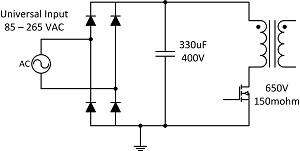
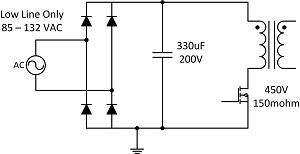
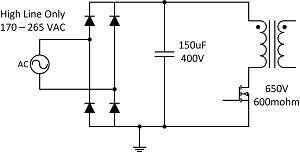
A power supply designed for high voltage will only need components with a higher voltage.
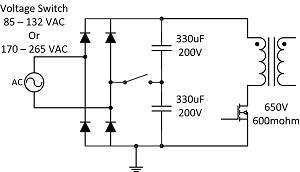
The universal input design must accommodate the worst of two independent power supplies; it needs to be able to handle the higher current of low-line operation and support the high-voltage requirements of high-line operation. A configuration using a voltage-selective switch has some benefits (lower voltage limit and lower current requirements), but there is a risk that the user will not put the switch in the correct state. It also requires twice the capacitance of a low-line-only configuration.
The input capacitor and main power switch vary in design based on the input range and driver cost. Other components can also benefit from the reduced range, such as the transformer, diode bridge, or electromagnetic interference (EMI) filter, but these primarily impact performance. The power level of the design also significantly impacts the cost difference. For a 5-10 W adapter for charging a mobile phone, the difference won't be noticeable. However, for a 250 W audio amplifier, the cost difference can be significant.

If the motor drive power level increases to 700 W, the difference becomes even more significant. Furthermore, if we consider the use of PFC circuits in Europe, creating a universal power supply will be a failure. If the PFC also needs to operate over the entire line range, its cost will increase.

The evidence is clear: if a product isn't destined for use in multiple regions throughout its lifetime, it makes sense to use separate designs to cover each region. A universal input power supply is still required, but designers need to decide based on power level and portability to determine whether it makes sense. PFC requirements and the certifications required for different regions can also make the decision quite simple.
- 0-30V/20A High-Power Regulated Power Supply (using LM338)
- Simple ±22V voltage regulator
- 500W 12V to 220V inverter
- Nickel-Cd battery thermal peak detection charger
- Solar-powered mobile phone charger
- Charge-coupled bidirectional power MOSFET relay
- Simplifying 100V Input Wide VIN Power Conversion
- A flyback converter solution where two outputs are better than one
- Top Three Ways to Split Voltage Rails into Bipolar Power Supplies
- When debugging a boost converter, you can analyze it from four directions.
- Power circuit of LBO-522 dual trace oscilloscope
- High current (4A) switching regulator integrated circuit L296 outputs 5.1 to 40V
- Power supply circuit with multiple outputs (MAX1902)
- 3-phase CPU power circuit using HIP6301 and HIP6601 chips
- 2-phase CPU power circuit using HIP6302 and HIP6601 chips
- Warm current power supply circuit b
- CF1 (CF2) DC power supply circuit
- DC power supply circuit for semiconductor radio
- Music power circuit
- Inverter power circuit







 京公网安备 11010802033920号