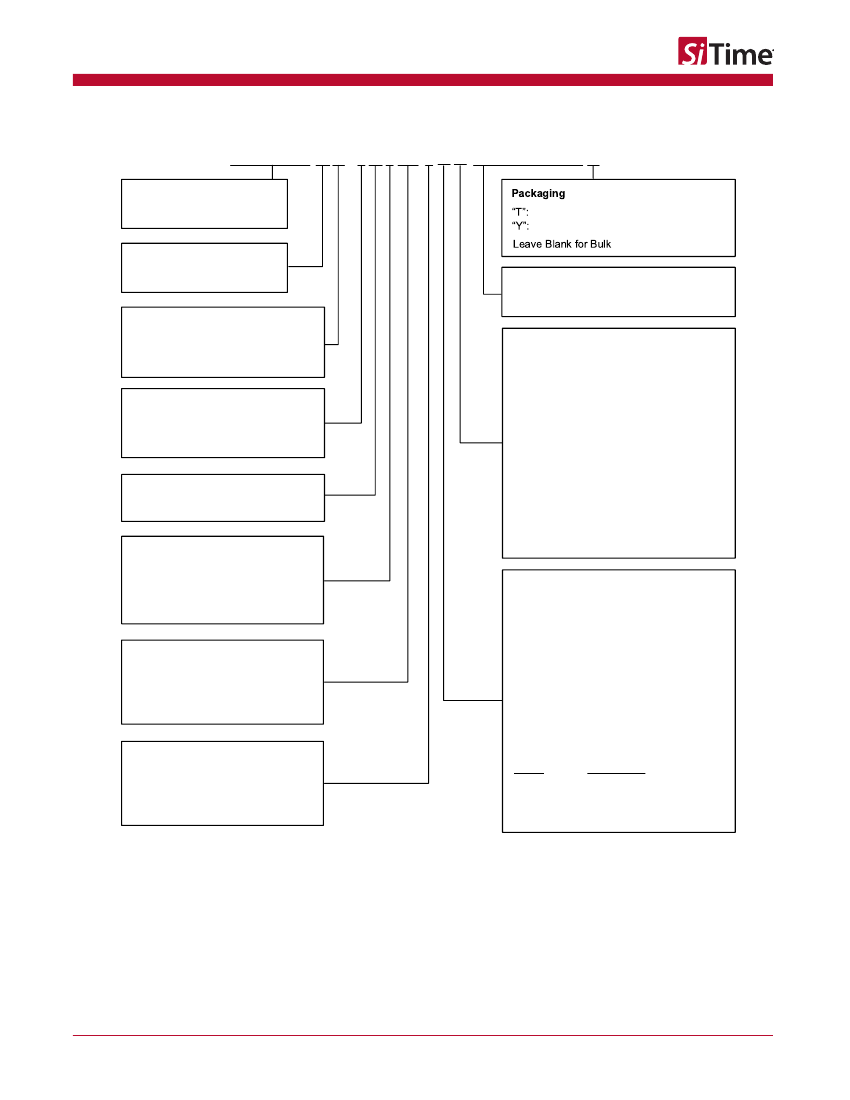
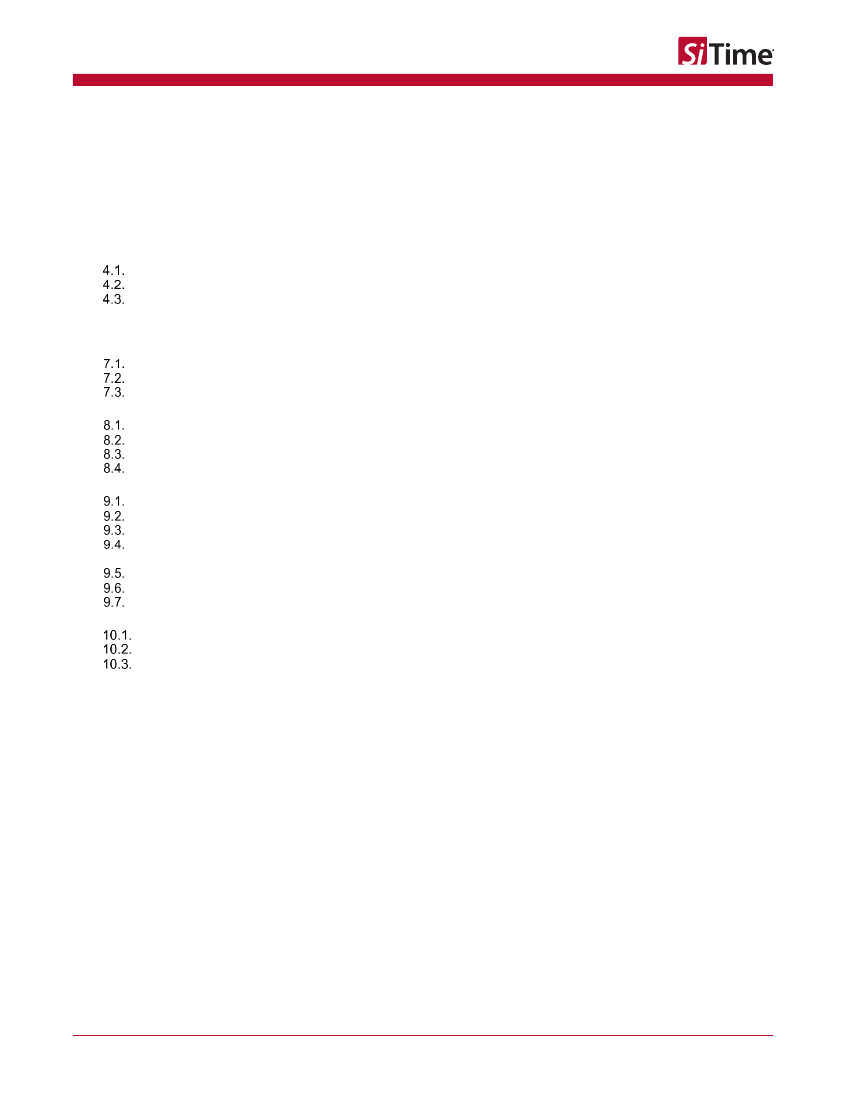
Ordering Information .................................................................................................................................................................... 2
User Programming Interface ..................................................................................................................................... 18
Start-up output frequency and signaling types ........................................................................................................... 18
Any-frequency function ............................................................................................................................................. 19
C/SPI Control Registers...................................................................................................................................................... 28
9 I
Register Address: 0x00. DCO Frequency Control Least Significant Word (LSW) .................................................... 28
Register Address: 0x01. OE Control, DCO Frequency Control Most Significant Word (MSW) ................................. 29
Register Address: 0x02. DCO PULL RANGE CONTROL ........................................................................................ 29
Register Address: 0x03. Frac-N PLL Feedback Divider Integer Value and Frac-N PLL Feedback Divider Fraction
Value MSW ............................................................................................................................................................... 30
Register Address: 0x05. Forward Divider, Driver Control ......................................................................................... 30
Register Address: 0x06. Driver Divider, Driver Control ............................................................................................. 31
2
C Operation ........................................................................................................................................................................ 32
10 I
I
2
C protocol ............................................................................................................................................................... 32
I
2
C Timing Specification ............................................................................................................................................ 35
I
2
C Device Address Modes ....................................................................................................................................... 36
Dimensions and Patterns ........................................................................................................................................................... 43
Additional Information ................................................................................................................................................................ 44
Revision History ......................................................................................................................................................................... 45
Rev 1.01
Page 3 of 45
www.sitime.com
SiT3521
1 to 340 MHz Elite Platform I2C/SPI Programmable Oscillator
1 Electrical Characteristics
All Min and Max limits in the Electrical Characteristics tables are specified over temperature and rated operating voltage with
standard output terminations shown in the termination diagrams. Typical values are at 25°C and nominal supply voltage.
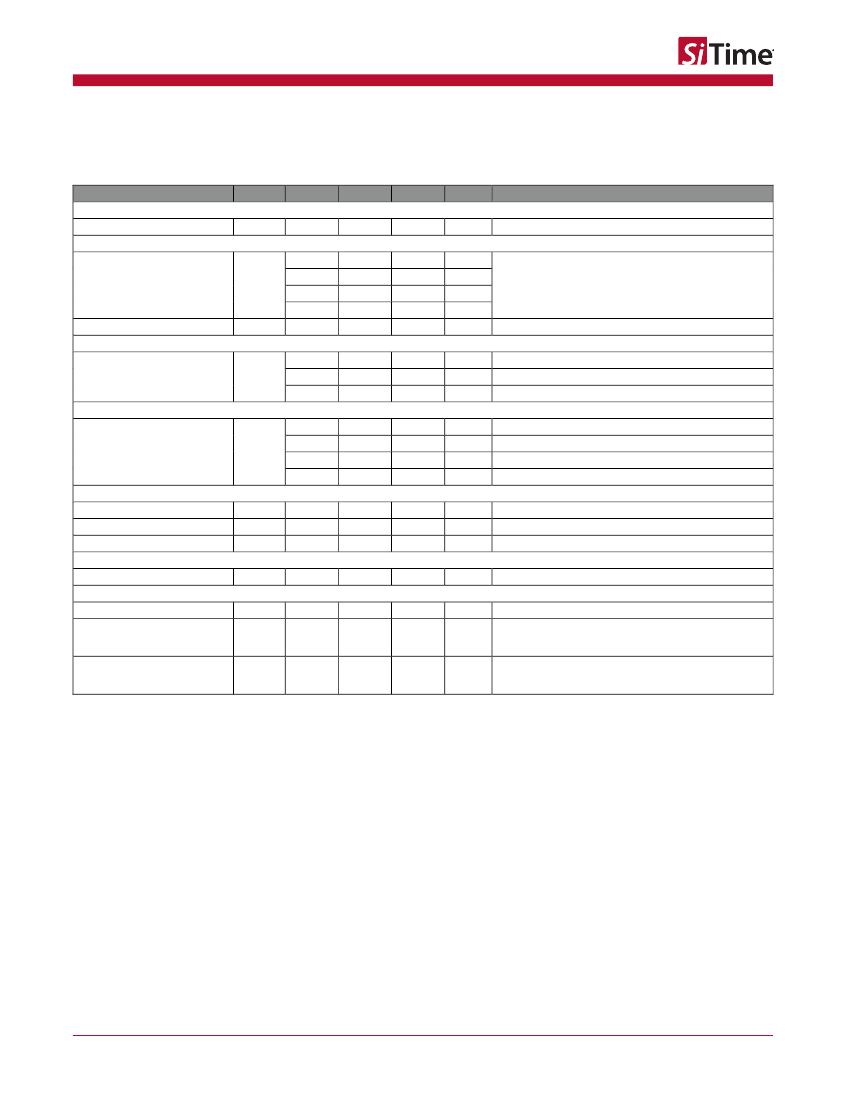
Table 1. Electrical Characteristics – Common to LVPECL, LVDS and HCSL
Parameter
Output Frequency Range
Symbol
f
Min.
1
Typ.
–
–
–
–
–
±1
–
–
–
Max.
340
Unit
MHz
Condition
Factory or user programmable, accurate to 6 decimal places
Frequency Range
Frequency Stability
Frequency Stability
F_stab
-10
-20
-25
-50
First Year Aging
F_1y
–
+10
+20
+25
+50
–
ppm
ppm
ppm
ppm
ppm
°C
°C
°C
1
st
-year aging at 25°C
Inclusive of initial tolerance, operating temperature, rated
power supply voltage and load variations.
Temperature Range
Operating Temperature Range
T_use
-20
-40
-40
+70
+85
+105
Supply Voltage
Supply Voltage
Vdd
2.97
2.7
2.52
2.25
3.3
3.0
2.8
2.5
–
–
100
–
–
–
3.63
3.3
3.08
2.75
–
30%
–
V
V
V
V
Extended Commercial
Industrial
Extended Industrial. Available only for I
2
C operation, not SPI.
Input Characteristics – OE Pin
Input Voltage High
Input Voltage Low
Input Pull-up Impedance
VIH
VIL
Z_in
70%
–
–
Vdd
Vdd
kΩ
OE pin
OE pin
OE pin, logic high or logic low
Output Characteristics
Duty Cycle
DC
45
–
–
55
%
Startup and Output Enable/Disable Timing
Start-up Time
Output Enable/Disable Time –
Hardware control via OE pin
Output Enable/Disable Time –
Software control via I
2
C/SPI
T_start
T_oe_hw
3.0
3.8
ms
µs
Measured from the time Vdd reaches its rated minimum value
Measured from the time OE pin reaches rated VIH and VIL to
the time clock pins reach 90% of swing and high-Z.
See
Figure 9
and
Figure 10
Measured from the time the last byte of command is
transmitted via I
2
C/SPI (reg1) to the time clock pins reach 90%
of swing and high-Z. See
Figure 30
and
Figure 31
T_oe_sw
–
–
6.5
µs
Rev 1.01
Page 4 of 45
www.sitime.com
SiT3521
1 to 340 MHz Elite Platform I2C/SPI Programmable Oscillator
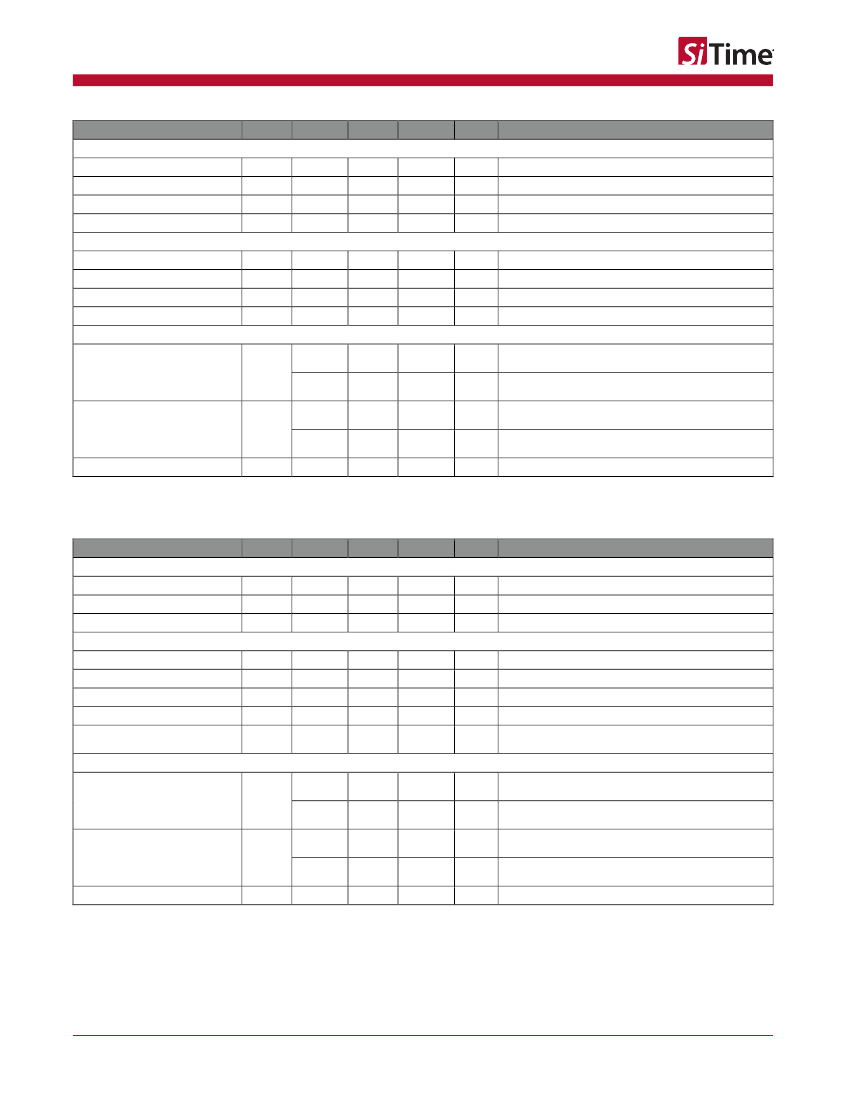
Table 2. Electrical Characteristics – LVPECL Specific
Parameter
Symbol
Min.
Typ.
Max.
Unit
Condition
Current Consumption
Current Consumption
OE Disable Supply Current
Output Disable Leakage Current
Maximum Output Current
Idd
I_OE
I_leak
I_driver
–
–
–
–
–
–
0.15
–
89
58
–
32
mA
mA
A
mA
Excluding Load Termination Current, Vdd = 3.3 V or 2.5 V
OE = Low
OE = Low
Maximum average current drawn from OUT+ or OUT-
Output Characteristics
Output High Voltage
Output Low Voltage
Output Differential Voltage Swing
Rise/Fall Time
VOH
VOL
V_Swing
Tr, Tf
Vdd - 1.1V
Vdd - 1.9V
1.2
–
–
–
1.6
225
Vdd - 0.7V
Vdd - 1.5V
2.0
290
Jitter
RMS Phase Jitter (random) –
DCO Mode Only
T_phj
–
–
RMS Phase Jitter (random) –
Any-frequency Mode Only
T_phj
–
–
RMS Period Jitter
[3]
Note:
3. Measured according to JESD65B.
T_jitt
–
0.225
0.1
0.225
0.11
1
0.340
0.14
0.340
0.15
1.6
ps
ps
ps
ps
ps
f = 156.25 MHz, Integration bandwidth = 12 kHz to 20 MHz,
all Vdd levels
f = 156.25, IEEE802.3-2005 10 GbE jitter mask integration
bandwidth = 1.875 MHz to 20 MHz, all Vdd levels
f = 156.25 MHz, Integration bandwidth = 12 kHz to 20 MHz,
all Vdd levels
f = 156.25, IEEE802.3-2005 10 GbE jitter mask integration
bandwidth = 1.875 MHz to 20 MHz, all Vdd levels
f = 100, 156.25 or 212.5 MHz, Vdd = 3.3 V or 2.5 V
V
V
V
ps
See
Figure 5
See
Figure 5
See
Figure 6
20% to 80%, see
Figure 6
Table 3. Electrical Characteristics – LVDS Specific
Parameter
Symbol
Min.
Typ.
Max.
Unit
Condition
Current Consumption
Current Consumption
OE Disable Supply Current
Output Disable Leakage Current
Idd
I_OE
I_leak
–
–
–
–
–
0.15
80
61
–
mA
mA
A
Excluding Load Termination Current, Vdd = 3.3 V or 2.5 V
OE = Low
OE = Low
Output Characteristics
Differential Output Voltage
Delta VOD
Offset Voltage
Delta VOS
Rise/Fall Time
VOD
ΔVOD
VOS
ΔVOS
Tr, Tf
250
–
1.125
–
–
–
–
–
–
400
455
50
1.375
50
470
Jitter
RMS Phase Jitter (random) –
DCO Mode Only
T_phj
–
–
RMS Phase Jitter (random) –
Any-frequency Mode Only
T_phj
–
–
RMS Period Jitter
[4]
Note:
4. Measured according to JESD65B.
T_jitt
–
0.21
0.1
0.21
0.1
1
0.275
0.12
0.367
0.12
1.6
ps
ps
ps
ps
ps
f = 156.25 MHz, Integration bandwidth = 12 kHz to 20 MHz,
all Vdd levels
f = 156.25, IEEE802.3-2005 10 GbE jitter mask integration
bandwidth = 1.875 MHz to 20 MHz, all Vdd levels
f = 156.25 MHz, Integration bandwidth = 12 kHz to 20 MHz,
all Vdd levels
f = 156.25, IEEE802.3-2005 10 GbE jitter mask integration
bandwidth = 1.875 MHz to 20 MHz, all Vdd levels
f = 100, 156.25 or 212.5 MHz, Vdd = 3.3 V or 2.5 V
mV
mV
V
mV
ps
f = 156.25MHz See
Figure 7
See
Figure 7
See
Figure 7
See
Figure 7
Measured with 2 pF capacitive loading to GND, 20% to 80%,
I want to do industrial Ethernet communication now. Can the Ethernet interface of STM32 be remotely upgraded and remotely controlled? Is PHY integrated? I attended TI's Lumen technical seminar yesterd...
In engineering, sine table data is often used. The sine table data is stored in a mif file for LPM_ROM initialization. So how to get the sine table data? It can be achieved with matlab
Here are two me...
I used 2452 to manually solder a small board, and then found a problem, that is, when powered on, the microcontroller could not start up, and then I touched the P2.6 pin with a test lead or something ...
【LPC54100】LPC54102 Let M0+ intermittently collect sensor purpose: temperature and angle values have their own sampling time, so the M0+ core intermittently reads temperature and angle values, occupyin...
[b]Application of wifi monitoring and positioning system in security, smart community and other fields[/b][align=left][color=#000000][color=#000000][font=Calibri]POS[/font]The monitoring and positioni...
ceOid=CeWriteRecordProps(m_hCPSDB,0,4,pProps); //The second parameter is set to 0 to write a new item to the database. Will it automatically be written to the end of the database? Why are the order of...
This article discusses how to wake up a touch-sensitive device such as a tablet without touching the device, using basic gesture recognition and novel proximity sensors. The article discusses the p...[Details]
Today, with the increasing integration of functions, mobile phones can also be used as portable media players (PMP), digital cameras, handheld computers (PDAs), and even global positioning systems ...[Details]
introduction
Throughout the history of automotive lighting, power has always played an important role. Initially, cars only needed headlights to see the road in the dark. Later, other light so...[Details]
Nippon Electric Works and Volvo Technology Japan have developed a wireless power supply system for electric vehicles (EVs). Using this system, the two companies have successfully conducted an exper...[Details]
I've been studying dot matrix recently. It looks simple, but it takes a while to master it completely! The 8*8 dot matrix hardware circuit I'm making now is like this. The row is driven by 74HC138 + t...[Details]
12v Lead Acid batteries used in trucks, cars, RVs and uninterruptible power supplies are usually rated at 12V. This circuit monitors the battery, the charge and discharge curves, gives the cu...[Details]
At very low temperatures, certain metals and alloys lose their resistance to electric
current
and become
superconductors
. Two parameters that are often measured are the transition ...[Details]
introduction
Steam turbines are driven by high-temperature and high-pressure steam generated by boilers to run at high speed. They are key power equipment in thermal power plants. The emergenc...[Details]
0 Introduction
Wireless Sensor Network (WSN) monitors the target by deploying a large number of sensor nodes in the target area. WSN realizes the positioning and tracking of the target, determi...[Details]
As the global LED market demand continues to increase, my country's LED industry will face huge opportunities in the future. However, the core LED technology and patents are basically monopolized b...[Details]
I. Introduction
The use of electronics in cars dates back to the early 20th century when electric starters replaced hand cranks. Automotive electronics became popular in the 1960s with the...[Details]
PID is proportional differential adjustment. You can refer to the detailed introduction in the automatic control course for details! The positive action and the negative action in temperature contr...[Details]
With the rapid development of the IT industry, the demand for small DC cooling fans with PWM control (hereinafter referred to as fans) used in electronic products is increasing. This type of DC fan...[Details]
1 Introduction
Max+PlusⅡ is an integrated FPGA/CPLD development environment provided by Altera. It can independently compile simple VHDL programs. However
,
the
automatic elevator contro...[Details]
Workers in garment factories usually turn on the power of the sewing machine motor as soon as they get to work and do not turn off the sewing machine power until they get off work. In fact, during ...[Details]

 stm32/stm8
 京公网安备 11010802033920号
 EEWORLD