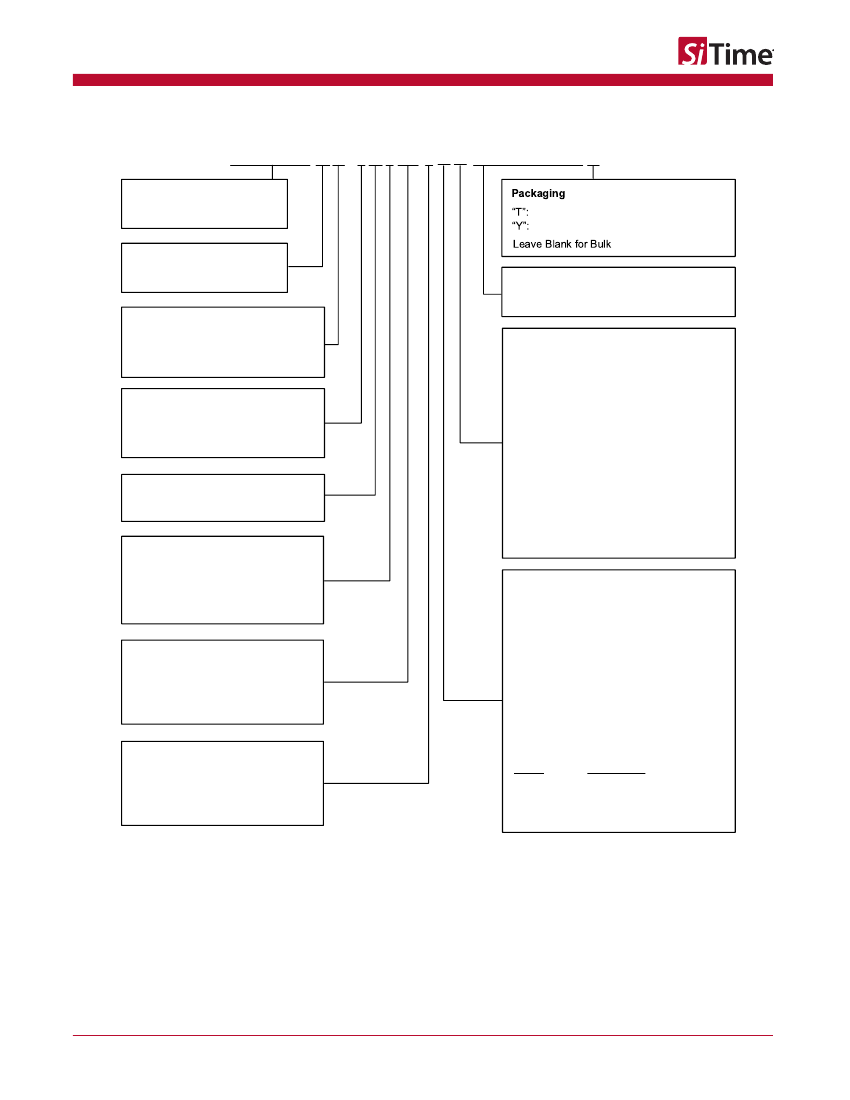
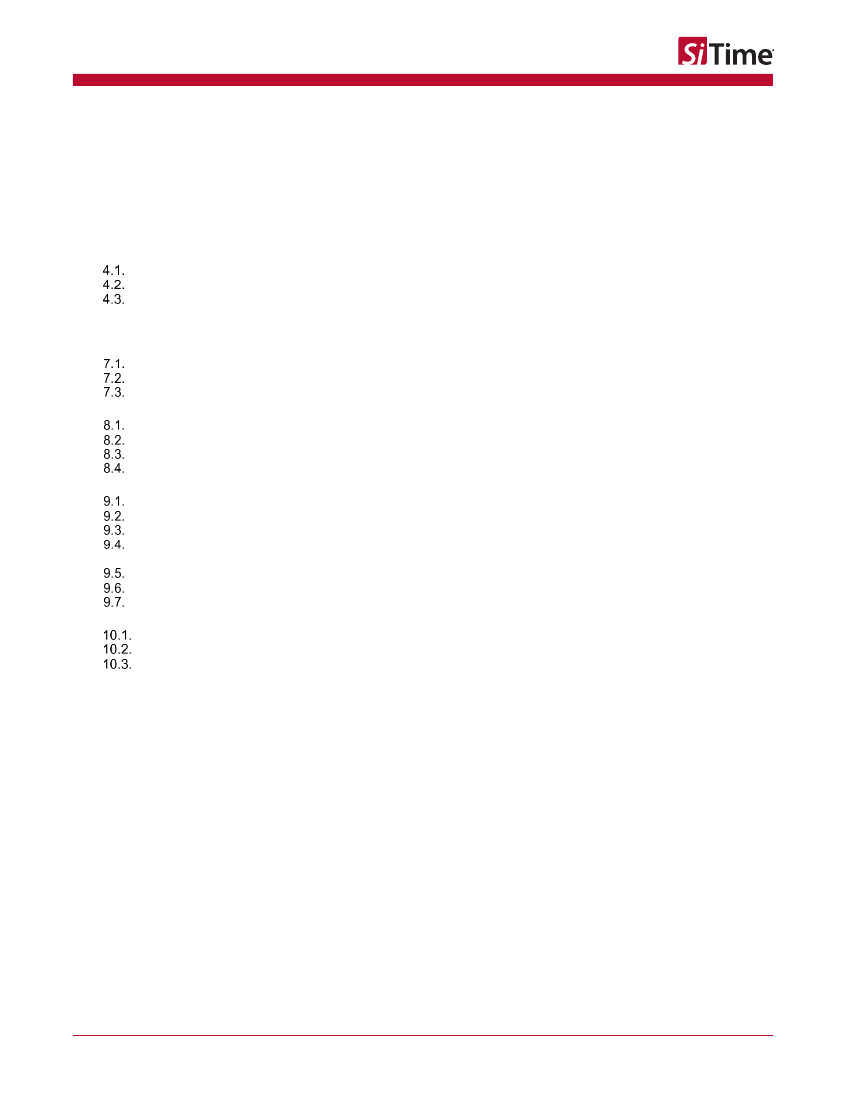
Ordering Information .................................................................................................................................................................... 2
User Programming Interface ..................................................................................................................................... 18
Start-up output frequency and signaling types ........................................................................................................... 18
Any-frequency function ............................................................................................................................................. 19
C/SPI Control Registers...................................................................................................................................................... 28
9 I
Register Address: 0x00. DCO Frequency Control Least Significant Word (LSW) .................................................... 28
Register Address: 0x01. OE Control, DCO Frequency Control Most Significant Word (MSW) ................................. 29
Register Address: 0x02. DCO PULL RANGE CONTROL ........................................................................................ 29
Register Address: 0x03. Frac-N PLL Feedback Divider Integer Value and Frac-N PLL Feedback Divider Fraction
Value MSW ............................................................................................................................................................... 30
Register Address: 0x05. Forward Divider, Driver Control ......................................................................................... 30
Register Address: 0x06. Driver Divider, Driver Control ............................................................................................. 31
2
C Operation ........................................................................................................................................................................ 32
10 I
I
2
C protocol ............................................................................................................................................................... 32
I
2
C Timing Specification ............................................................................................................................................ 35
I
2
C Device Address Modes ....................................................................................................................................... 36
Dimensions and Patterns ........................................................................................................................................................... 43
Additional Information ................................................................................................................................................................ 44
Revision History ......................................................................................................................................................................... 45
Rev 1.01
Page 3 of 45
www.sitime.com
SiT3521
1 to 340 MHz Elite Platform I2C/SPI Programmable Oscillator
1 Electrical Characteristics
All Min and Max limits in the Electrical Characteristics tables are specified over temperature and rated operating voltage with
standard output terminations shown in the termination diagrams. Typical values are at 25°C and nominal supply voltage.
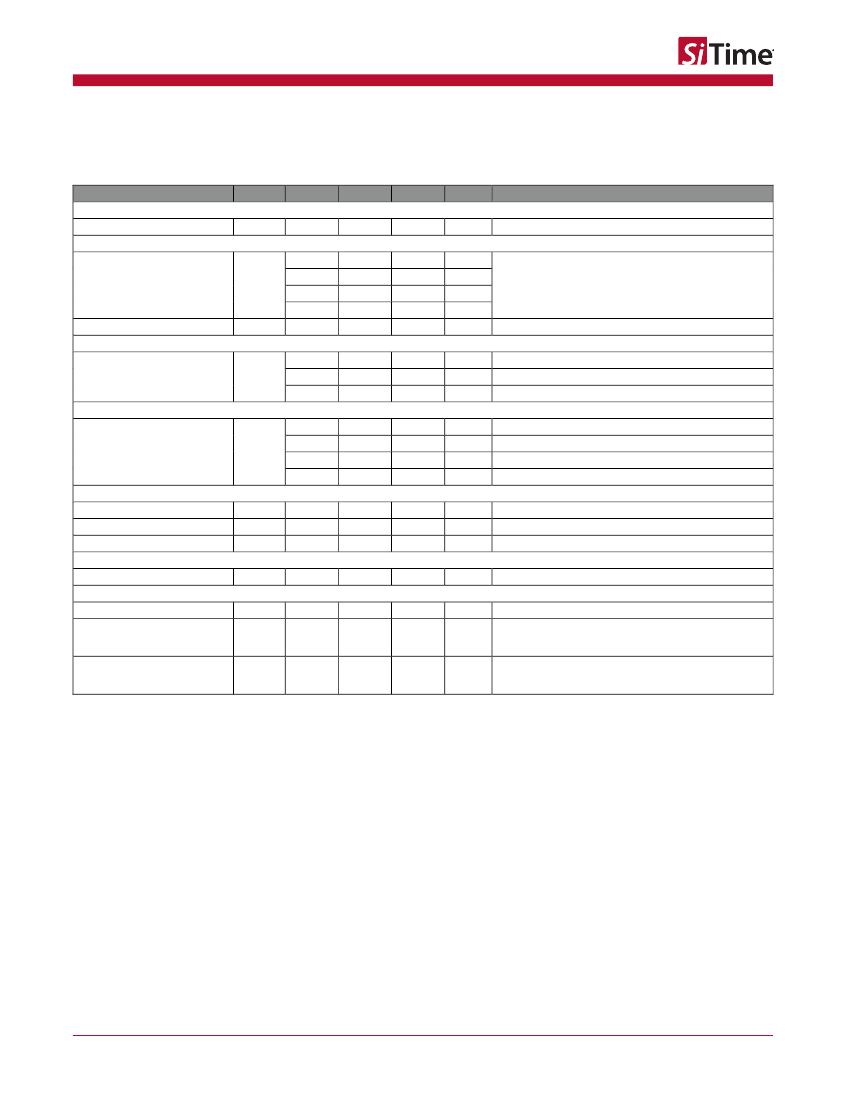
Table 1. Electrical Characteristics – Common to LVPECL, LVDS and HCSL
Parameter
Output Frequency Range
Symbol
f
Min.
1
Typ.
–
–
–
–
–
±1
–
–
–
Max.
340
Unit
MHz
Condition
Factory or user programmable, accurate to 6 decimal places
Frequency Range
Frequency Stability
Frequency Stability
F_stab
-10
-20
-25
-50
First Year Aging
F_1y
–
+10
+20
+25
+50
–
ppm
ppm
ppm
ppm
ppm
°C
°C
°C
1
st
-year aging at 25°C
Inclusive of initial tolerance, operating temperature, rated
power supply voltage and load variations.
Temperature Range
Operating Temperature Range
T_use
-20
-40
-40
+70
+85
+105
Supply Voltage
Supply Voltage
Vdd
2.97
2.7
2.52
2.25
3.3
3.0
2.8
2.5
–
–
100
–
–
–
3.63
3.3
3.08
2.75
–
30%
–
V
V
V
V
Extended Commercial
Industrial
Extended Industrial. Available only for I
2
C operation, not SPI.
Input Characteristics – OE Pin
Input Voltage High
Input Voltage Low
Input Pull-up Impedance
VIH
VIL
Z_in
70%
–
–
Vdd
Vdd
kΩ
OE pin
OE pin
OE pin, logic high or logic low
Output Characteristics
Duty Cycle
DC
45
–
–
55
%
Startup and Output Enable/Disable Timing
Start-up Time
Output Enable/Disable Time –
Hardware control via OE pin
Output Enable/Disable Time –
Software control via I
2
C/SPI
T_start
T_oe_hw
3.0
3.8
ms
µs
Measured from the time Vdd reaches its rated minimum value
Measured from the time OE pin reaches rated VIH and VIL to
the time clock pins reach 90% of swing and high-Z.
See
Figure 9
and
Figure 10
Measured from the time the last byte of command is
transmitted via I
2
C/SPI (reg1) to the time clock pins reach 90%
of swing and high-Z. See
Figure 30
and
Figure 31
T_oe_sw
–
–
6.5
µs
Rev 1.01
Page 4 of 45
www.sitime.com
SiT3521
1 to 340 MHz Elite Platform I2C/SPI Programmable Oscillator
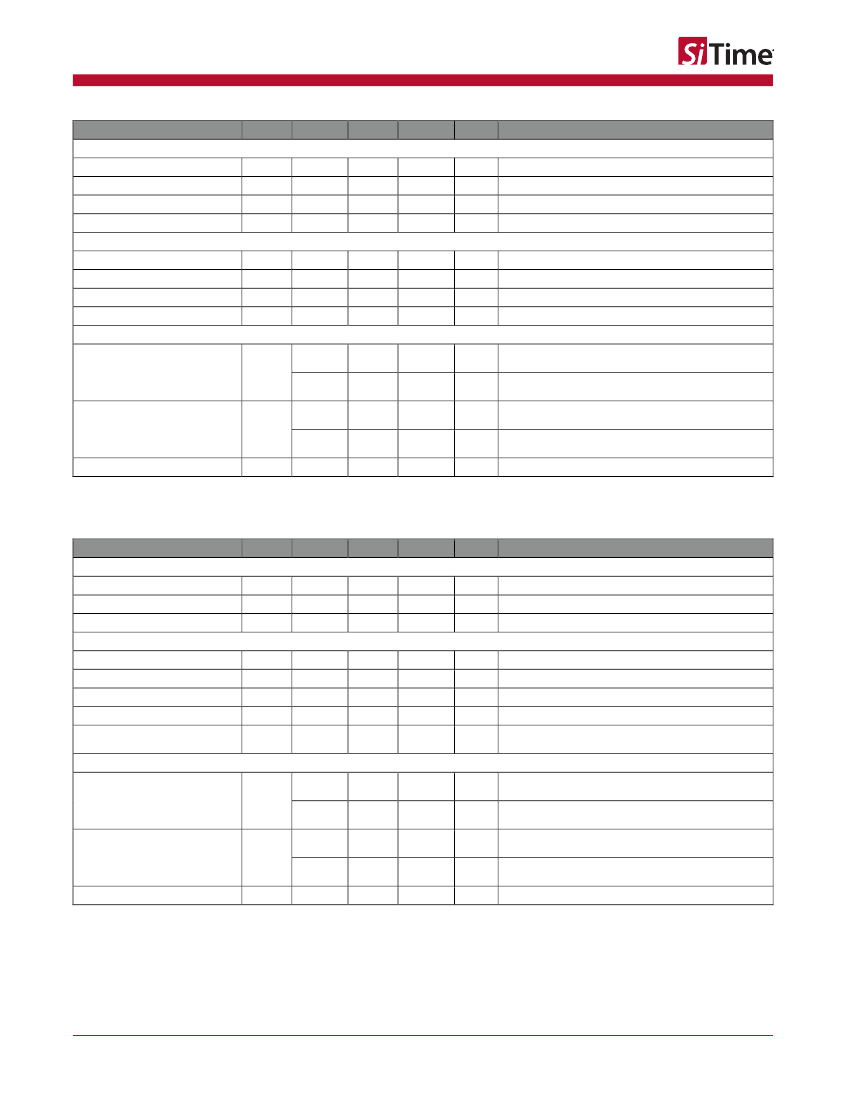
Table 2. Electrical Characteristics – LVPECL Specific
Parameter
Symbol
Min.
Typ.
Max.
Unit
Condition
Current Consumption
Current Consumption
OE Disable Supply Current
Output Disable Leakage Current
Maximum Output Current
Idd
I_OE
I_leak
I_driver
–
–
–
–
–
–
0.15
–
89
58
–
32
mA
mA
A
mA
Excluding Load Termination Current, Vdd = 3.3 V or 2.5 V
OE = Low
OE = Low
Maximum average current drawn from OUT+ or OUT-
Output Characteristics
Output High Voltage
Output Low Voltage
Output Differential Voltage Swing
Rise/Fall Time
VOH
VOL
V_Swing
Tr, Tf
Vdd - 1.1V
Vdd - 1.9V
1.2
–
–
–
1.6
225
Vdd - 0.7V
Vdd - 1.5V
2.0
290
Jitter
RMS Phase Jitter (random) –
DCO Mode Only
T_phj
–
–
RMS Phase Jitter (random) –
Any-frequency Mode Only
T_phj
–
–
RMS Period Jitter
[3]
Note:
3. Measured according to JESD65B.
T_jitt
–
0.225
0.1
0.225
0.11
1
0.340
0.14
0.340
0.15
1.6
ps
ps
ps
ps
ps
f = 156.25 MHz, Integration bandwidth = 12 kHz to 20 MHz,
all Vdd levels
f = 156.25, IEEE802.3-2005 10 GbE jitter mask integration
bandwidth = 1.875 MHz to 20 MHz, all Vdd levels
f = 156.25 MHz, Integration bandwidth = 12 kHz to 20 MHz,
all Vdd levels
f = 156.25, IEEE802.3-2005 10 GbE jitter mask integration
bandwidth = 1.875 MHz to 20 MHz, all Vdd levels
f = 100, 156.25 or 212.5 MHz, Vdd = 3.3 V or 2.5 V
V
V
V
ps
See
Figure 5
See
Figure 5
See
Figure 6
20% to 80%, see
Figure 6
Table 3. Electrical Characteristics – LVDS Specific
Parameter
Symbol
Min.
Typ.
Max.
Unit
Condition
Current Consumption
Current Consumption
OE Disable Supply Current
Output Disable Leakage Current
Idd
I_OE
I_leak
–
–
–
–
–
0.15
80
61
–
mA
mA
A
Excluding Load Termination Current, Vdd = 3.3 V or 2.5 V
OE = Low
OE = Low
Output Characteristics
Differential Output Voltage
Delta VOD
Offset Voltage
Delta VOS
Rise/Fall Time
VOD
ΔVOD
VOS
ΔVOS
Tr, Tf
250
–
1.125
–
–
–
–
–
–
400
455
50
1.375
50
470
Jitter
RMS Phase Jitter (random) –
DCO Mode Only
T_phj
–
–
RMS Phase Jitter (random) –
Any-frequency Mode Only
T_phj
–
–
RMS Period Jitter
[4]
Note:
4. Measured according to JESD65B.
T_jitt
–
0.21
0.1
0.21
0.1
1
0.275
0.12
0.367
0.12
1.6
ps
ps
ps
ps
ps
f = 156.25 MHz, Integration bandwidth = 12 kHz to 20 MHz,
all Vdd levels
f = 156.25, IEEE802.3-2005 10 GbE jitter mask integration
bandwidth = 1.875 MHz to 20 MHz, all Vdd levels
f = 156.25 MHz, Integration bandwidth = 12 kHz to 20 MHz,
all Vdd levels
f = 156.25, IEEE802.3-2005 10 GbE jitter mask integration
bandwidth = 1.875 MHz to 20 MHz, all Vdd levels
f = 100, 156.25 or 212.5 MHz, Vdd = 3.3 V or 2.5 V
mV
mV
V
mV
ps
f = 156.25MHz See
Figure 7
See
Figure 7
See
Figure 7
See
Figure 7
Measured with 2 pF capacitive loading to GND, 20% to 80%,
I want to make an embedded software testing environment: The software under test (developed in C language) runs on the target machine (VxWork operating system) The software under test is connected to ...
[i=s]This post was last edited by landao_gd on 2022-9-22 00:15[/i]I was accidentally selected for this teardown.
This, this, this, this, do you know?
The goods received are like this, the packaging is...
[b][font=Comic Sans MS][size=6][color=#0000ff]These two are four-item five-wire[/color][/size][/font][/b] [b][font=Comic Sans MS][size=6][color=#0000ff]They were removed from an EPSON printer[/color][...
The main DSP manufacturers in the market include TI , ADI , Motorola , Lucent and Zilog , among which TI has the largest market share. The products range from low-end low-speed DSP to high-end DSP pro...
[i=s] This post was last edited by paulhyde on 2014-9-15 08:56 [/i] 1. Basic method of making printed circuit boards 1. Use carbon paper to copy the wiring diagram onto the copper-clad wall: Before co...
1 Introduction
The multifunctional monitor is a commonly used clinical medical device. It can display the patient's electrocardiogram (ECG), respiration (RESP), blood oxygen saturation (SP...[Details]
Digital-to-analog converters (ADCs) provide the critical conversion of analog signals to digital signals in many systems. They perform amplitude quantization of an analog input signal to a binary fini...[Details]
To ensure the success of China's TD-SCDMA network commercialization, operators and equipment suppliers need to conduct a large number of tests on networked equipment, among which RF testing is...[Details]
This article first briefly introduces the working principles of current mode and voltage mode and their respective advantages and disadvantages; then discusses the ideal voltage mode using output c...[Details]
Today's mobile phone production testing faces an increasingly complex environment, with challenges of multiple frequency bands and multiple standards, pressure on production test speed, and pres...[Details]
introduction
Every friend who has been in contact with PC since the 286 era must have deeply experienced the convenience brought to our lives and work by the leaps and bounds of comput...[Details]
Anyone who has owned a laptop computer will have noticed that when running on battery power, their portable device behaves differently than when running on AC mains power—the display dims, the proc...[Details]
0 Introduction
With the release of the "Elevator Supervision and Inspection Regulations", new requirements have been put forward for the inspection quality of elevators by inspection agenc...[Details]
1 Introduction
The brushless DC motor uses an electronic commutation device to replace the mechanical commutation device of the traditional DC motor, and has similar mechanical character...[Details]
O Introduction
Semiconductor laser (LD) is a solid light source. It has been widely used due to its advantages such as good monochromaticity, small size, light weight, low price and low po...[Details]
Historically, GPS receiver designers have combined simulation and drive testing to determine receiver performance in complex environments. While GPS signal simulation provides a repeatable signal s...[Details]
introduction
In-Circuit Programming (ICP) is a fast MCU programming method that is widely used. For the 8-bit MCU of Freescale Semiconductor that I use, the speed of in-circuit programming...[Details]
Video signal interference generation
1. Interference from front-end power supply: variable frequency motor of elevator, high-power motor of factory, substation, etc.
2. Interference i...[Details]
Since the binocular vision monitoring system can imitate the functions of the human eye, perceive the three-dimensional world information, and obtain the depth information from the object to the CC...[Details]
1 Introduction
At present, the Ethernet protocol has been widely used in various computer networks, such as office LANs, industrial control networks, etc., and it is still developing. New ...[Details]

 Embedded System
 京公网安备 11010802033920号
 EEWORLD