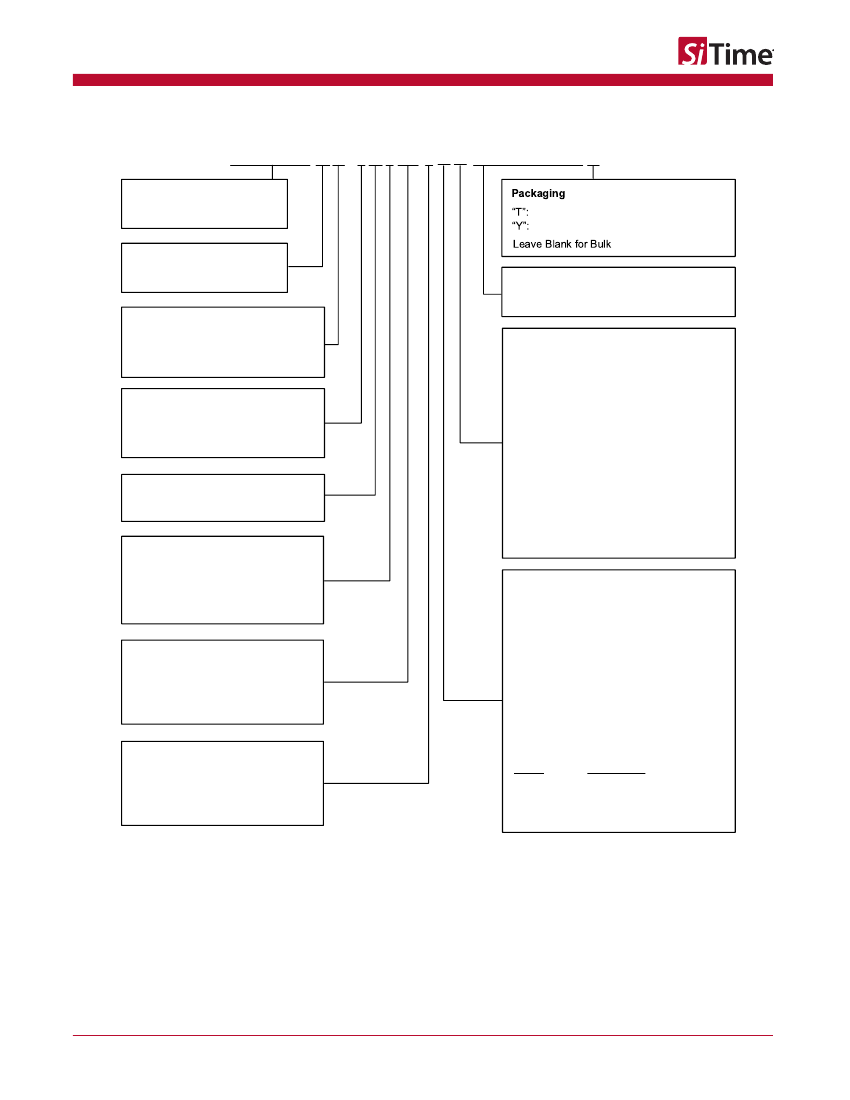
Ordering Information .................................................................................................................................................................... 2
User Programming Interface ..................................................................................................................................... 18
Start-up output frequency and signaling types ........................................................................................................... 18
Any-frequency function ............................................................................................................................................. 19
C/SPI Control Registers...................................................................................................................................................... 28
9 I
Register Address: 0x00. DCO Frequency Control Least Significant Word (LSW) .................................................... 28
Register Address: 0x01. OE Control, DCO Frequency Control Most Significant Word (MSW) ................................. 29
Register Address: 0x02. DCO PULL RANGE CONTROL ........................................................................................ 29
Register Address: 0x03. Frac-N PLL Feedback Divider Integer Value and Frac-N PLL Feedback Divider Fraction
Value MSW ............................................................................................................................................................... 30
Register Address: 0x05. Forward Divider, Driver Control ......................................................................................... 30
Register Address: 0x06. Driver Divider, Driver Control ............................................................................................. 31
2
C Operation ........................................................................................................................................................................ 32
10 I
I
2
C protocol ............................................................................................................................................................... 32
I
2
C Timing Specification ............................................................................................................................................ 35
I
2
C Device Address Modes ....................................................................................................................................... 36
Dimensions and Patterns ........................................................................................................................................................... 43
Additional Information ................................................................................................................................................................ 44
Revision History ......................................................................................................................................................................... 45
Rev 1.01
Page 3 of 45
www.sitime.com
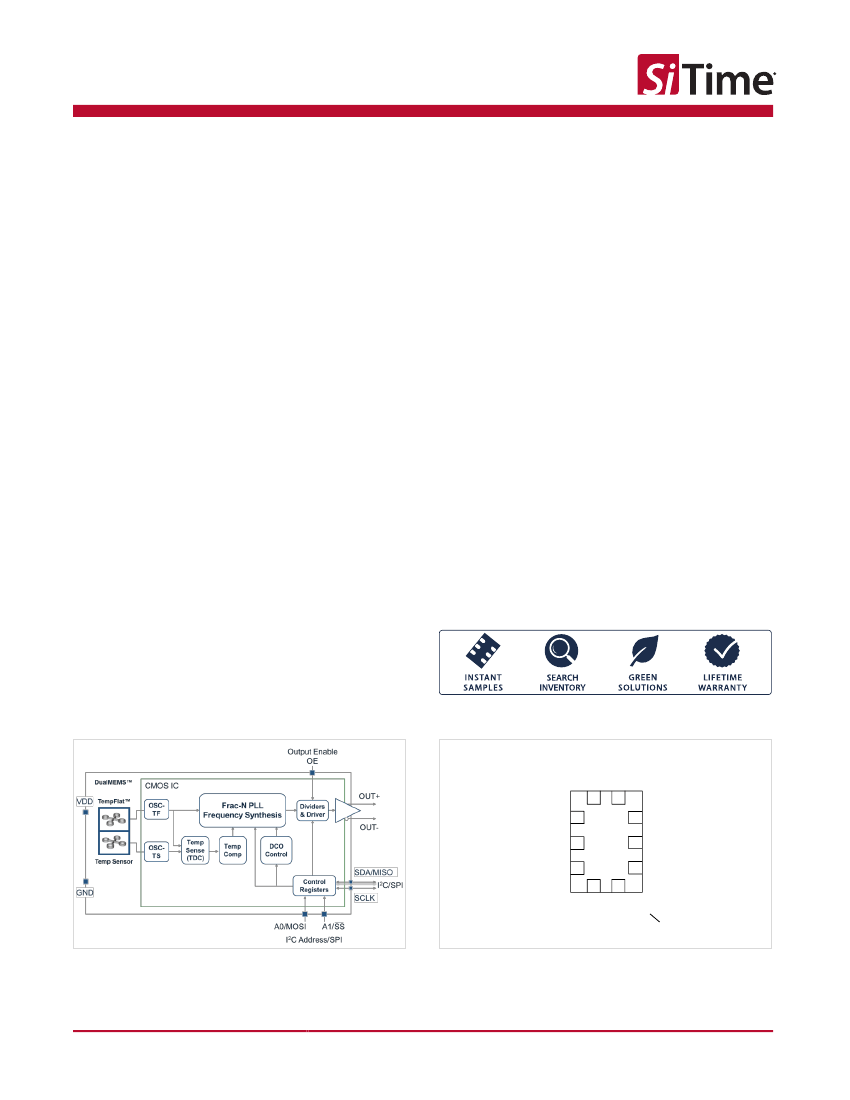
SiT3521
1 to 340 MHz Elite Platform I2C/SPI Programmable Oscillator
1 Electrical Characteristics
All Min and Max limits in the Electrical Characteristics tables are specified over temperature and rated operating voltage with
standard output terminations shown in the termination diagrams. Typical values are at 25°C and nominal supply voltage.
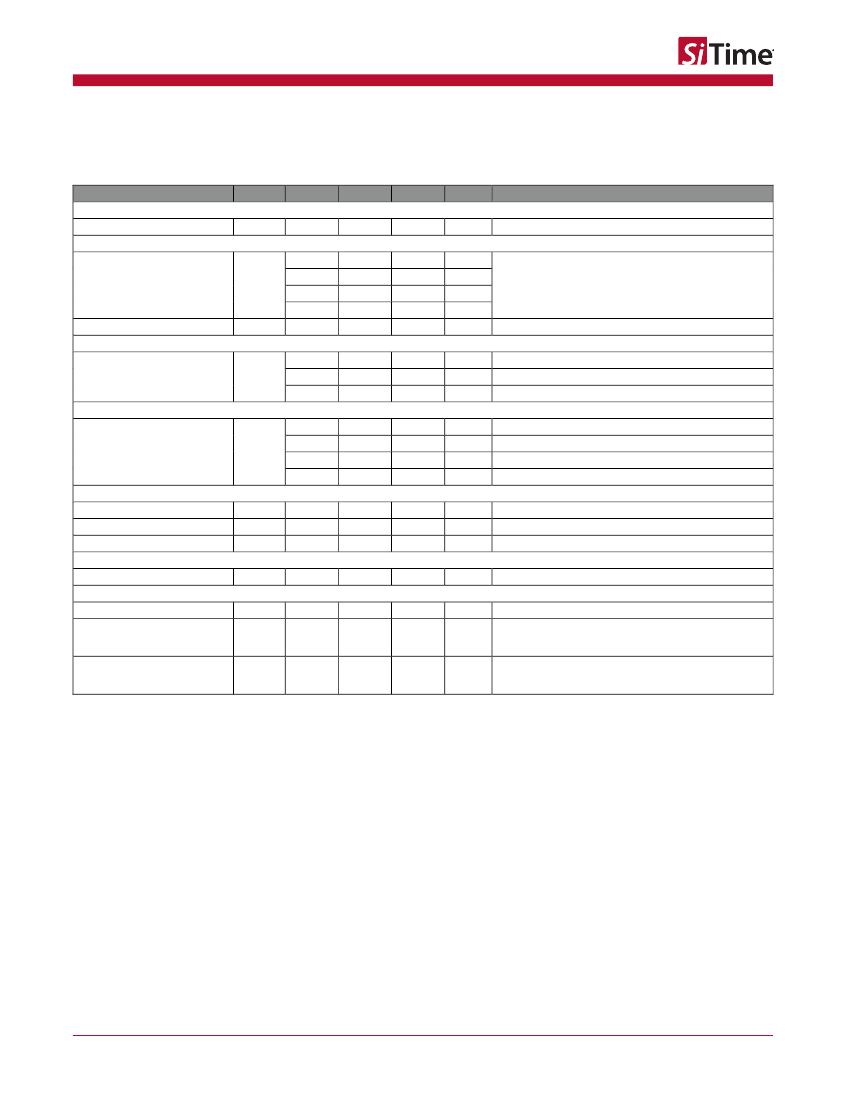
Table 1. Electrical Characteristics – Common to LVPECL, LVDS and HCSL
Parameter
Output Frequency Range
Symbol
f
Min.
1
Typ.
–
–
–
–
–
±1
–
–
–
Max.
340
Unit
MHz
Condition
Factory or user programmable, accurate to 6 decimal places
Frequency Range
Frequency Stability
Frequency Stability
F_stab
-10
-20
-25
-50
First Year Aging
F_1y
–
+10
+20
+25
+50
–
ppm
ppm
ppm
ppm
ppm
°C
°C
°C
1
st
-year aging at 25°C
Inclusive of initial tolerance, operating temperature, rated
power supply voltage and load variations.
Temperature Range
Operating Temperature Range
T_use
-20
-40
-40
+70
+85
+105
Supply Voltage
Supply Voltage
Vdd
2.97
2.7
2.52
2.25
3.3
3.0
2.8
2.5
–
–
100
–
–
–
3.63
3.3
3.08
2.75
–
30%
–
V
V
V
V
Extended Commercial
Industrial
Extended Industrial. Available only for I
2
C operation, not SPI.
Input Characteristics – OE Pin
Input Voltage High
Input Voltage Low
Input Pull-up Impedance
VIH
VIL
Z_in
70%
–
–
Vdd
Vdd
kΩ
OE pin
OE pin
OE pin, logic high or logic low
Output Characteristics
Duty Cycle
DC
45
–
–
55
%
Startup and Output Enable/Disable Timing
Start-up Time
Output Enable/Disable Time –
Hardware control via OE pin
Output Enable/Disable Time –
Software control via I
2
C/SPI
T_start
T_oe_hw
3.0
3.8
ms
µs
Measured from the time Vdd reaches its rated minimum value
Measured from the time OE pin reaches rated VIH and VIL to
the time clock pins reach 90% of swing and high-Z.
See
Figure 9
and
Figure 10
Measured from the time the last byte of command is
transmitted via I
2
C/SPI (reg1) to the time clock pins reach 90%
of swing and high-Z. See
Figure 30
and
Figure 31
T_oe_sw
–
–
6.5
µs
Rev 1.01
Page 4 of 45
www.sitime.com
SiT3521
1 to 340 MHz Elite Platform I2C/SPI Programmable Oscillator
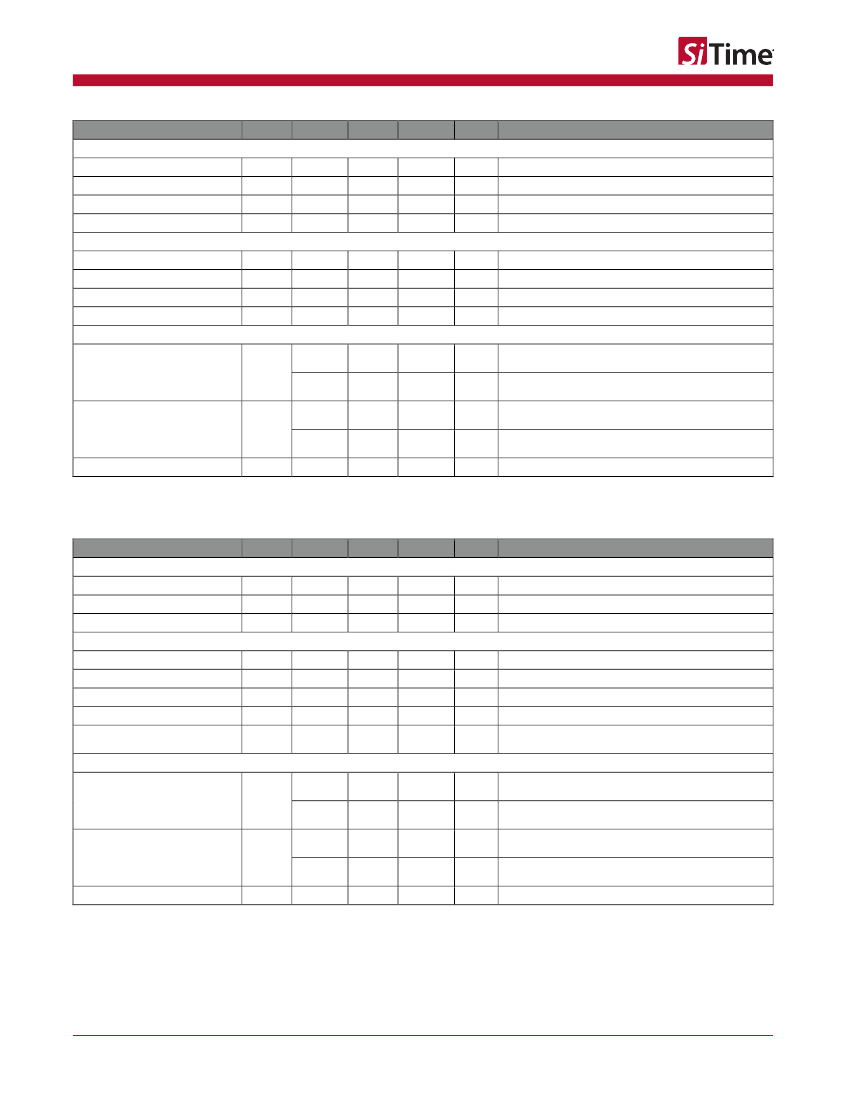
Table 2. Electrical Characteristics – LVPECL Specific
Parameter
Symbol
Min.
Typ.
Max.
Unit
Condition
Current Consumption
Current Consumption
OE Disable Supply Current
Output Disable Leakage Current
Maximum Output Current
Idd
I_OE
I_leak
I_driver
–
–
–
–
–
–
0.15
–
89
58
–
32
mA
mA
A
mA
Excluding Load Termination Current, Vdd = 3.3 V or 2.5 V
OE = Low
OE = Low
Maximum average current drawn from OUT+ or OUT-
Output Characteristics
Output High Voltage
Output Low Voltage
Output Differential Voltage Swing
Rise/Fall Time
VOH
VOL
V_Swing
Tr, Tf
Vdd - 1.1V
Vdd - 1.9V
1.2
–
–
–
1.6
225
Vdd - 0.7V
Vdd - 1.5V
2.0
290
Jitter
RMS Phase Jitter (random) –
DCO Mode Only
T_phj
–
–
RMS Phase Jitter (random) –
Any-frequency Mode Only
T_phj
–
–
RMS Period Jitter
[3]
Note:
3. Measured according to JESD65B.
T_jitt
–
0.225
0.1
0.225
0.11
1
0.340
0.14
0.340
0.15
1.6
ps
ps
ps
ps
ps
f = 156.25 MHz, Integration bandwidth = 12 kHz to 20 MHz,
all Vdd levels
f = 156.25, IEEE802.3-2005 10 GbE jitter mask integration
bandwidth = 1.875 MHz to 20 MHz, all Vdd levels
f = 156.25 MHz, Integration bandwidth = 12 kHz to 20 MHz,
all Vdd levels
f = 156.25, IEEE802.3-2005 10 GbE jitter mask integration
bandwidth = 1.875 MHz to 20 MHz, all Vdd levels
f = 100, 156.25 or 212.5 MHz, Vdd = 3.3 V or 2.5 V
V
V
V
ps
See
Figure 5
See
Figure 5
See
Figure 6
20% to 80%, see
Figure 6
Table 3. Electrical Characteristics – LVDS Specific
Parameter
Symbol
Min.
Typ.
Max.
Unit
Condition
Current Consumption
Current Consumption
OE Disable Supply Current
Output Disable Leakage Current
Idd
I_OE
I_leak
–
–
–
–
–
0.15
80
61
–
mA
mA
A
Excluding Load Termination Current, Vdd = 3.3 V or 2.5 V
OE = Low
OE = Low
Output Characteristics
Differential Output Voltage
Delta VOD
Offset Voltage
Delta VOS
Rise/Fall Time
VOD
ΔVOD
VOS
ΔVOS
Tr, Tf
250
–
1.125
–
–
–
–
–
–
400
455
50
1.375
50
470
Jitter
RMS Phase Jitter (random) –
DCO Mode Only
T_phj
–
–
RMS Phase Jitter (random) –
Any-frequency Mode Only
T_phj
–
–
RMS Period Jitter
[4]
Note:
4. Measured according to JESD65B.
T_jitt
–
0.21
0.1
0.21
0.1
1
0.275
0.12
0.367
0.12
1.6
ps
ps
ps
ps
ps
f = 156.25 MHz, Integration bandwidth = 12 kHz to 20 MHz,
all Vdd levels
f = 156.25, IEEE802.3-2005 10 GbE jitter mask integration
bandwidth = 1.875 MHz to 20 MHz, all Vdd levels
f = 156.25 MHz, Integration bandwidth = 12 kHz to 20 MHz,
all Vdd levels
f = 156.25, IEEE802.3-2005 10 GbE jitter mask integration
bandwidth = 1.875 MHz to 20 MHz, all Vdd levels
f = 100, 156.25 or 212.5 MHz, Vdd = 3.3 V or 2.5 V
mV
mV
V
mV
ps
f = 156.25MHz See
Figure 7
See
Figure 7
See
Figure 7
See
Figure 7
Measured with 2 pF capacitive loading to GND, 20% to 80%,
When I run the program directly using TI's EEPROM routine, the program always stops at the fail() function, which means that 28335 fails to communicate with the EEPROM, and the number of data read and...
(This question was found on another website before. It is a typical question that tests comprehensive design ability. There is no "standard answer" for this question, only a reference answer) 1. Reali...
When the system has a timer interrupt, for example, the temperature value is collected regularly and then sent to the host computer through the serial port. In this way, the program needs to use the t...
This article continues to talk about serial port and USB communication, mainly talking about the configuration of serial port and USB-CDC class, and briefly talking about the use of serial port and US...
Dear friends, I want to use ARM+WinCE4.2 as an asp WEB server. I have added the WEB Server to WinCE4.2, but when I edited an asp web page and put it in the www/wwwpub directory, the following error oc...
As the epidemic prevention and control enters a critical period, we have to face the new transmission risks brought by the resumption of production and work. I believe that every Chinese is worried ab...
Shanghai, January 16, 2026 – Today,
the 2025 Intel AI Developer Outstanding Project Roadshow and Intel Platform Enterprise AI Solution Innovation Practice Competition Awards Ceremony were succe...[Details]
According to data from Gasgoo Automotive Research Institute, from January to November 2025, the domestic ADAS supply chain landscape underwent accelerated restructuring: from LiDAR and forward-faci...[Details]
On January 14, South Korean media outlet ChosunBiz reported that, according to data obtained from Omdia,
the total production capacity of the world's three largest DRAM memory manufacturers (Sa...[Details]
January 12th news, according to a report by foreign media Wccftech today, former Intel CEO Pat Kissinger recently spoke about his former employer's latest achievements in advanced manufacturing pro...[Details]
On December 11, Helm.ai, an AI software company specializing in ADAS, Level 4 autonomous driving, and robotic automation, released Factored Embodied AI, a new architectural framework designed to br...[Details]
Many autonomous vehicles are equipped with LiDAR (Light Detection and Ranging) sensors, which are distance sensors that use lasers to measure distances. It emits laser light in its surroundings; wh...[Details]
On December 17, Nokia announced that it had completed the acquisition of the remaining 50% stake in Nokia Shanghai Bell Co., Ltd. held by China Huaxin Post & Telecommunications Technology Co., Ltd....[Details]
The rapid upgrade of AI applications has meant that perceptual AI and generative AI are no longer the only main players. Using AI agents to perform complex tasks, from perception and generation t...[Details]
Today, Dongfeng Motor announced significant progress in the field of new energy vehicle battery technology. Through breakthroughs in key processes such as material system innovation, electrolyte me...[Details]
With the rapid development of automotive electronics, its complexity has also increased explosively. To compare the advantages and disadvantages of different electronic and electrical archi...[Details]
If we break down the robotics industry (industrial robots, service robots, and new humanoid robots), it is not a "new industry" but rather a concentrated release of the long-term accumulation of mu...[Details]
On December 25, CCTV News reported that the first batch of research reports on the actual test of intelligent automotive chassis in the industry was released in Chongqing.
This time, the...[Details]
Compiled from eenews
In 2025, the landscape of AI chip manufacturers underwent a dramatic transformation, with Nvidia reaping significant benefits. Companies like OpenAI spearheaded the ...[Details]
Abstract:
Wiring harnesses are crucial automotive components, representing the traditional, bulky, yet indispensable neural network of a vehicle. Facing entirely new vehicle models and archit...[Details]
According to foreign media reports, a research team at Pohang University of Science and Technology (POSTECH) has developed a new generation of hybrid anodes that utilize an external magnetic field ...[Details]

 DSP and ARM Processors
 京公网安备 11010802033920号
 EEWORLD