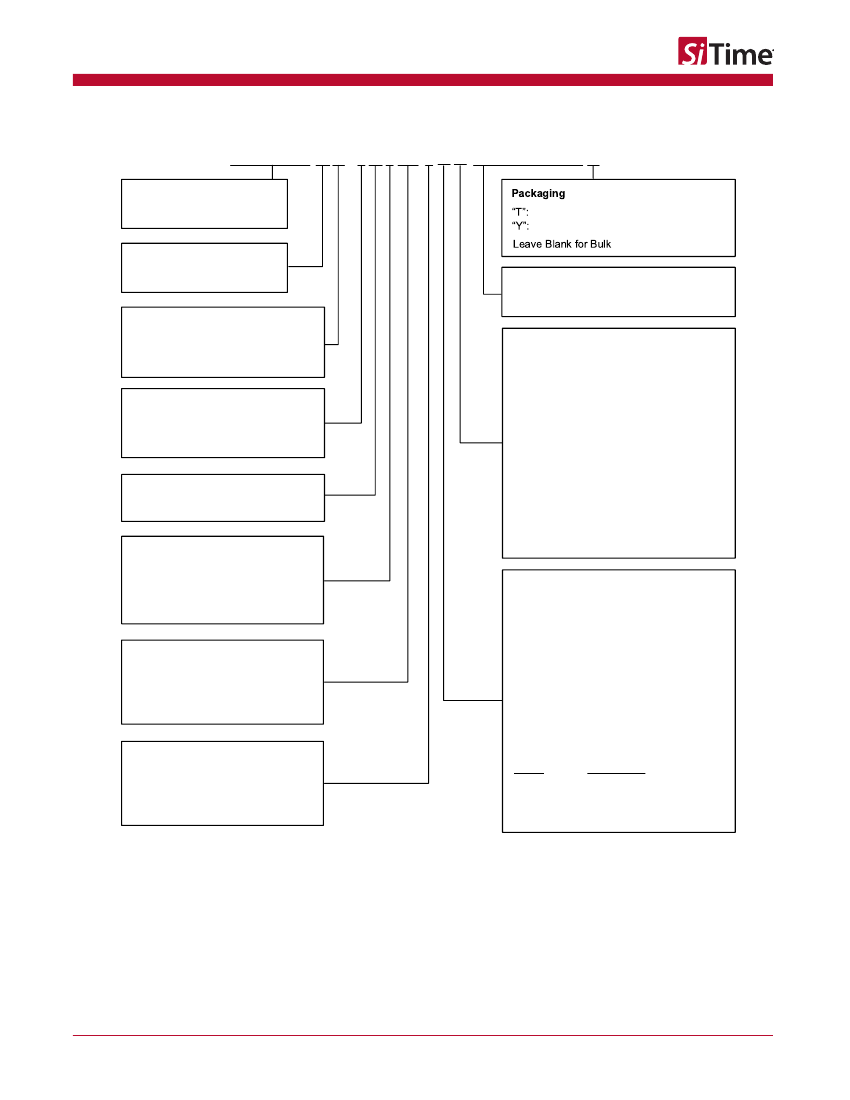
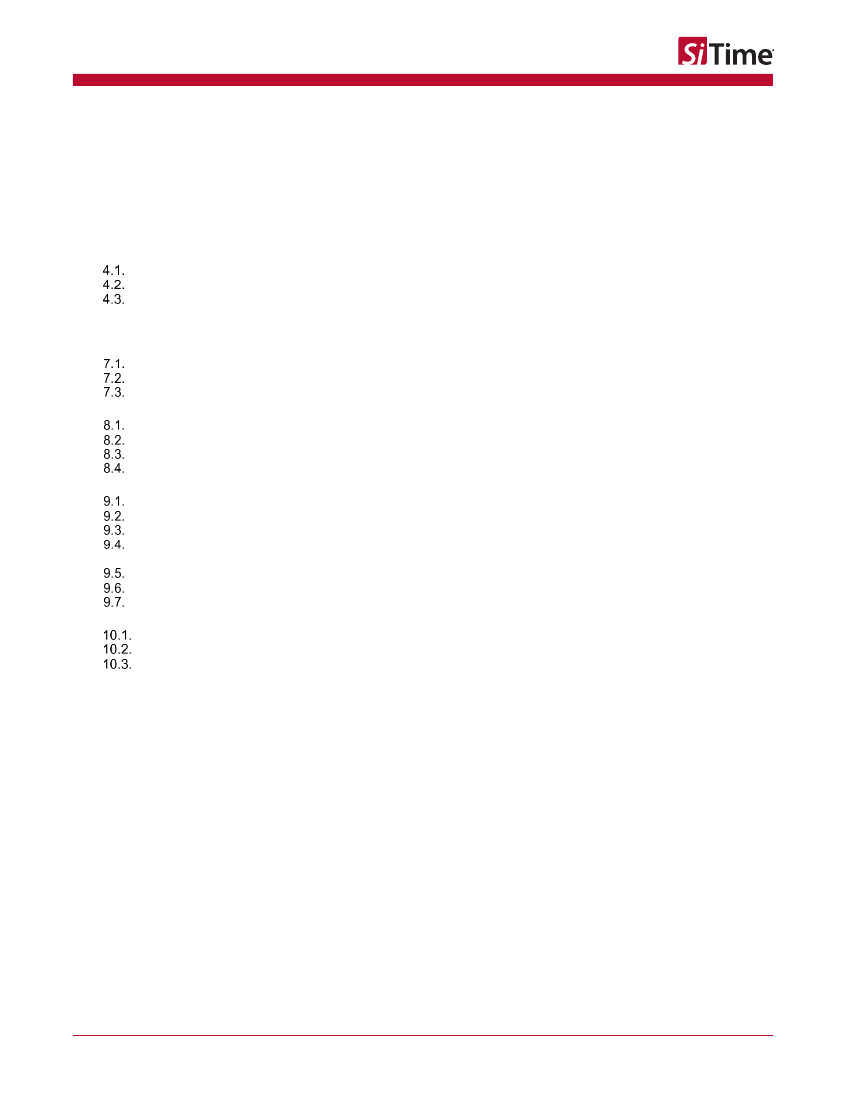
Ordering Information .................................................................................................................................................................... 2
User Programming Interface ..................................................................................................................................... 18
Start-up output frequency and signaling types ........................................................................................................... 18
Any-frequency function ............................................................................................................................................. 19
C/SPI Control Registers...................................................................................................................................................... 28
9 I
Register Address: 0x00. DCO Frequency Control Least Significant Word (LSW) .................................................... 28
Register Address: 0x01. OE Control, DCO Frequency Control Most Significant Word (MSW) ................................. 29
Register Address: 0x02. DCO PULL RANGE CONTROL ........................................................................................ 29
Register Address: 0x03. Frac-N PLL Feedback Divider Integer Value and Frac-N PLL Feedback Divider Fraction
Value MSW ............................................................................................................................................................... 30
Register Address: 0x05. Forward Divider, Driver Control ......................................................................................... 30
Register Address: 0x06. Driver Divider, Driver Control ............................................................................................. 31
2
C Operation ........................................................................................................................................................................ 32
10 I
I
2
C protocol ............................................................................................................................................................... 32
I
2
C Timing Specification ............................................................................................................................................ 35
I
2
C Device Address Modes ....................................................................................................................................... 36
Dimensions and Patterns ........................................................................................................................................................... 43
Additional Information ................................................................................................................................................................ 44
Revision History ......................................................................................................................................................................... 45
Rev 1.01
Page 3 of 45
www.sitime.com
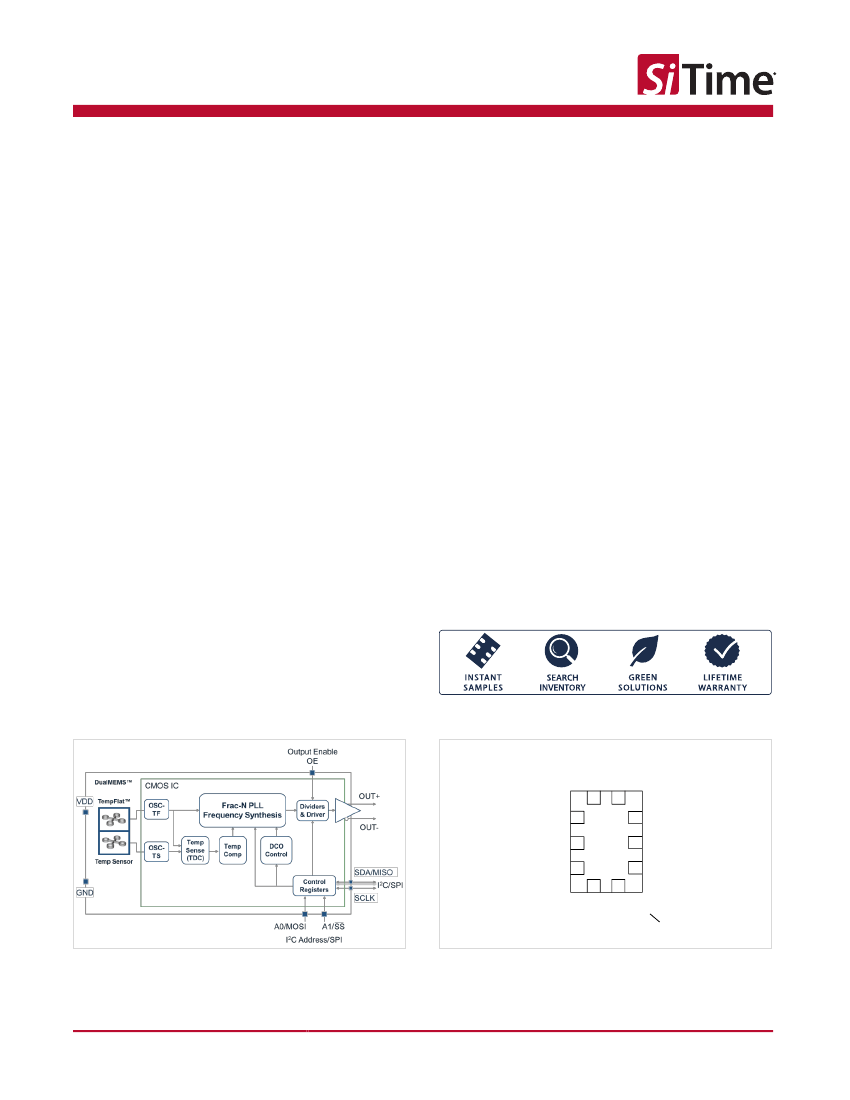
SiT3521
1 to 340 MHz Elite Platform I2C/SPI Programmable Oscillator
1 Electrical Characteristics
All Min and Max limits in the Electrical Characteristics tables are specified over temperature and rated operating voltage with
standard output terminations shown in the termination diagrams. Typical values are at 25°C and nominal supply voltage.
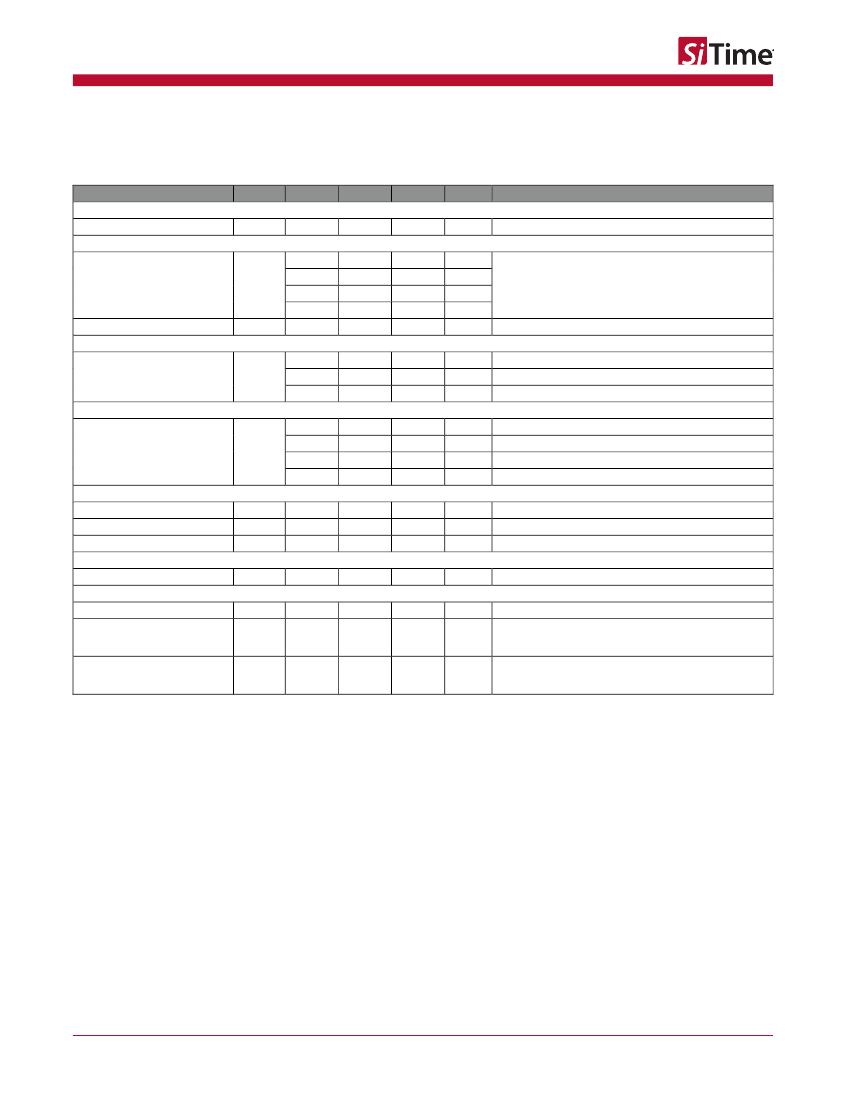
Table 1. Electrical Characteristics – Common to LVPECL, LVDS and HCSL
Parameter
Output Frequency Range
Symbol
f
Min.
1
Typ.
–
–
–
–
–
±1
–
–
–
Max.
340
Unit
MHz
Condition
Factory or user programmable, accurate to 6 decimal places
Frequency Range
Frequency Stability
Frequency Stability
F_stab
-10
-20
-25
-50
First Year Aging
F_1y
–
+10
+20
+25
+50
–
ppm
ppm
ppm
ppm
ppm
°C
°C
°C
1
st
-year aging at 25°C
Inclusive of initial tolerance, operating temperature, rated
power supply voltage and load variations.
Temperature Range
Operating Temperature Range
T_use
-20
-40
-40
+70
+85
+105
Supply Voltage
Supply Voltage
Vdd
2.97
2.7
2.52
2.25
3.3
3.0
2.8
2.5
–
–
100
–
–
–
3.63
3.3
3.08
2.75
–
30%
–
V
V
V
V
Extended Commercial
Industrial
Extended Industrial. Available only for I
2
C operation, not SPI.
Input Characteristics – OE Pin
Input Voltage High
Input Voltage Low
Input Pull-up Impedance
VIH
VIL
Z_in
70%
–
–
Vdd
Vdd
kΩ
OE pin
OE pin
OE pin, logic high or logic low
Output Characteristics
Duty Cycle
DC
45
–
–
55
%
Startup and Output Enable/Disable Timing
Start-up Time
Output Enable/Disable Time –
Hardware control via OE pin
Output Enable/Disable Time –
Software control via I
2
C/SPI
T_start
T_oe_hw
3.0
3.8
ms
µs
Measured from the time Vdd reaches its rated minimum value
Measured from the time OE pin reaches rated VIH and VIL to
the time clock pins reach 90% of swing and high-Z.
See
Figure 9
and
Figure 10
Measured from the time the last byte of command is
transmitted via I
2
C/SPI (reg1) to the time clock pins reach 90%
of swing and high-Z. See
Figure 30
and
Figure 31
T_oe_sw
–
–
6.5
µs
Rev 1.01
Page 4 of 45
www.sitime.com
SiT3521
1 to 340 MHz Elite Platform I2C/SPI Programmable Oscillator
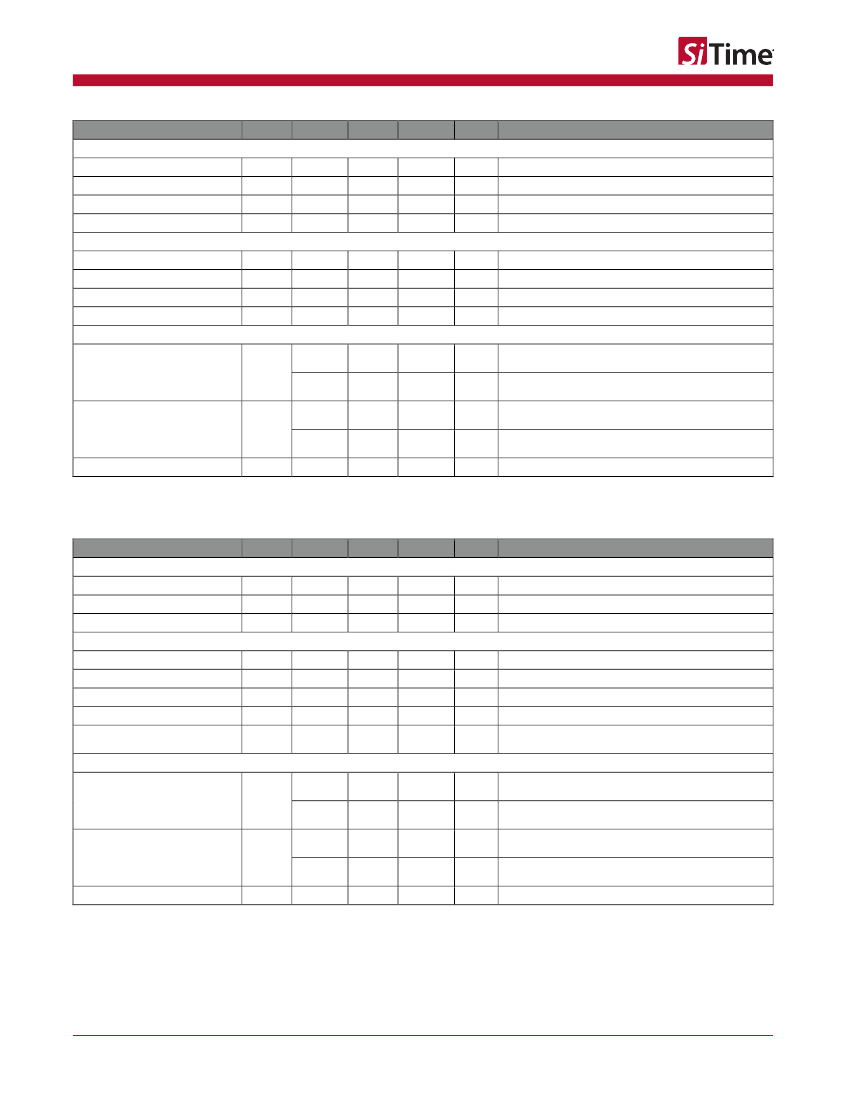
Table 2. Electrical Characteristics – LVPECL Specific
Parameter
Symbol
Min.
Typ.
Max.
Unit
Condition
Current Consumption
Current Consumption
OE Disable Supply Current
Output Disable Leakage Current
Maximum Output Current
Idd
I_OE
I_leak
I_driver
–
–
–
–
–
–
0.15
–
89
58
–
32
mA
mA
A
mA
Excluding Load Termination Current, Vdd = 3.3 V or 2.5 V
OE = Low
OE = Low
Maximum average current drawn from OUT+ or OUT-
Output Characteristics
Output High Voltage
Output Low Voltage
Output Differential Voltage Swing
Rise/Fall Time
VOH
VOL
V_Swing
Tr, Tf
Vdd - 1.1V
Vdd - 1.9V
1.2
–
–
–
1.6
225
Vdd - 0.7V
Vdd - 1.5V
2.0
290
Jitter
RMS Phase Jitter (random) –
DCO Mode Only
T_phj
–
–
RMS Phase Jitter (random) –
Any-frequency Mode Only
T_phj
–
–
RMS Period Jitter
[3]
Note:
3. Measured according to JESD65B.
T_jitt
–
0.225
0.1
0.225
0.11
1
0.340
0.14
0.340
0.15
1.6
ps
ps
ps
ps
ps
f = 156.25 MHz, Integration bandwidth = 12 kHz to 20 MHz,
all Vdd levels
f = 156.25, IEEE802.3-2005 10 GbE jitter mask integration
bandwidth = 1.875 MHz to 20 MHz, all Vdd levels
f = 156.25 MHz, Integration bandwidth = 12 kHz to 20 MHz,
all Vdd levels
f = 156.25, IEEE802.3-2005 10 GbE jitter mask integration
bandwidth = 1.875 MHz to 20 MHz, all Vdd levels
f = 100, 156.25 or 212.5 MHz, Vdd = 3.3 V or 2.5 V
V
V
V
ps
See
Figure 5
See
Figure 5
See
Figure 6
20% to 80%, see
Figure 6
Table 3. Electrical Characteristics – LVDS Specific
Parameter
Symbol
Min.
Typ.
Max.
Unit
Condition
Current Consumption
Current Consumption
OE Disable Supply Current
Output Disable Leakage Current
Idd
I_OE
I_leak
–
–
–
–
–
0.15
80
61
–
mA
mA
A
Excluding Load Termination Current, Vdd = 3.3 V or 2.5 V
OE = Low
OE = Low
Output Characteristics
Differential Output Voltage
Delta VOD
Offset Voltage
Delta VOS
Rise/Fall Time
VOD
ΔVOD
VOS
ΔVOS
Tr, Tf
250
–
1.125
–
–
–
–
–
–
400
455
50
1.375
50
470
Jitter
RMS Phase Jitter (random) –
DCO Mode Only
T_phj
–
–
RMS Phase Jitter (random) –
Any-frequency Mode Only
T_phj
–
–
RMS Period Jitter
[4]
Note:
4. Measured according to JESD65B.
T_jitt
–
0.21
0.1
0.21
0.1
1
0.275
0.12
0.367
0.12
1.6
ps
ps
ps
ps
ps
f = 156.25 MHz, Integration bandwidth = 12 kHz to 20 MHz,
all Vdd levels
f = 156.25, IEEE802.3-2005 10 GbE jitter mask integration
bandwidth = 1.875 MHz to 20 MHz, all Vdd levels
f = 156.25 MHz, Integration bandwidth = 12 kHz to 20 MHz,
all Vdd levels
f = 156.25, IEEE802.3-2005 10 GbE jitter mask integration
bandwidth = 1.875 MHz to 20 MHz, all Vdd levels
f = 100, 156.25 or 212.5 MHz, Vdd = 3.3 V or 2.5 V
mV
mV
V
mV
ps
f = 156.25MHz See
Figure 7
See
Figure 7
See
Figure 7
See
Figure 7
Measured with 2 pF capacitive loading to GND, 20% to 80%,
Today, I was happily adjusting the PWM program and when the oscilloscope probe touched the pin, there seemed to be some sparks. I didn't pay much attention to it. The waveform appeared, but the freque...
1 I spent a lot of effort to design a FPGA PCB. I showed it to my classmates. They said three things about the board, saying that it was too bad and that the board I drew was too bad. (I held back at ...
I would like to ask you:In BIOS, I use TSK0 to call the function test(), and the hardware interrupt INT1 calls T0ISR(). After running the program, the program always enters T0ISR() without calling the...
Written by Ogawa Studio, this book is written for the LM3S USB chip. The uploaded ones are all drafts and have not been revised . There may be many shortcomings. I hope netizens will forgive me!
QQ:26...
The program implements the following functions: Through the pulse of clk, the number of clk jumps is counted when recive=0 to achieve the purpose of timing, and then the time is displayed through 4 se...
The problem of dynamic sealing of equipment always exists with the operation of the equipment. Today, we have specially sorted out the various commonly used sealing forms, usage scope and character...[Details]
To enable real-time monitoring of home security and automatically dial a number for voice prompts or send text messages when an alarm occurs, a GPRS-based embedded telephone alarm system was design...[Details]
A vacuum eutectic furnace is a critical piece of equipment used in the manufacturing and processing of various materials, particularly in the fields of microelectronics and nanotechnology. One of t...[Details]
Limited vocabulary recognition
According to the number of characters, words or short sentences in the vocabulary, it can be roughly divided into: less than 100 is small vocabulary; 100-1000 is...[Details]
Recently,
Xpeng Motors and Xinlian Integrated Circuit jointly announced the mass production of China's first hybrid silicon carbide product.
Designed and developed by Xpeng Motors and joint...[Details]
Recently, AstroBo Robot, a subsidiary of Chenxing Automation, launched a new mobile collaborative palletizing product. Leveraging an omnidirectional mobile chassis, an intelligent scheduling system...[Details]
According to foreign media reports, Nissan Motor has recently reached a cooperation with US battery technology company LiCAP Technologies to jointly promote the research and development of next-gen...[Details]
With the continuous development of the industrial automation industry, we are seeing an increasing number of intelligent devices using flexible, efficient, and precise robotic arms to p...[Details]
The 2025 China International Automotive Testing Exhibition will be held at the Shanghai World Expo Exhibition and Convention Center from August 27 to 29, 2025.
Clacton Seafront, UK, ...[Details]
As the range of electric vehicles continues to increase, driving electric vehicles for long-distance travel has become a trend. For high-speed travel, how much impact will high-speed driving of ele...[Details]
Speaking of the problem of vehicle spontaneous combustion, whether it is a pure electric vehicle or a fuel vehicle, there will be incidents of spontaneous combustion. For the same spontaneous combu...[Details]
introduction
Inverter air conditioners are a trend in the current era and have gradually become commonplace in countless households. Beyond their basic cooling and heating functions, air condi...[Details]
On August 18th, China's largest expressway
charging station,
the G25 Changshen Expressway Tonglu Service Area (South Area), officially opened and launched its integrated solar-storage-charg...[Details]
The evolution of high-speed networks remains guided by the same core objectives: increasing data rates, reducing latency, improving reliability, lowering power consumption, and maintaining or exten...[Details]
Munich, Germany, August 19, 2025 –
Infineon Technologies AG, a global semiconductor leader in power systems and the Internet of Things, announced today that its AIROC™ CYW20829 Bluetooth® low e...[Details]

 NXP MCU
 京公网安备 11010802033920号
 EEWORLD