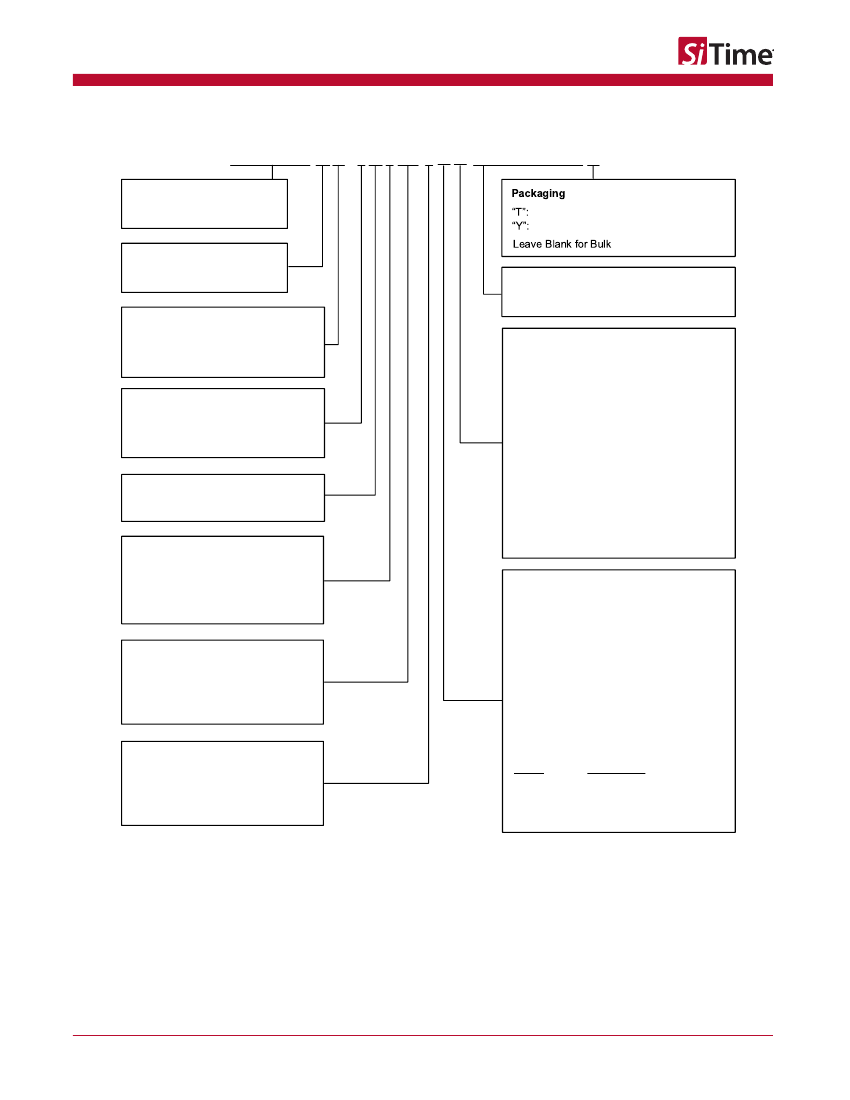
Ordering Information .................................................................................................................................................................... 2
User Programming Interface ..................................................................................................................................... 18
Start-up output frequency and signaling types ........................................................................................................... 18
Any-frequency function ............................................................................................................................................. 19
C/SPI Control Registers...................................................................................................................................................... 28
9 I
Register Address: 0x00. DCO Frequency Control Least Significant Word (LSW) .................................................... 28
Register Address: 0x01. OE Control, DCO Frequency Control Most Significant Word (MSW) ................................. 29
Register Address: 0x02. DCO PULL RANGE CONTROL ........................................................................................ 29
Register Address: 0x03. Frac-N PLL Feedback Divider Integer Value and Frac-N PLL Feedback Divider Fraction
Value MSW ............................................................................................................................................................... 30
Register Address: 0x05. Forward Divider, Driver Control ......................................................................................... 30
Register Address: 0x06. Driver Divider, Driver Control ............................................................................................. 31
2
C Operation ........................................................................................................................................................................ 32
10 I
I
2
C protocol ............................................................................................................................................................... 32
I
2
C Timing Specification ............................................................................................................................................ 35
I
2
C Device Address Modes ....................................................................................................................................... 36
Dimensions and Patterns ........................................................................................................................................................... 43
Additional Information ................................................................................................................................................................ 44
Revision History ......................................................................................................................................................................... 45
Rev 1.01
Page 3 of 45
www.sitime.com
SiT3521
1 to 340 MHz Elite Platform I2C/SPI Programmable Oscillator
1 Electrical Characteristics
All Min and Max limits in the Electrical Characteristics tables are specified over temperature and rated operating voltage with
standard output terminations shown in the termination diagrams. Typical values are at 25°C and nominal supply voltage.
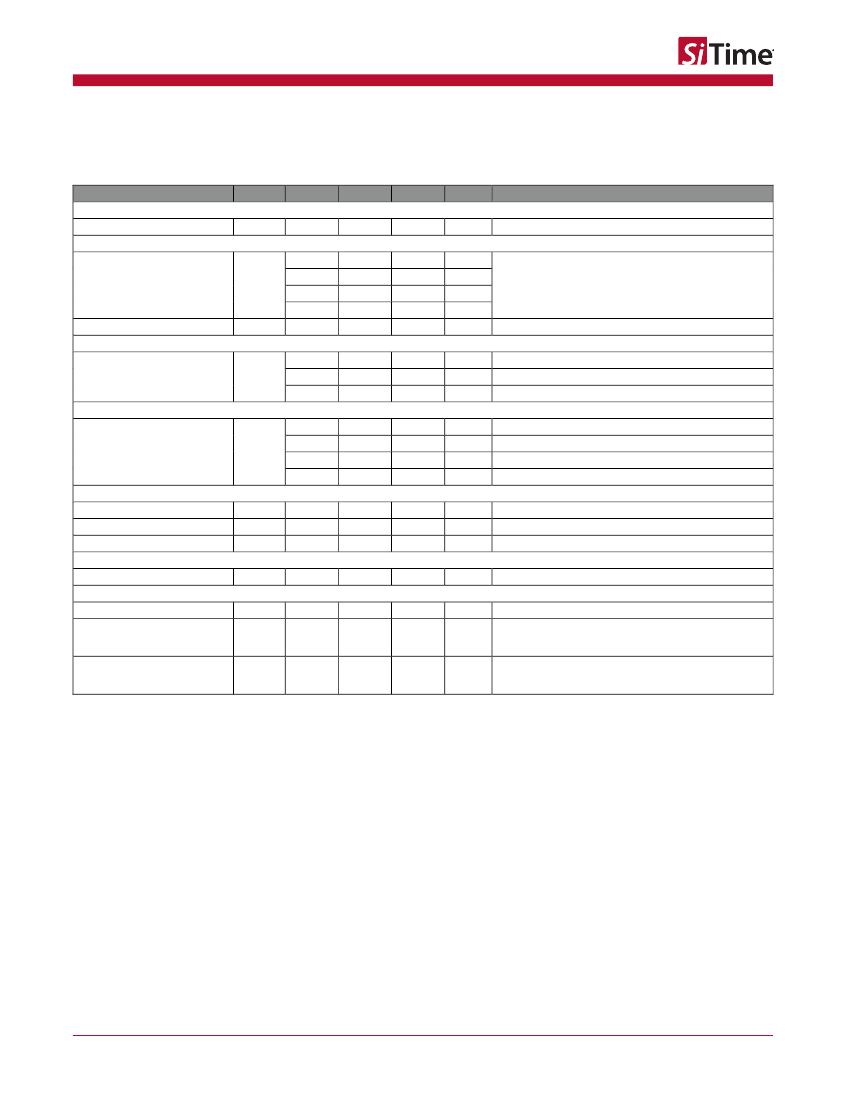
Table 1. Electrical Characteristics – Common to LVPECL, LVDS and HCSL
Parameter
Output Frequency Range
Symbol
f
Min.
1
Typ.
–
–
–
–
–
±1
–
–
–
Max.
340
Unit
MHz
Condition
Factory or user programmable, accurate to 6 decimal places
Frequency Range
Frequency Stability
Frequency Stability
F_stab
-10
-20
-25
-50
First Year Aging
F_1y
–
+10
+20
+25
+50
–
ppm
ppm
ppm
ppm
ppm
°C
°C
°C
1
st
-year aging at 25°C
Inclusive of initial tolerance, operating temperature, rated
power supply voltage and load variations.
Temperature Range
Operating Temperature Range
T_use
-20
-40
-40
+70
+85
+105
Supply Voltage
Supply Voltage
Vdd
2.97
2.7
2.52
2.25
3.3
3.0
2.8
2.5
–
–
100
–
–
–
3.63
3.3
3.08
2.75
–
30%
–
V
V
V
V
Extended Commercial
Industrial
Extended Industrial. Available only for I
2
C operation, not SPI.
Input Characteristics – OE Pin
Input Voltage High
Input Voltage Low
Input Pull-up Impedance
VIH
VIL
Z_in
70%
–
–
Vdd
Vdd
kΩ
OE pin
OE pin
OE pin, logic high or logic low
Output Characteristics
Duty Cycle
DC
45
–
–
55
%
Startup and Output Enable/Disable Timing
Start-up Time
Output Enable/Disable Time –
Hardware control via OE pin
Output Enable/Disable Time –
Software control via I
2
C/SPI
T_start
T_oe_hw
3.0
3.8
ms
µs
Measured from the time Vdd reaches its rated minimum value
Measured from the time OE pin reaches rated VIH and VIL to
the time clock pins reach 90% of swing and high-Z.
See
Figure 9
and
Figure 10
Measured from the time the last byte of command is
transmitted via I
2
C/SPI (reg1) to the time clock pins reach 90%
of swing and high-Z. See
Figure 30
and
Figure 31
T_oe_sw
–
–
6.5
µs
Rev 1.01
Page 4 of 45
www.sitime.com
SiT3521
1 to 340 MHz Elite Platform I2C/SPI Programmable Oscillator
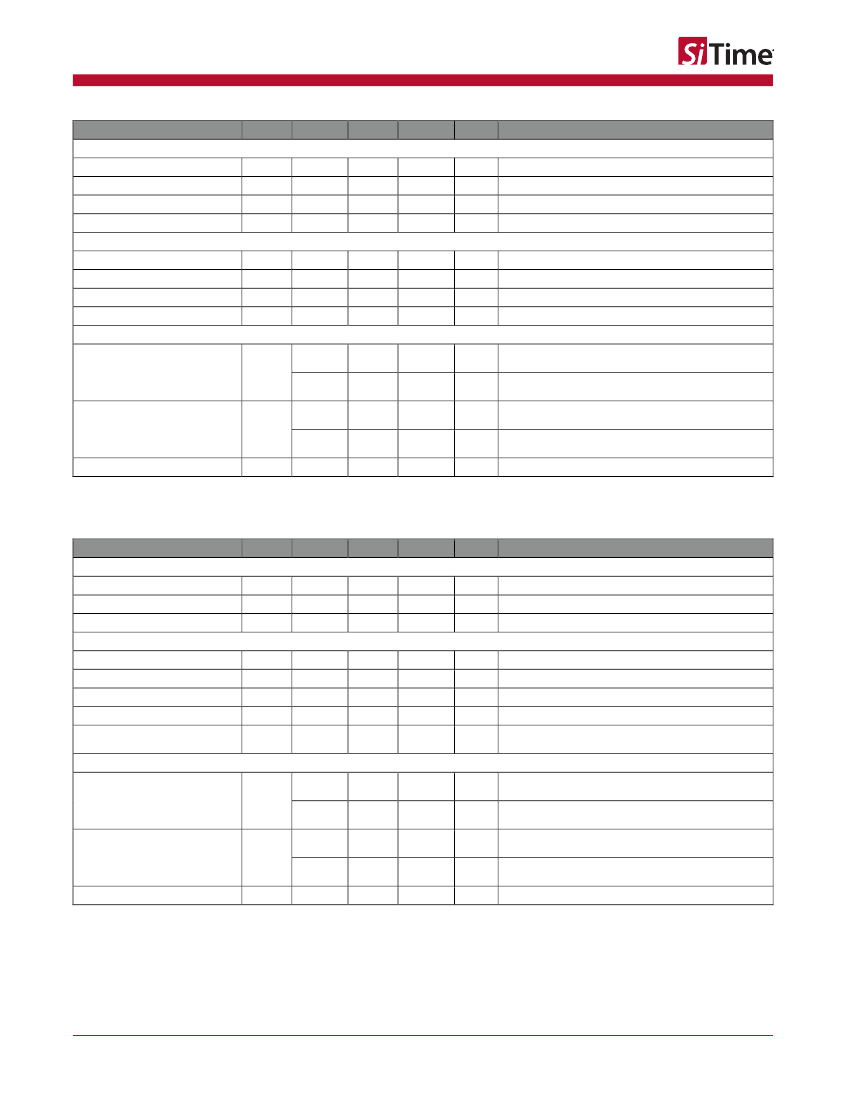
Table 2. Electrical Characteristics – LVPECL Specific
Parameter
Symbol
Min.
Typ.
Max.
Unit
Condition
Current Consumption
Current Consumption
OE Disable Supply Current
Output Disable Leakage Current
Maximum Output Current
Idd
I_OE
I_leak
I_driver
–
–
–
–
–
–
0.15
–
89
58
–
32
mA
mA
A
mA
Excluding Load Termination Current, Vdd = 3.3 V or 2.5 V
OE = Low
OE = Low
Maximum average current drawn from OUT+ or OUT-
Output Characteristics
Output High Voltage
Output Low Voltage
Output Differential Voltage Swing
Rise/Fall Time
VOH
VOL
V_Swing
Tr, Tf
Vdd - 1.1V
Vdd - 1.9V
1.2
–
–
–
1.6
225
Vdd - 0.7V
Vdd - 1.5V
2.0
290
Jitter
RMS Phase Jitter (random) –
DCO Mode Only
T_phj
–
–
RMS Phase Jitter (random) –
Any-frequency Mode Only
T_phj
–
–
RMS Period Jitter
[3]
Note:
3. Measured according to JESD65B.
T_jitt
–
0.225
0.1
0.225
0.11
1
0.340
0.14
0.340
0.15
1.6
ps
ps
ps
ps
ps
f = 156.25 MHz, Integration bandwidth = 12 kHz to 20 MHz,
all Vdd levels
f = 156.25, IEEE802.3-2005 10 GbE jitter mask integration
bandwidth = 1.875 MHz to 20 MHz, all Vdd levels
f = 156.25 MHz, Integration bandwidth = 12 kHz to 20 MHz,
all Vdd levels
f = 156.25, IEEE802.3-2005 10 GbE jitter mask integration
bandwidth = 1.875 MHz to 20 MHz, all Vdd levels
f = 100, 156.25 or 212.5 MHz, Vdd = 3.3 V or 2.5 V
V
V
V
ps
See
Figure 5
See
Figure 5
See
Figure 6
20% to 80%, see
Figure 6
Table 3. Electrical Characteristics – LVDS Specific
Parameter
Symbol
Min.
Typ.
Max.
Unit
Condition
Current Consumption
Current Consumption
OE Disable Supply Current
Output Disable Leakage Current
Idd
I_OE
I_leak
–
–
–
–
–
0.15
80
61
–
mA
mA
A
Excluding Load Termination Current, Vdd = 3.3 V or 2.5 V
OE = Low
OE = Low
Output Characteristics
Differential Output Voltage
Delta VOD
Offset Voltage
Delta VOS
Rise/Fall Time
VOD
ΔVOD
VOS
ΔVOS
Tr, Tf
250
–
1.125
–
–
–
–
–
–
400
455
50
1.375
50
470
Jitter
RMS Phase Jitter (random) –
DCO Mode Only
T_phj
–
–
RMS Phase Jitter (random) –
Any-frequency Mode Only
T_phj
–
–
RMS Period Jitter
[4]
Note:
4. Measured according to JESD65B.
T_jitt
–
0.21
0.1
0.21
0.1
1
0.275
0.12
0.367
0.12
1.6
ps
ps
ps
ps
ps
f = 156.25 MHz, Integration bandwidth = 12 kHz to 20 MHz,
all Vdd levels
f = 156.25, IEEE802.3-2005 10 GbE jitter mask integration
bandwidth = 1.875 MHz to 20 MHz, all Vdd levels
f = 156.25 MHz, Integration bandwidth = 12 kHz to 20 MHz,
all Vdd levels
f = 156.25, IEEE802.3-2005 10 GbE jitter mask integration
bandwidth = 1.875 MHz to 20 MHz, all Vdd levels
f = 100, 156.25 or 212.5 MHz, Vdd = 3.3 V or 2.5 V
mV
mV
V
mV
ps
f = 156.25MHz See
Figure 7
See
Figure 7
See
Figure 7
See
Figure 7
Measured with 2 pF capacitive loading to GND, 20% to 80%,
Why is my bo2 network only separated by a circle after I laid copper? Wouldn't it be short-circuited? I searched for a long time and didn't understand why. Is it because it can't detect the shape of t...
Heart rate and blood oximeter chips are welcome to be added! If you have sensors or chips for thermometers and blood pressure meters, please add them too....
Unlike most wireless technologies, ultra-wideband (UWB) works via impulse radio. It uses a series of pulses over a wide frequency band, so it is sometimes called IR-UWB or impulse radio UWB. In contra...
[i=s] This post was last edited by maychang on 2017-6-1 11:30 [/i] [backcolor=rgb(255,255,255)]Due to education problems, there are very few students who think independently. Newcomers are very confus...
How to choose the model when purchasing the electric motor, how to choose it! [/size][/size][/font][/color][/align][/align][align=left][align=left][color=#2d2d2d][font=宋体][size=10.5pt][size=3]Here I w...
The core of a machine vision system is image acquisition and processing. All information comes from images, and image quality is crucial to the entire vision system. A good image can improve the st...[Details]
Most of the houses we live in now are elevator buildings, mainly because it is more convenient to go up and down the stairs! It can also make life more comfortable. It even helps to increase the ad...[Details]
As time goes by, people are increasingly concerned about their own and their families' health. However, existing monitoring devices for individual vital signs have struggled to gain market share du...[Details]
On August 22, according to the Ministry of Industry and Information Technology's official website, my country's first mandatory national standard for the control of hazardous substances in electric...[Details]
Have you ever heard stories about "crazy appliances"? Think of microwaves that turn on automatically or ovens that preheat without any human input? With radios and electromagnetic interfaces ubiqui...[Details]
Electric vehicles are becoming increasingly popular, with increasingly longer ranges. There are two ways to charge electric vehicles: slow charging and fast charging. Which is the most suitable? Sl...[Details]
Tires are a very important component for cars. They are related to the driving experience of the vehicle. We are almost inseparable from cars in our daily lives. For tires, according to the role of...[Details]
Learned the following information.
Customer product: industrial computer motherboard
Glue application area: CPU/BGA filling
Glue color requirements: black or t...[Details]
According to Nikkei, a survey found that global electric vehicle battery supply is expected to reach more than three times the required quantity due to
cooling
demand for electric vehicles,...[Details]
Tiantai Robot's official Weibo account announced on the evening of August 20 that Tiantai Robot Co., Ltd., together with strategic partners including Shandong Future Robot Technology Co., Ltd., Sha...[Details]
The difference between a series inverter and a parallel inverter is that they use different oscillation circuits. A series inverter connects L, R, and C in series, while a parallel inverter connect...[Details]
Consumer demand for premium listening experiences has driven rapid evolution in the wireless headphone market in recent years. Hybrid designs, which utilize two drivers per earbud to enhance sound ...[Details]
High-definition media consumption is experiencing a dual growth: an increase in the number of consumers and a transition to higher-definition content. This growth is driven by increasingly widespre...[Details]
AI distributed rendering architecture improves mobile phone rendering capabilities, and game performance tests can check frame generation indicators in real time
Shanghai, China, Aug...[Details]
The Radxa Cubie A7A is a single-board computer (SBC) powered by the Allwinner A733 octa-core Cortex-A76/A55 SoC, equipped with a 3 TOPS AI accelerator and up to 16GB of LPDDR5 memory.
Fo...[Details]

 PCB Design
 京公网安备 11010802033920号
 EEWORLD