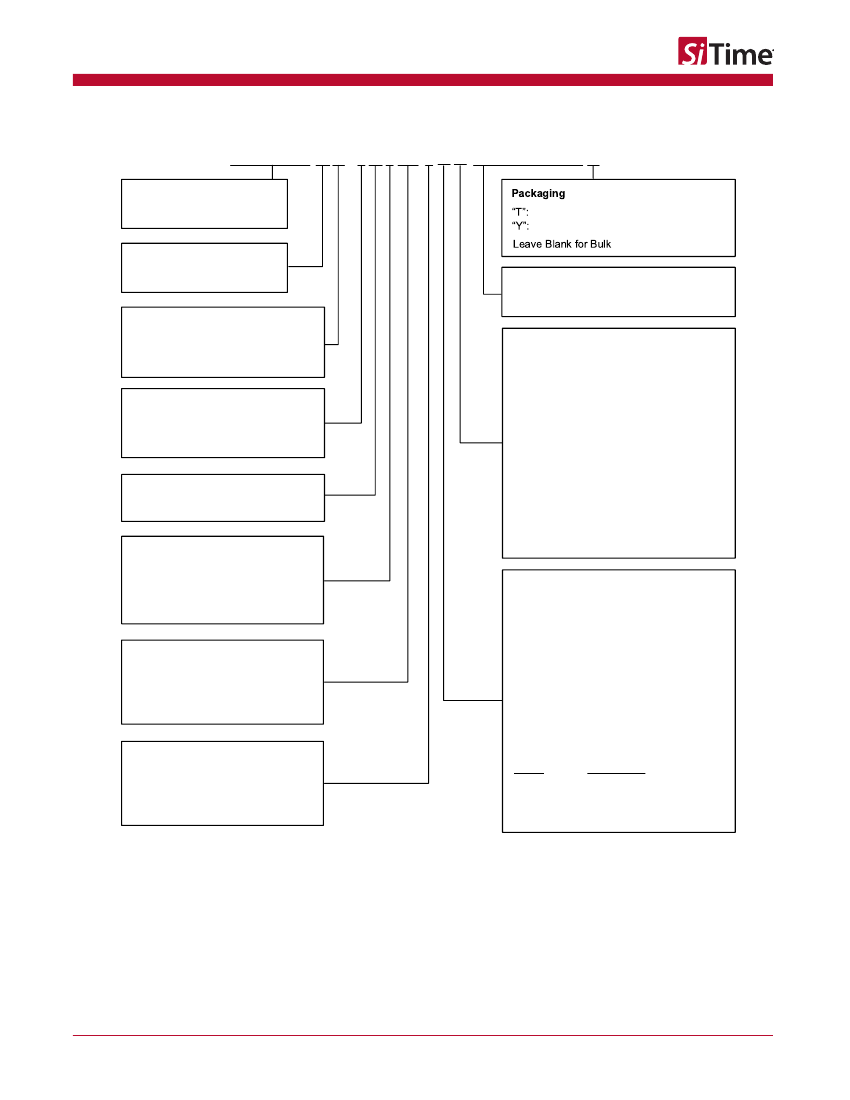
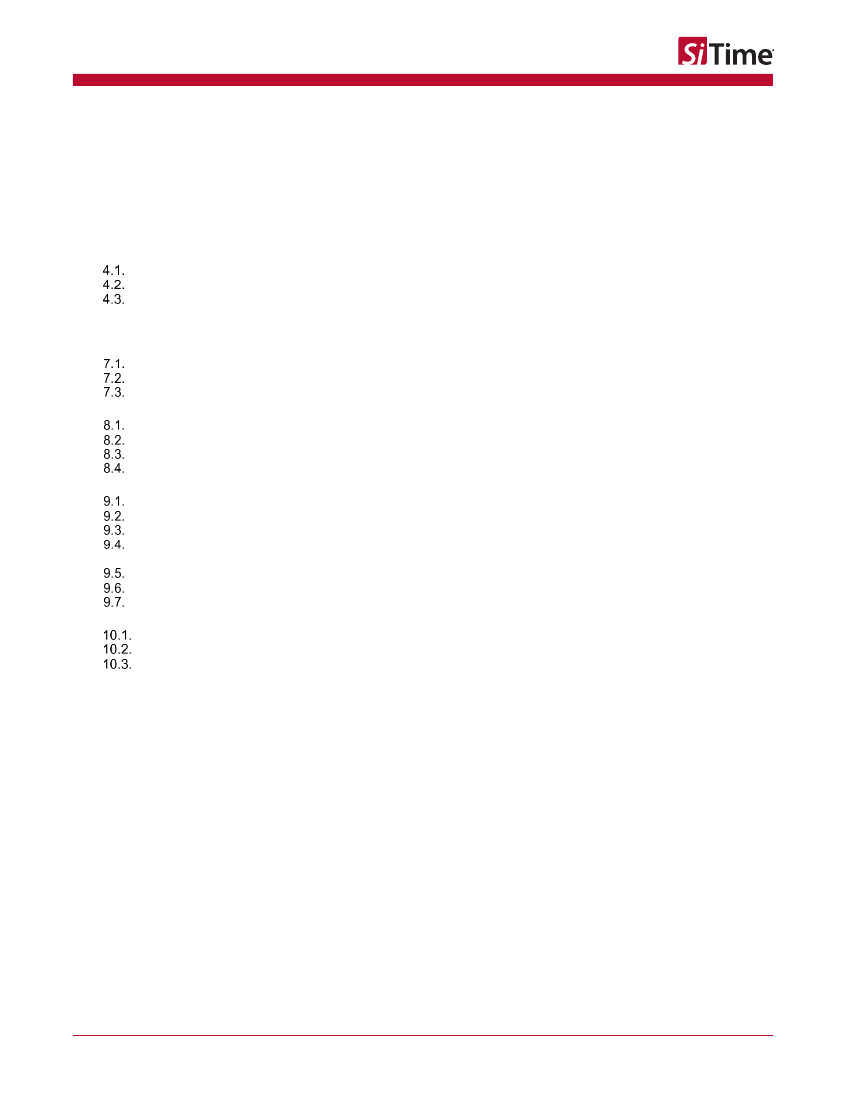
Ordering Information .................................................................................................................................................................... 2
User Programming Interface ..................................................................................................................................... 18
Start-up output frequency and signaling types ........................................................................................................... 18
Any-frequency function ............................................................................................................................................. 19
C/SPI Control Registers...................................................................................................................................................... 28
9 I
Register Address: 0x00. DCO Frequency Control Least Significant Word (LSW) .................................................... 28
Register Address: 0x01. OE Control, DCO Frequency Control Most Significant Word (MSW) ................................. 29
Register Address: 0x02. DCO PULL RANGE CONTROL ........................................................................................ 29
Register Address: 0x03. Frac-N PLL Feedback Divider Integer Value and Frac-N PLL Feedback Divider Fraction
Value MSW ............................................................................................................................................................... 30
Register Address: 0x05. Forward Divider, Driver Control ......................................................................................... 30
Register Address: 0x06. Driver Divider, Driver Control ............................................................................................. 31
2
C Operation ........................................................................................................................................................................ 32
10 I
I
2
C protocol ............................................................................................................................................................... 32
I
2
C Timing Specification ............................................................................................................................................ 35
I
2
C Device Address Modes ....................................................................................................................................... 36
Dimensions and Patterns ........................................................................................................................................................... 43
Additional Information ................................................................................................................................................................ 44
Revision History ......................................................................................................................................................................... 45
Rev 1.01
Page 3 of 45
www.sitime.com
SiT3521
1 to 340 MHz Elite Platform I2C/SPI Programmable Oscillator
1 Electrical Characteristics
All Min and Max limits in the Electrical Characteristics tables are specified over temperature and rated operating voltage with
standard output terminations shown in the termination diagrams. Typical values are at 25°C and nominal supply voltage.
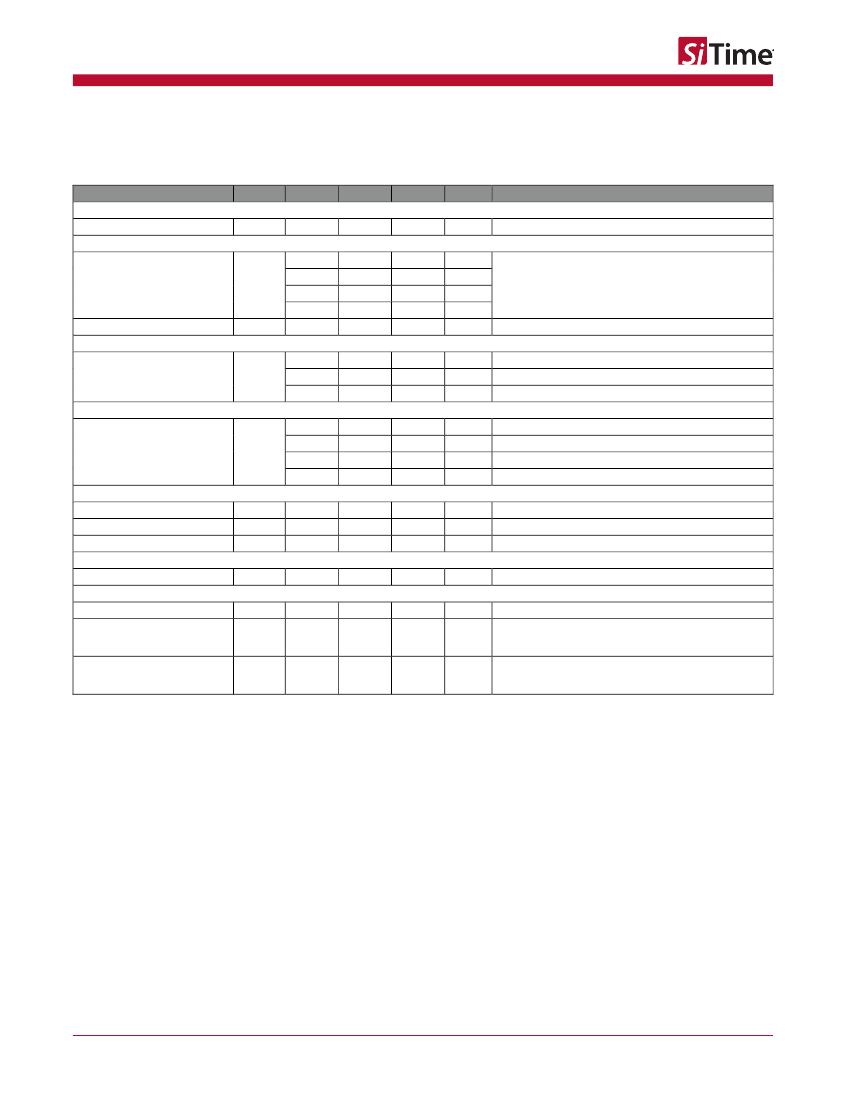
Table 1. Electrical Characteristics – Common to LVPECL, LVDS and HCSL
Parameter
Output Frequency Range
Symbol
f
Min.
1
Typ.
–
–
–
–
–
±1
–
–
–
Max.
340
Unit
MHz
Condition
Factory or user programmable, accurate to 6 decimal places
Frequency Range
Frequency Stability
Frequency Stability
F_stab
-10
-20
-25
-50
First Year Aging
F_1y
–
+10
+20
+25
+50
–
ppm
ppm
ppm
ppm
ppm
°C
°C
°C
1
st
-year aging at 25°C
Inclusive of initial tolerance, operating temperature, rated
power supply voltage and load variations.
Temperature Range
Operating Temperature Range
T_use
-20
-40
-40
+70
+85
+105
Supply Voltage
Supply Voltage
Vdd
2.97
2.7
2.52
2.25
3.3
3.0
2.8
2.5
–
–
100
–
–
–
3.63
3.3
3.08
2.75
–
30%
–
V
V
V
V
Extended Commercial
Industrial
Extended Industrial. Available only for I
2
C operation, not SPI.
Input Characteristics – OE Pin
Input Voltage High
Input Voltage Low
Input Pull-up Impedance
VIH
VIL
Z_in
70%
–
–
Vdd
Vdd
kΩ
OE pin
OE pin
OE pin, logic high or logic low
Output Characteristics
Duty Cycle
DC
45
–
–
55
%
Startup and Output Enable/Disable Timing
Start-up Time
Output Enable/Disable Time –
Hardware control via OE pin
Output Enable/Disable Time –
Software control via I
2
C/SPI
T_start
T_oe_hw
3.0
3.8
ms
µs
Measured from the time Vdd reaches its rated minimum value
Measured from the time OE pin reaches rated VIH and VIL to
the time clock pins reach 90% of swing and high-Z.
See
Figure 9
and
Figure 10
Measured from the time the last byte of command is
transmitted via I
2
C/SPI (reg1) to the time clock pins reach 90%
of swing and high-Z. See
Figure 30
and
Figure 31
T_oe_sw
–
–
6.5
µs
Rev 1.01
Page 4 of 45
www.sitime.com
SiT3521
1 to 340 MHz Elite Platform I2C/SPI Programmable Oscillator
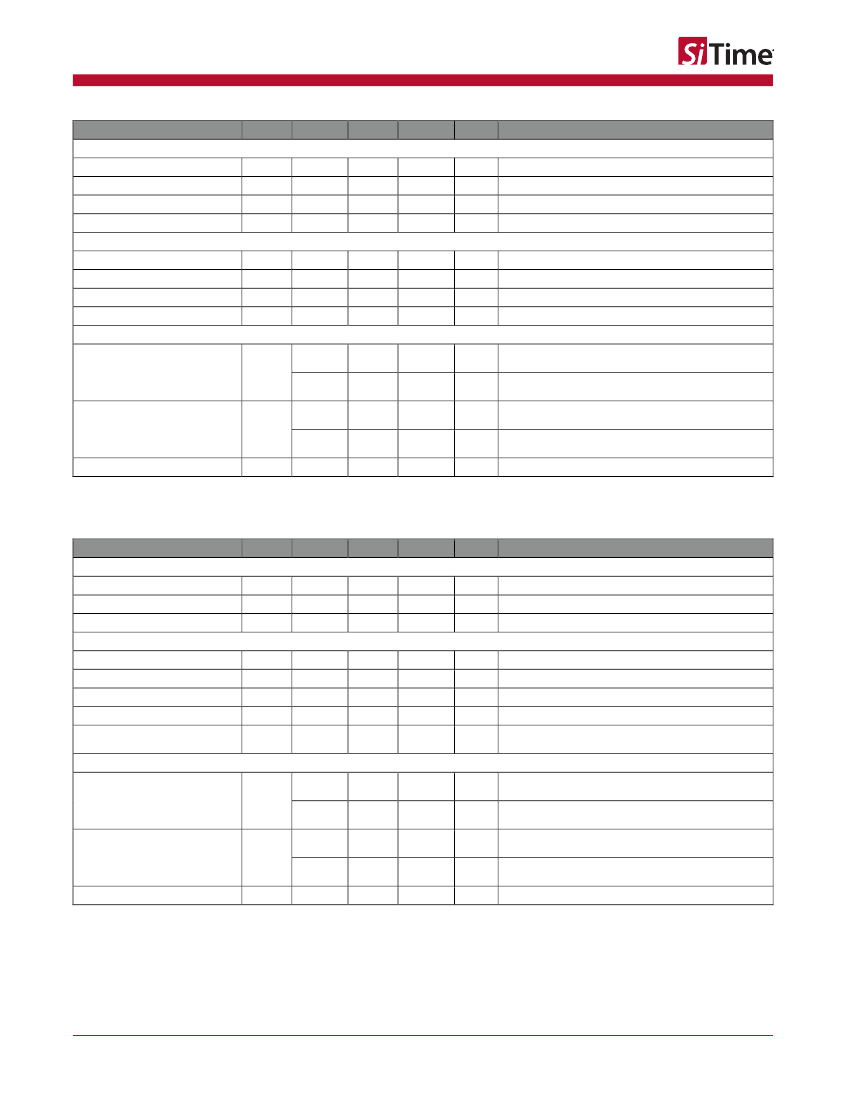
Table 2. Electrical Characteristics – LVPECL Specific
Parameter
Symbol
Min.
Typ.
Max.
Unit
Condition
Current Consumption
Current Consumption
OE Disable Supply Current
Output Disable Leakage Current
Maximum Output Current
Idd
I_OE
I_leak
I_driver
–
–
–
–
–
–
0.15
–
89
58
–
32
mA
mA
A
mA
Excluding Load Termination Current, Vdd = 3.3 V or 2.5 V
OE = Low
OE = Low
Maximum average current drawn from OUT+ or OUT-
Output Characteristics
Output High Voltage
Output Low Voltage
Output Differential Voltage Swing
Rise/Fall Time
VOH
VOL
V_Swing
Tr, Tf
Vdd - 1.1V
Vdd - 1.9V
1.2
–
–
–
1.6
225
Vdd - 0.7V
Vdd - 1.5V
2.0
290
Jitter
RMS Phase Jitter (random) –
DCO Mode Only
T_phj
–
–
RMS Phase Jitter (random) –
Any-frequency Mode Only
T_phj
–
–
RMS Period Jitter
[3]
Note:
3. Measured according to JESD65B.
T_jitt
–
0.225
0.1
0.225
0.11
1
0.340
0.14
0.340
0.15
1.6
ps
ps
ps
ps
ps
f = 156.25 MHz, Integration bandwidth = 12 kHz to 20 MHz,
all Vdd levels
f = 156.25, IEEE802.3-2005 10 GbE jitter mask integration
bandwidth = 1.875 MHz to 20 MHz, all Vdd levels
f = 156.25 MHz, Integration bandwidth = 12 kHz to 20 MHz,
all Vdd levels
f = 156.25, IEEE802.3-2005 10 GbE jitter mask integration
bandwidth = 1.875 MHz to 20 MHz, all Vdd levels
f = 100, 156.25 or 212.5 MHz, Vdd = 3.3 V or 2.5 V
V
V
V
ps
See
Figure 5
See
Figure 5
See
Figure 6
20% to 80%, see
Figure 6
Table 3. Electrical Characteristics – LVDS Specific
Parameter
Symbol
Min.
Typ.
Max.
Unit
Condition
Current Consumption
Current Consumption
OE Disable Supply Current
Output Disable Leakage Current
Idd
I_OE
I_leak
–
–
–
–
–
0.15
80
61
–
mA
mA
A
Excluding Load Termination Current, Vdd = 3.3 V or 2.5 V
OE = Low
OE = Low
Output Characteristics
Differential Output Voltage
Delta VOD
Offset Voltage
Delta VOS
Rise/Fall Time
VOD
ΔVOD
VOS
ΔVOS
Tr, Tf
250
–
1.125
–
–
–
–
–
–
400
455
50
1.375
50
470
Jitter
RMS Phase Jitter (random) –
DCO Mode Only
T_phj
–
–
RMS Phase Jitter (random) –
Any-frequency Mode Only
T_phj
–
–
RMS Period Jitter
[4]
Note:
4. Measured according to JESD65B.
T_jitt
–
0.21
0.1
0.21
0.1
1
0.275
0.12
0.367
0.12
1.6
ps
ps
ps
ps
ps
f = 156.25 MHz, Integration bandwidth = 12 kHz to 20 MHz,
all Vdd levels
f = 156.25, IEEE802.3-2005 10 GbE jitter mask integration
bandwidth = 1.875 MHz to 20 MHz, all Vdd levels
f = 156.25 MHz, Integration bandwidth = 12 kHz to 20 MHz,
all Vdd levels
f = 156.25, IEEE802.3-2005 10 GbE jitter mask integration
bandwidth = 1.875 MHz to 20 MHz, all Vdd levels
f = 100, 156.25 or 212.5 MHz, Vdd = 3.3 V or 2.5 V
mV
mV
V
mV
ps
f = 156.25MHz See
Figure 7
See
Figure 7
See
Figure 7
See
Figure 7
Measured with 2 pF capacitive loading to GND, 20% to 80%,
[font=normal 宋体, Arial, Helvetica, sans-serif][color=#000000][size=12px]Use the adc of msp430G2553 to directly sample the output value of the dual power supply circuit. [/size][/color][/font] [font=no...
I have a Matlab program that I want to port to a DSP development board. I don't know what to pay attention to or how to port it. If anyone has done this, please share your experience....
[font=微软雅黑][size=3]First, here are the pictures: [/size][/font] [align=center][/align] [font=微软雅黑][size=3] The pictures show the flight control motherboard, IMU, components and main control board. [/s...
1. System Overview----As parents, after sending their children to kindergarten, they must want to know all kinds of situations of their children in kindergarten. Every move of their children always co...
MSP430 is widely used in the industry for its ultra-low power consumption, especially in electronic weighing, wireless sensor networks, and embedded systems. I want to buy an MSP430 board to do a curr...
[align=left][color=#000000]Microcontrollers are something that every electronic engineer is very familiar with. Based on them, they have made various small projects. These projects may be interesting,...
When discussing autonomous driving technology, there are often two extremes: on the one hand, there's the vision of "fully autonomous driving," while on the other, there's concern about potential s...[Details]
Electric vehicles are becoming increasingly popular, with increasingly longer ranges. There are two ways to charge electric vehicles: slow charging and fast charging. Which is the most suitable? Sl...[Details]
On August 20, Geely announced its focus on "One Cockpit". Through a unified AI OS architecture, a unified AI Agent, and a unified user ID, it will achieve an All-in-One AI cockpit, create the first...[Details]
Plug-in hybrid vehicles (PHEVs) utilize two powertrains. Their pure electric range is typically inferior to that of pure electric vehicles, often reaching less than half that. Currently, mainstream...[Details]
Consumer demand for premium listening experiences has driven rapid evolution in the wireless headphone market in recent years. Hybrid designs, which utilize two drivers per earbud to enhance sound ...[Details]
Wearable technology is taking off, with applications evolving rapidly, from smartwatches to fitness trackers and even smart wigs! Bluetooth Smart is at the center of this revolution. This is the se...[Details]
As the electric vehicle industry continues to surge in today's society, while people are concerned about the appearance and interior of new energy vehicles, they are also concerned about the classi...[Details]
The transition to SDVs (software-defined vehicles) involves more than just replacing parts; rather, it involves the organic connection of various elements, from internal vehicle systems to ext...[Details]
This new standardized, pre-integrated computing platform is designed to accelerate chip development, reduce development costs, and provide scalable software to power the AI-defined car.
...[Details]
Compared to gasoline-powered vehicles, electric vehicles have a simpler structure, allowing for greater flexibility in the layout of various components. While electric and gasoline-powered vehicles...[Details]
The number of new energy vehicles in use is increasing, and there are multiple choices available. New energy vehicles can be divided into hybrid and pure electric, and the types of hybrid include m...[Details]
System Principle
According to the average imbalance rate of the branch three-phase phase line load and the average value of the branch phase line current, the adjustment of the phase line load...[Details]
introduction
In the context of the comprehensive development of the Internet of Things (IoT) technology under the "Perceiving China" initiative, "Perceiving Mines" is a crucial component of Ch...[Details]
We often notice that some safety light curtains have EDM function. What does EDM mean here? What is its function?
The full name of EDM is External Device Monitor, which means external device m...[Details]
In recent years, portable electronic devices such as mobile phones, digital cameras, music players, tablets, ultrabooks, and laptops have become almost a necessity, raising safety concerns. Besides...[Details]

 Microcontroller MCU
 京公网安备 11010802033920号
 EEWORLD