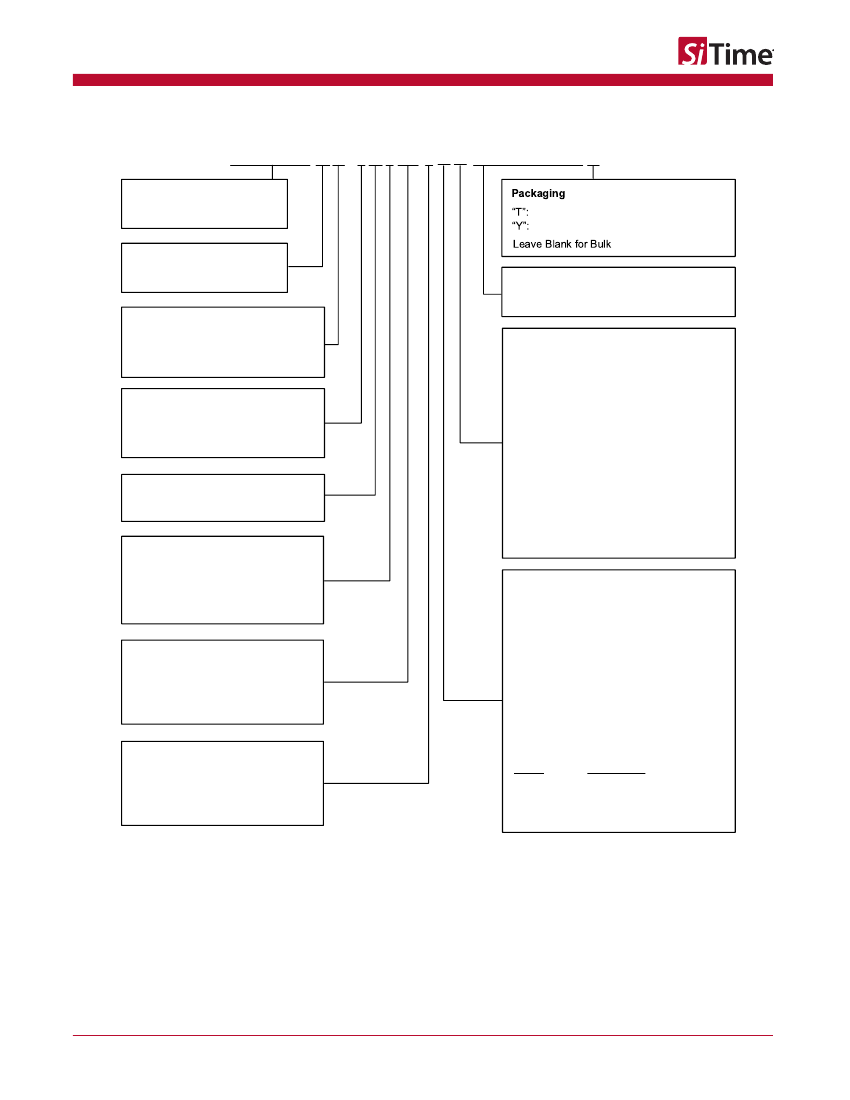
Ordering Information .................................................................................................................................................................... 2
User Programming Interface ..................................................................................................................................... 18
Start-up output frequency and signaling types ........................................................................................................... 18
Any-frequency function ............................................................................................................................................. 19
C/SPI Control Registers...................................................................................................................................................... 28
9 I
Register Address: 0x00. DCO Frequency Control Least Significant Word (LSW) .................................................... 28
Register Address: 0x01. OE Control, DCO Frequency Control Most Significant Word (MSW) ................................. 29
Register Address: 0x02. DCO PULL RANGE CONTROL ........................................................................................ 29
Register Address: 0x03. Frac-N PLL Feedback Divider Integer Value and Frac-N PLL Feedback Divider Fraction
Value MSW ............................................................................................................................................................... 30
Register Address: 0x05. Forward Divider, Driver Control ......................................................................................... 30
Register Address: 0x06. Driver Divider, Driver Control ............................................................................................. 31
2
C Operation ........................................................................................................................................................................ 32
10 I
I
2
C protocol ............................................................................................................................................................... 32
I
2
C Timing Specification ............................................................................................................................................ 35
I
2
C Device Address Modes ....................................................................................................................................... 36
Dimensions and Patterns ........................................................................................................................................................... 43
Additional Information ................................................................................................................................................................ 44
Revision History ......................................................................................................................................................................... 45
Rev 1.01
Page 3 of 45
www.sitime.com
SiT3521
1 to 340 MHz Elite Platform I2C/SPI Programmable Oscillator
1 Electrical Characteristics
All Min and Max limits in the Electrical Characteristics tables are specified over temperature and rated operating voltage with
standard output terminations shown in the termination diagrams. Typical values are at 25°C and nominal supply voltage.
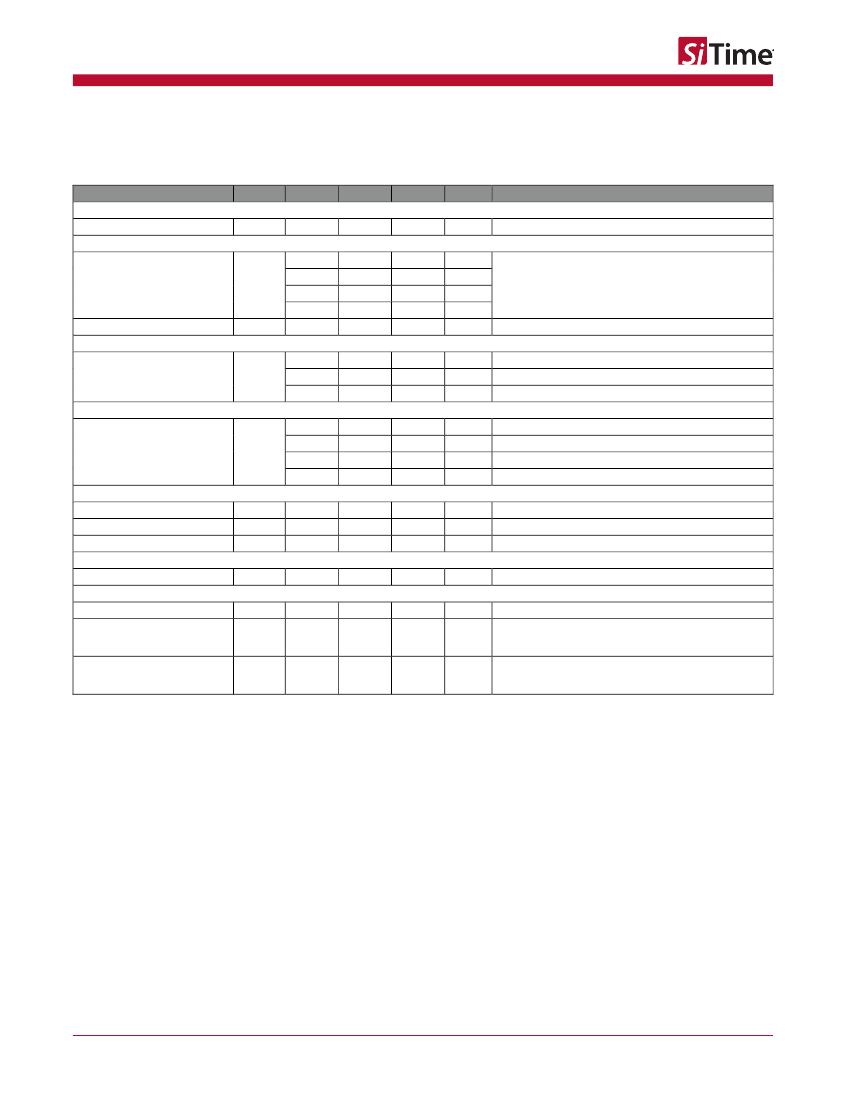
Table 1. Electrical Characteristics – Common to LVPECL, LVDS and HCSL
Parameter
Output Frequency Range
Symbol
f
Min.
1
Typ.
–
–
–
–
–
±1
–
–
–
Max.
340
Unit
MHz
Condition
Factory or user programmable, accurate to 6 decimal places
Frequency Range
Frequency Stability
Frequency Stability
F_stab
-10
-20
-25
-50
First Year Aging
F_1y
–
+10
+20
+25
+50
–
ppm
ppm
ppm
ppm
ppm
°C
°C
°C
1
st
-year aging at 25°C
Inclusive of initial tolerance, operating temperature, rated
power supply voltage and load variations.
Temperature Range
Operating Temperature Range
T_use
-20
-40
-40
+70
+85
+105
Supply Voltage
Supply Voltage
Vdd
2.97
2.7
2.52
2.25
3.3
3.0
2.8
2.5
–
–
100
–
–
–
3.63
3.3
3.08
2.75
–
30%
–
V
V
V
V
Extended Commercial
Industrial
Extended Industrial. Available only for I
2
C operation, not SPI.
Input Characteristics – OE Pin
Input Voltage High
Input Voltage Low
Input Pull-up Impedance
VIH
VIL
Z_in
70%
–
–
Vdd
Vdd
kΩ
OE pin
OE pin
OE pin, logic high or logic low
Output Characteristics
Duty Cycle
DC
45
–
–
55
%
Startup and Output Enable/Disable Timing
Start-up Time
Output Enable/Disable Time –
Hardware control via OE pin
Output Enable/Disable Time –
Software control via I
2
C/SPI
T_start
T_oe_hw
3.0
3.8
ms
µs
Measured from the time Vdd reaches its rated minimum value
Measured from the time OE pin reaches rated VIH and VIL to
the time clock pins reach 90% of swing and high-Z.
See
Figure 9
and
Figure 10
Measured from the time the last byte of command is
transmitted via I
2
C/SPI (reg1) to the time clock pins reach 90%
of swing and high-Z. See
Figure 30
and
Figure 31
T_oe_sw
–
–
6.5
µs
Rev 1.01
Page 4 of 45
www.sitime.com
SiT3521
1 to 340 MHz Elite Platform I2C/SPI Programmable Oscillator
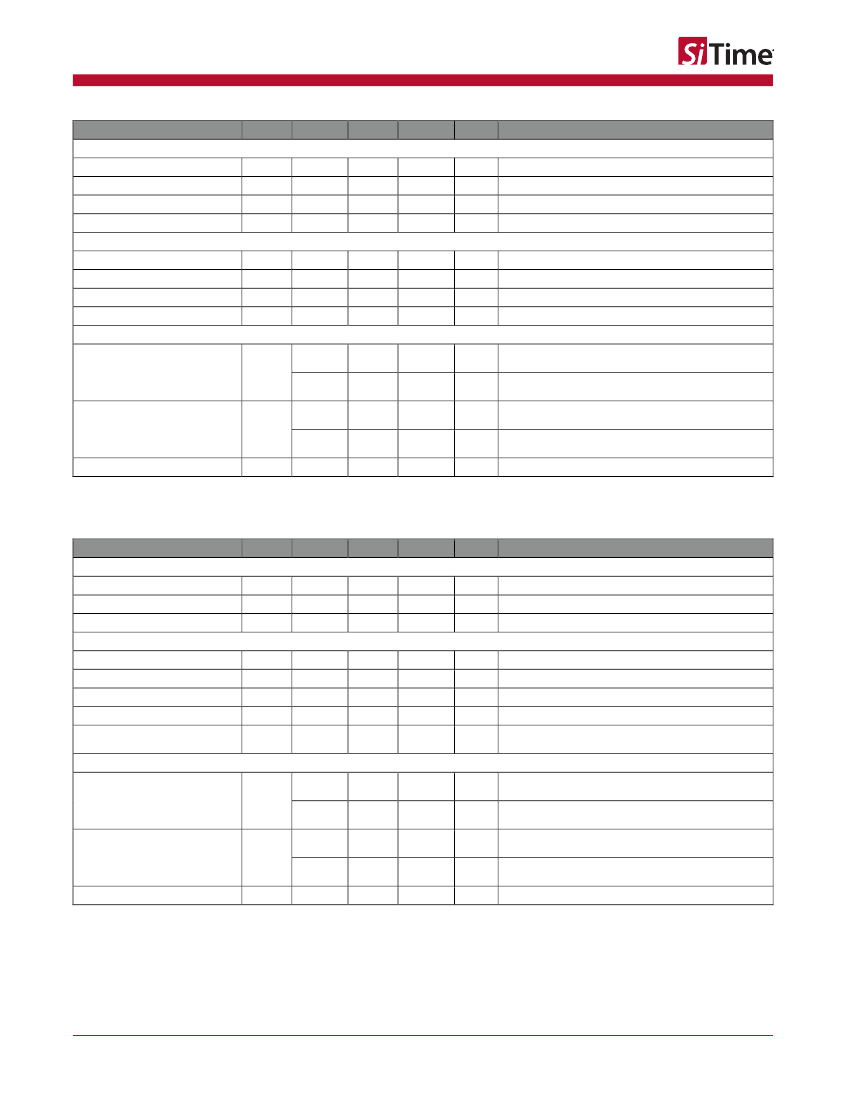
Table 2. Electrical Characteristics – LVPECL Specific
Parameter
Symbol
Min.
Typ.
Max.
Unit
Condition
Current Consumption
Current Consumption
OE Disable Supply Current
Output Disable Leakage Current
Maximum Output Current
Idd
I_OE
I_leak
I_driver
–
–
–
–
–
–
0.15
–
89
58
–
32
mA
mA
A
mA
Excluding Load Termination Current, Vdd = 3.3 V or 2.5 V
OE = Low
OE = Low
Maximum average current drawn from OUT+ or OUT-
Output Characteristics
Output High Voltage
Output Low Voltage
Output Differential Voltage Swing
Rise/Fall Time
VOH
VOL
V_Swing
Tr, Tf
Vdd - 1.1V
Vdd - 1.9V
1.2
–
–
–
1.6
225
Vdd - 0.7V
Vdd - 1.5V
2.0
290
Jitter
RMS Phase Jitter (random) –
DCO Mode Only
T_phj
–
–
RMS Phase Jitter (random) –
Any-frequency Mode Only
T_phj
–
–
RMS Period Jitter
[3]
Note:
3. Measured according to JESD65B.
T_jitt
–
0.225
0.1
0.225
0.11
1
0.340
0.14
0.340
0.15
1.6
ps
ps
ps
ps
ps
f = 156.25 MHz, Integration bandwidth = 12 kHz to 20 MHz,
all Vdd levels
f = 156.25, IEEE802.3-2005 10 GbE jitter mask integration
bandwidth = 1.875 MHz to 20 MHz, all Vdd levels
f = 156.25 MHz, Integration bandwidth = 12 kHz to 20 MHz,
all Vdd levels
f = 156.25, IEEE802.3-2005 10 GbE jitter mask integration
bandwidth = 1.875 MHz to 20 MHz, all Vdd levels
f = 100, 156.25 or 212.5 MHz, Vdd = 3.3 V or 2.5 V
V
V
V
ps
See
Figure 5
See
Figure 5
See
Figure 6
20% to 80%, see
Figure 6
Table 3. Electrical Characteristics – LVDS Specific
Parameter
Symbol
Min.
Typ.
Max.
Unit
Condition
Current Consumption
Current Consumption
OE Disable Supply Current
Output Disable Leakage Current
Idd
I_OE
I_leak
–
–
–
–
–
0.15
80
61
–
mA
mA
A
Excluding Load Termination Current, Vdd = 3.3 V or 2.5 V
OE = Low
OE = Low
Output Characteristics
Differential Output Voltage
Delta VOD
Offset Voltage
Delta VOS
Rise/Fall Time
VOD
ΔVOD
VOS
ΔVOS
Tr, Tf
250
–
1.125
–
–
–
–
–
–
400
455
50
1.375
50
470
Jitter
RMS Phase Jitter (random) –
DCO Mode Only
T_phj
–
–
RMS Phase Jitter (random) –
Any-frequency Mode Only
T_phj
–
–
RMS Period Jitter
[4]
Note:
4. Measured according to JESD65B.
T_jitt
–
0.21
0.1
0.21
0.1
1
0.275
0.12
0.367
0.12
1.6
ps
ps
ps
ps
ps
f = 156.25 MHz, Integration bandwidth = 12 kHz to 20 MHz,
all Vdd levels
f = 156.25, IEEE802.3-2005 10 GbE jitter mask integration
bandwidth = 1.875 MHz to 20 MHz, all Vdd levels
f = 156.25 MHz, Integration bandwidth = 12 kHz to 20 MHz,
all Vdd levels
f = 156.25, IEEE802.3-2005 10 GbE jitter mask integration
bandwidth = 1.875 MHz to 20 MHz, all Vdd levels
f = 100, 156.25 or 212.5 MHz, Vdd = 3.3 V or 2.5 V
mV
mV
V
mV
ps
f = 156.25MHz See
Figure 7
See
Figure 7
See
Figure 7
See
Figure 7
Measured with 2 pF capacitive loading to GND, 20% to 80%,
Will it have any impact if 51 MCU uses 1 timer for 4 serial ports? And these 4 serial ports may work at the same time, will there be any interference?...
[font=微软雅黑][size=3]I stayed up late yesterday to listen to Luo Yonghao's crosstalk like many Hammer fans. Luo Yonghao himself joked that he was as famous as Guo Degang in Beijing :pleased: The press c...
Recently I need to get the USB driver under XP, and try to build an integrated development environment under vs05. Previously, according to the information collected on the Internet, I used vc6sp6+ddk...
In the application of pic67k22, the ultra-low power wake-up function of the RA0 pin is used, but the wake-up period is not fixed, the capacitor is fixed, and the charging delay is also hard-coded, but...
[b]AMD, Google, IBM, Mellanox, Micron, Xilinx and other industry giants jointly announced that they will work together to create a new "OpenCAPI" (Open Coherent Accelerator Interface) standard, thereb...
[i=s]This post was last edited by dcexpert on 2015-5-16 11:38[/i] I attended Infineon's national tour seminar on power management two days ago and was given a thick second edition of "Mastering Switch...
1. Problem When developing STM32 with IAR, I found that I could not print floating point numbers by redirecting printf to the serial port. The code is as follows: The output is as follows: It can...[Details]
Autonomous driving
and
5G
are the two hot topics that global companies and media are paying the most attention to, and the combination of the two is the focus of everyone's attention....[Details]
What is SYSTICK: This is a 24-bit system tick timer, SysTick, with automatic reload and overflow interrupt functions. All microcontrollers based on the Cortex_M3 processor can obtain a certain time ...[Details]
Independent watchdog (IWDG) and low power mode are often used in STM32 development. The watchdog is to detect and solve faults caused by software errors, and the low power mode is to enter sleep mode...[Details]
In the 80C51 single-chip microcomputer, the clock frequency is known to be 6MHz. Please program P1.0 and P1.1 to output square waves with periods of 2s and 0.5s respectively. Please give the answer a...[Details]
Please help me analyze the clock cycles occupied by the following delay program. Seek to explain: DELAY: MOV R6, #13 DELAY1: MOV R5, #250 DELAY2: NOP DJNZ R5, DELAY2 DJNZ R6, DEL...[Details]
//Note: The GCC-AVR version used in this article is WinAVR20100110 Interrupts are not part of the C language, and the implementation of interrupts is implemented by the compiler. Therefore, the writ...[Details]
What is an AVR microcontroller? What are the advantages of an AVR microcontroller? Why should you choose an AVR microcontroller? AVR microcontroller is a new type of microcontroller developed by ATME...[Details]
About a dozen years ago,
AMD
was also a rival to Intel. It can be said that the two microprocessor manufacturers have been in love and hate for many years, which is completely a commercial ...[Details]
Homemade LED Electronics Clocks can be seen in many electronic newspapers and magazines, but most of them need to reset the time and other parameters after power failure, which brings a lot of inco...[Details]
In this example, a single-byte binary number (0X20) is converted into uncompressed BCD code and stored in 0X25, 0X24, and 0X23, where 0X25 is the hundreds place and 0X23 is the ones place. main: MOV ...[Details]
Infrared remote control is the most widely used remote control method. Infrared remote control devices have the characteristics of small size, low power consumption, strong functions and low cost. Th...[Details]
On June 25 this year, in Guangzhou, at an energy forum held by British oil giant BP Group, Zhao Daiqing, a researcher at the Guangzhou Institute of Energy Conservation of the Chinese Academy of Sci...[Details]
Regulations and standards are yet to be improved, the public does not pay enough attention to security issues, enterprises strictly control production costs, and have relatively weak security awarene...[Details]
On the 19th, Micron announced its first quarter financial report for the 2018 fiscal year (starting from September 1, 2017). The revenue for the first quarter ended at the end of November was $6.8 ...[Details]

 MCU
MCU
 京公网安备 11010802033920号
 EEWORLD