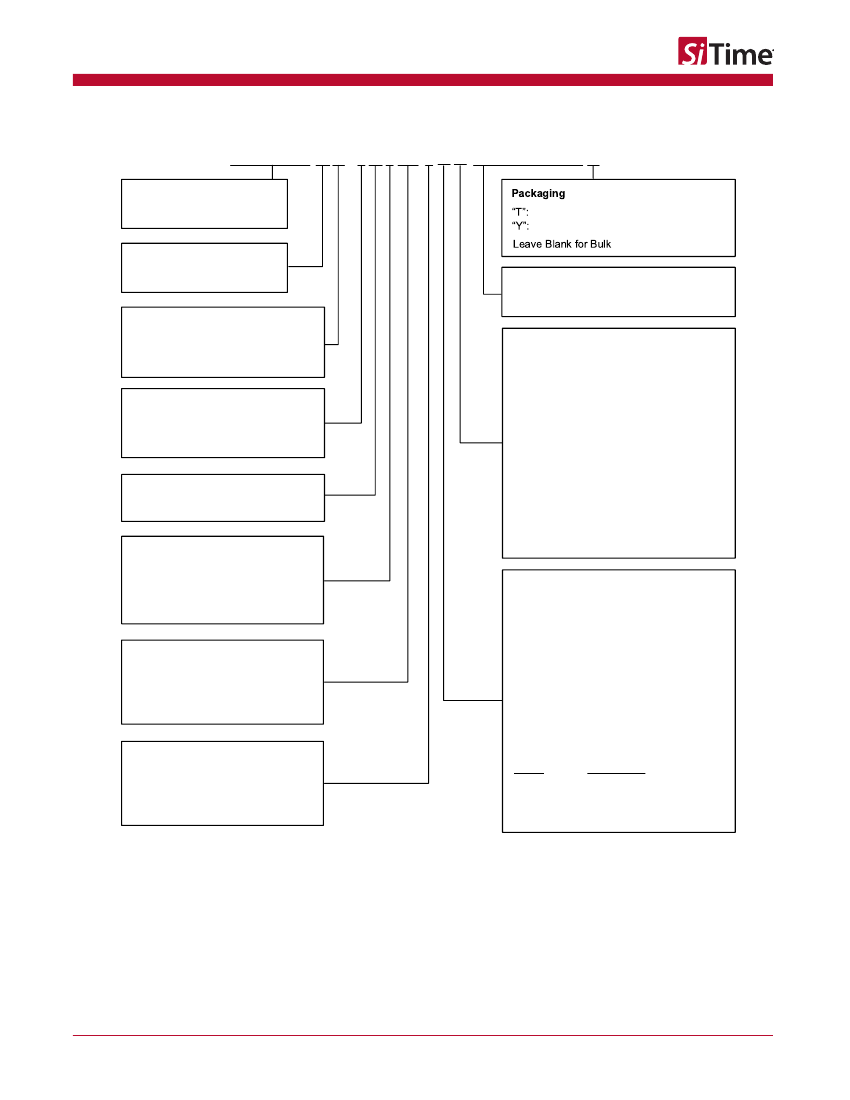
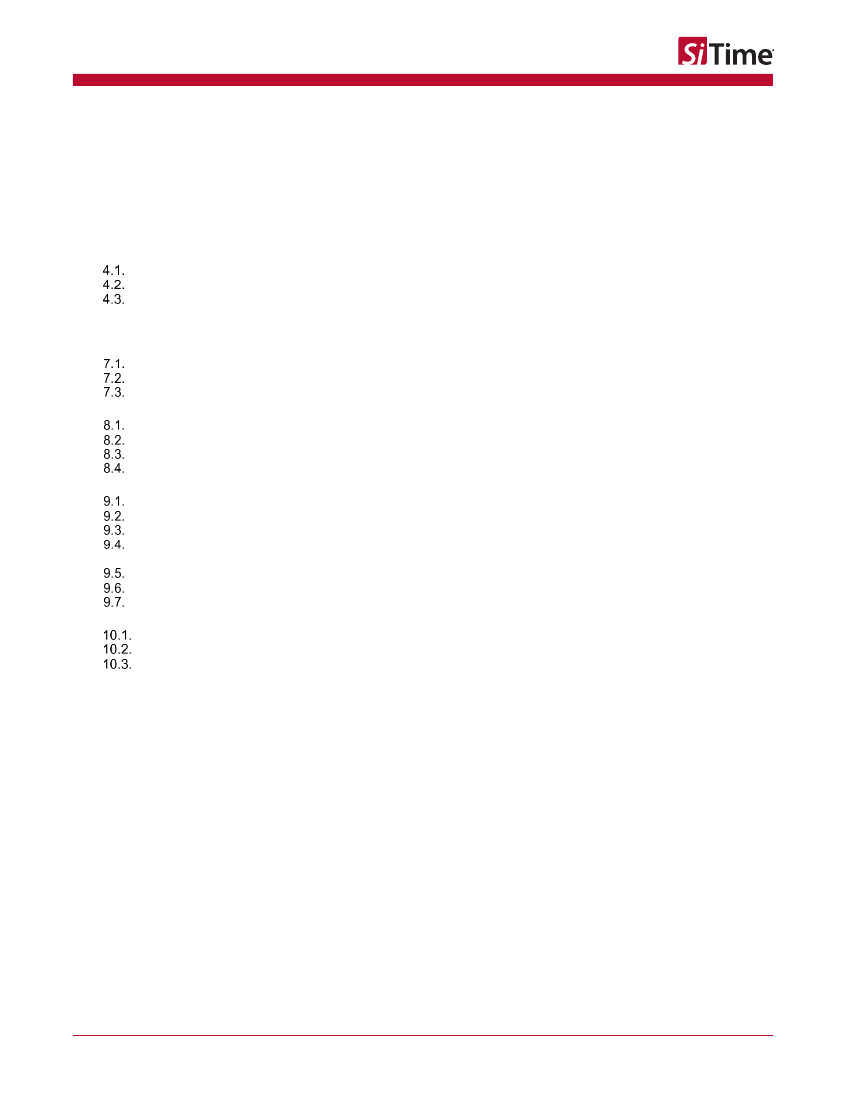
Ordering Information .................................................................................................................................................................... 2
User Programming Interface ..................................................................................................................................... 18
Start-up output frequency and signaling types ........................................................................................................... 18
Any-frequency function ............................................................................................................................................. 19
C/SPI Control Registers...................................................................................................................................................... 28
9 I
Register Address: 0x00. DCO Frequency Control Least Significant Word (LSW) .................................................... 28
Register Address: 0x01. OE Control, DCO Frequency Control Most Significant Word (MSW) ................................. 29
Register Address: 0x02. DCO PULL RANGE CONTROL ........................................................................................ 29
Register Address: 0x03. Frac-N PLL Feedback Divider Integer Value and Frac-N PLL Feedback Divider Fraction
Value MSW ............................................................................................................................................................... 30
Register Address: 0x05. Forward Divider, Driver Control ......................................................................................... 30
Register Address: 0x06. Driver Divider, Driver Control ............................................................................................. 31
2
C Operation ........................................................................................................................................................................ 32
10 I
I
2
C protocol ............................................................................................................................................................... 32
I
2
C Timing Specification ............................................................................................................................................ 35
I
2
C Device Address Modes ....................................................................................................................................... 36
Dimensions and Patterns ........................................................................................................................................................... 43
Additional Information ................................................................................................................................................................ 44
Revision History ......................................................................................................................................................................... 45
Rev 1.01
Page 3 of 45
www.sitime.com
SiT3521
1 to 340 MHz Elite Platform I2C/SPI Programmable Oscillator
1 Electrical Characteristics
All Min and Max limits in the Electrical Characteristics tables are specified over temperature and rated operating voltage with
standard output terminations shown in the termination diagrams. Typical values are at 25°C and nominal supply voltage.
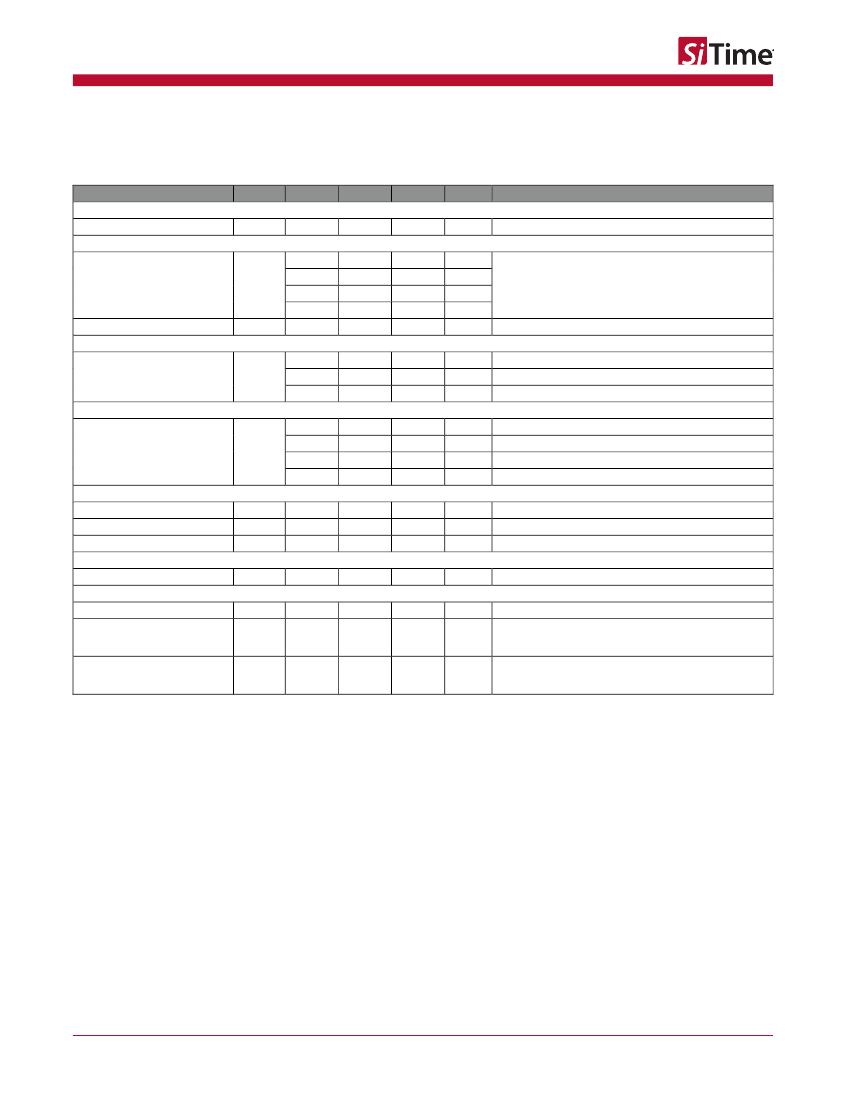
Table 1. Electrical Characteristics – Common to LVPECL, LVDS and HCSL
Parameter
Output Frequency Range
Symbol
f
Min.
1
Typ.
–
–
–
–
–
±1
–
–
–
Max.
340
Unit
MHz
Condition
Factory or user programmable, accurate to 6 decimal places
Frequency Range
Frequency Stability
Frequency Stability
F_stab
-10
-20
-25
-50
First Year Aging
F_1y
–
+10
+20
+25
+50
–
ppm
ppm
ppm
ppm
ppm
°C
°C
°C
1
st
-year aging at 25°C
Inclusive of initial tolerance, operating temperature, rated
power supply voltage and load variations.
Temperature Range
Operating Temperature Range
T_use
-20
-40
-40
+70
+85
+105
Supply Voltage
Supply Voltage
Vdd
2.97
2.7
2.52
2.25
3.3
3.0
2.8
2.5
–
–
100
–
–
–
3.63
3.3
3.08
2.75
–
30%
–
V
V
V
V
Extended Commercial
Industrial
Extended Industrial. Available only for I
2
C operation, not SPI.
Input Characteristics – OE Pin
Input Voltage High
Input Voltage Low
Input Pull-up Impedance
VIH
VIL
Z_in
70%
–
–
Vdd
Vdd
kΩ
OE pin
OE pin
OE pin, logic high or logic low
Output Characteristics
Duty Cycle
DC
45
–
–
55
%
Startup and Output Enable/Disable Timing
Start-up Time
Output Enable/Disable Time –
Hardware control via OE pin
Output Enable/Disable Time –
Software control via I
2
C/SPI
T_start
T_oe_hw
3.0
3.8
ms
µs
Measured from the time Vdd reaches its rated minimum value
Measured from the time OE pin reaches rated VIH and VIL to
the time clock pins reach 90% of swing and high-Z.
See
Figure 9
and
Figure 10
Measured from the time the last byte of command is
transmitted via I
2
C/SPI (reg1) to the time clock pins reach 90%
of swing and high-Z. See
Figure 30
and
Figure 31
T_oe_sw
–
–
6.5
µs
Rev 1.01
Page 4 of 45
www.sitime.com
SiT3521
1 to 340 MHz Elite Platform I2C/SPI Programmable Oscillator
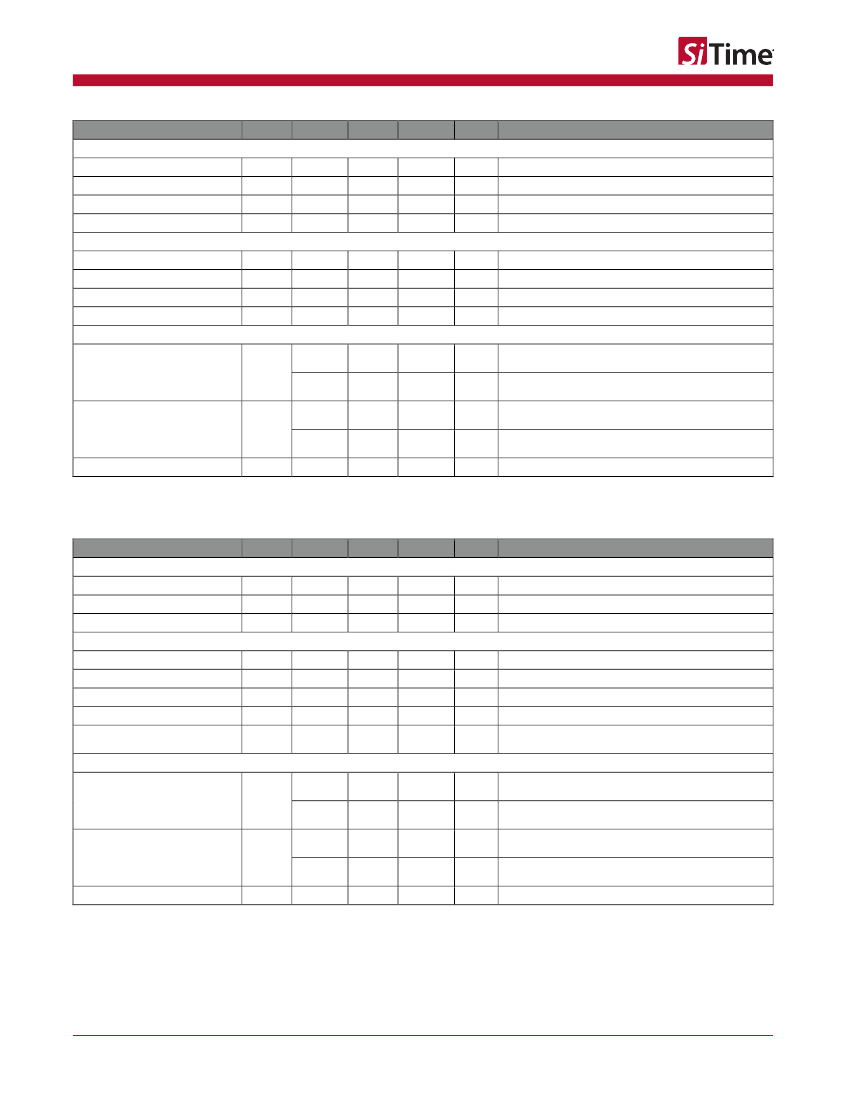
Table 2. Electrical Characteristics – LVPECL Specific
Parameter
Symbol
Min.
Typ.
Max.
Unit
Condition
Current Consumption
Current Consumption
OE Disable Supply Current
Output Disable Leakage Current
Maximum Output Current
Idd
I_OE
I_leak
I_driver
–
–
–
–
–
–
0.15
–
89
58
–
32
mA
mA
A
mA
Excluding Load Termination Current, Vdd = 3.3 V or 2.5 V
OE = Low
OE = Low
Maximum average current drawn from OUT+ or OUT-
Output Characteristics
Output High Voltage
Output Low Voltage
Output Differential Voltage Swing
Rise/Fall Time
VOH
VOL
V_Swing
Tr, Tf
Vdd - 1.1V
Vdd - 1.9V
1.2
–
–
–
1.6
225
Vdd - 0.7V
Vdd - 1.5V
2.0
290
Jitter
RMS Phase Jitter (random) –
DCO Mode Only
T_phj
–
–
RMS Phase Jitter (random) –
Any-frequency Mode Only
T_phj
–
–
RMS Period Jitter
[3]
Note:
3. Measured according to JESD65B.
T_jitt
–
0.225
0.1
0.225
0.11
1
0.340
0.14
0.340
0.15
1.6
ps
ps
ps
ps
ps
f = 156.25 MHz, Integration bandwidth = 12 kHz to 20 MHz,
all Vdd levels
f = 156.25, IEEE802.3-2005 10 GbE jitter mask integration
bandwidth = 1.875 MHz to 20 MHz, all Vdd levels
f = 156.25 MHz, Integration bandwidth = 12 kHz to 20 MHz,
all Vdd levels
f = 156.25, IEEE802.3-2005 10 GbE jitter mask integration
bandwidth = 1.875 MHz to 20 MHz, all Vdd levels
f = 100, 156.25 or 212.5 MHz, Vdd = 3.3 V or 2.5 V
V
V
V
ps
See
Figure 5
See
Figure 5
See
Figure 6
20% to 80%, see
Figure 6
Table 3. Electrical Characteristics – LVDS Specific
Parameter
Symbol
Min.
Typ.
Max.
Unit
Condition
Current Consumption
Current Consumption
OE Disable Supply Current
Output Disable Leakage Current
Idd
I_OE
I_leak
–
–
–
–
–
0.15
80
61
–
mA
mA
A
Excluding Load Termination Current, Vdd = 3.3 V or 2.5 V
OE = Low
OE = Low
Output Characteristics
Differential Output Voltage
Delta VOD
Offset Voltage
Delta VOS
Rise/Fall Time
VOD
ΔVOD
VOS
ΔVOS
Tr, Tf
250
–
1.125
–
–
–
–
–
–
400
455
50
1.375
50
470
Jitter
RMS Phase Jitter (random) –
DCO Mode Only
T_phj
–
–
RMS Phase Jitter (random) –
Any-frequency Mode Only
T_phj
–
–
RMS Period Jitter
[4]
Note:
4. Measured according to JESD65B.
T_jitt
–
0.21
0.1
0.21
0.1
1
0.275
0.12
0.367
0.12
1.6
ps
ps
ps
ps
ps
f = 156.25 MHz, Integration bandwidth = 12 kHz to 20 MHz,
all Vdd levels
f = 156.25, IEEE802.3-2005 10 GbE jitter mask integration
bandwidth = 1.875 MHz to 20 MHz, all Vdd levels
f = 156.25 MHz, Integration bandwidth = 12 kHz to 20 MHz,
all Vdd levels
f = 156.25, IEEE802.3-2005 10 GbE jitter mask integration
bandwidth = 1.875 MHz to 20 MHz, all Vdd levels
f = 100, 156.25 or 212.5 MHz, Vdd = 3.3 V or 2.5 V
mV
mV
V
mV
ps
f = 156.25MHz See
Figure 7
See
Figure 7
See
Figure 7
See
Figure 7
Measured with 2 pF capacitive loading to GND, 20% to 80%,
[i=s]This post was last edited by anananjjj on 2019-11-9 20:15[/i]Seeing everyone showing off their development boards, I decided to join in the fun!
The pictures show only a portion of my collection....
[i=s]This post was last edited by paulhyde on 2014-9-15 09:47[/i] It is rumored that there will be no wireless communication topic this year. I wonder if it is true. If there is no wireless communicat...
in [Help], Problems caused by changing a power supply My problem is this: the host simply scans the port, the slave is responsible for displaying the information (using LED), and reads the characters ...
Generally speaking, a program includes a read-only code segment and a readable and writable data segment. In the ARM integrated development environment, the read-only code segment and constants are ca...
Selecting the right integrated circuit (IC) for a power supply may seem easy on the surface. However, the task becomes more complex with the introduction of consumer electronics that require multiple ...
Dear experts, I would like to ask you a question about the use of IAR tools.
I added a project using IAR, [this project is already packaged, not compiled by me], there are two projects in the project,...
Nios II is a configurable 16-/32-bit RISC processor. Combined with a rich set of peripheral-specific instructions and hardware acceleration units, it provides a highly flexible and powerful SOPC sy...[Details]
The mass production process of the new generation of cockpit platform has started, and the smart cockpit market has entered a new bonus cycle of technology iteration and platform upgrade.
...[Details]
Recently,
Xpeng Motors and Xinlian Integrated Circuit jointly announced the mass production of China's first hybrid silicon carbide product.
Designed and developed by Xpeng Motors and joint...[Details]
Capable of providing precise and efficient thermal management for artificial intelligence computing power, intelligent sensing and autonomous driving systems
Shenzhen, ...[Details]
Laird Thermal Systems has introduced the HiTemp ET series Peltier cooler modules, which can operate at high temperatures and provide on-site cooling for sensitive electronic devices.
Dig...[Details]
1. Multi-channel DAC technology bottleneck
Currently,
the development of multi-channel DAC technology focuses on two core challenges.
First, industrial applications urgently ...[Details]
The 2025 China International Automotive Testing Exhibition will be held at the Shanghai World Expo Exhibition and Convention Center from August 27 to 29, 2025.
Clacton Seafront, UK, ...[Details]
According to foreign media reports, Ford Motor has applied to the U.S. Patent and Social Security Office (USPTO) for a patent for a door anti-collision system that may be used in future Ford vehicl...[Details]
On August 20, Geely announced its focus on "One Cockpit". Through a unified AI OS architecture, a unified AI Agent, and a unified user ID, it will achieve an All-in-One AI cockpit, create the first...[Details]
Speaking of the problem of vehicle spontaneous combustion, whether it is a pure electric vehicle or a fuel vehicle, there will be incidents of spontaneous combustion. For the same spontaneous combu...[Details]
Puttshack's Trackaball uses the Nordic nRF54L15 system-on-chip (SoC) to monitor sensors and enable Bluetooth low energy connectivity, while the nPM2100 power management integrated circuit (PMIC) ...[Details]
introduction
As core electronic components used in vastly different fields, automotive-grade chips and mobile/consumer-grade chips exhibit significant differences in their...[Details]
introduction
A common voltage regulator is a three-terminal one. Its function is to step down the voltage and stabilize it at a fixed output value. Voltage regulators are commonly available in...[Details]
On August 20, it was reported that the specifications of Intel's upcoming Panther Lake mobile processor appeared on the Intel GFX CI website, which mainly focuses on Intel's open source Linux drive...[Details]
As the electric vehicle industry continues to surge in today's society, while people are concerned about the appearance and interior of new energy vehicles, they are also concerned about the classi...[Details]

 Special Edition for Assessment Centres
 京公网安备 11010802033920号
 EEWORLD