OlfsNA

CW32 Voltage and Current Meter

 
Overview
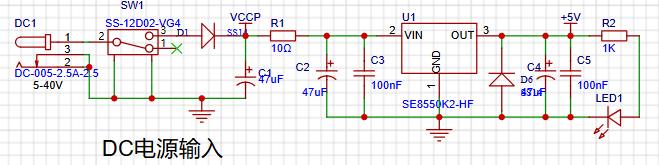
1. Hardware Section 1.1 The power supply circuit
adds D5, a parallel reverse diode, to prevent short circuits in the subsequent stages from damaging the SE8550K2.
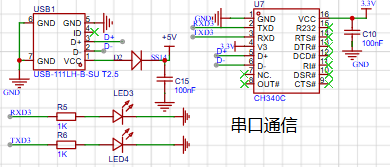
1.2 Serial Communication
An onboard CH340 chip is added for serial communication.
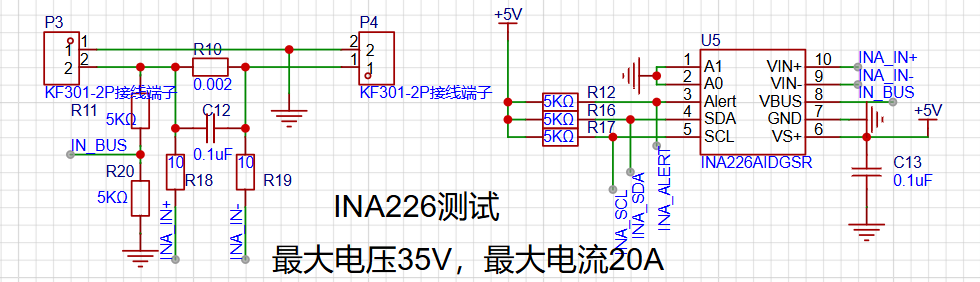
1.3 INA226 Test Circuit
2. MCU Selection
   The project uses the LCSC CW32F030C8Tx development board (core board) as the main controller. The selection of the controller is crucial, as it relates to the overall project performance.
   Regarding the voltage and current meters, the author conducted some debugging and testing using STM32/CW32 and some other 32-bit microcontrollers. Here, only a comparison with the STM32F103C8T6 is made as a reference for learning device selection, mainly to provide ideas and improve understanding.
Avoid Blind Selection When selecting the MCU (microcontroller unit) for this project, multiple aspects need to be considered to ensure that the selected MCU meets the project requirements.

Clearly define your project requirements: Clearly understand how much computing power the project needs, including clock speed, processor core type, and whether a floating-point unit is required.
Clearly define the required I/O ports and important peripherals for the project, such as the ADC peripheral. Since this is a development board project, the main purpose is debugging and learning; therefore, there are no strict limitations on the number of I/O ports, i.e., cost issues are not considered.

The key advantages of CW32 in this project include

: wide operating temperature range (-40~105℃)
, wide operating voltage range (1.65V~5.5V, STM32 only supports 3.3V systems)
, strong anti-interference capability (HBM ESD 8KV), and ESD reliability reaching the highest international standard level (STM32 ESD 2KV).
The focus of this project is a better ADC: a 12-bit high-speed ADC achieving ±1.0LSB INL 11.3ENOB, multiple Vref reference voltages... (STM32 only supports VDD=Vref), and
stable and reliable eFLASH technology.

A detailed explanation of these advantages will be provided in the chapters on ADC sampling and related extensions.
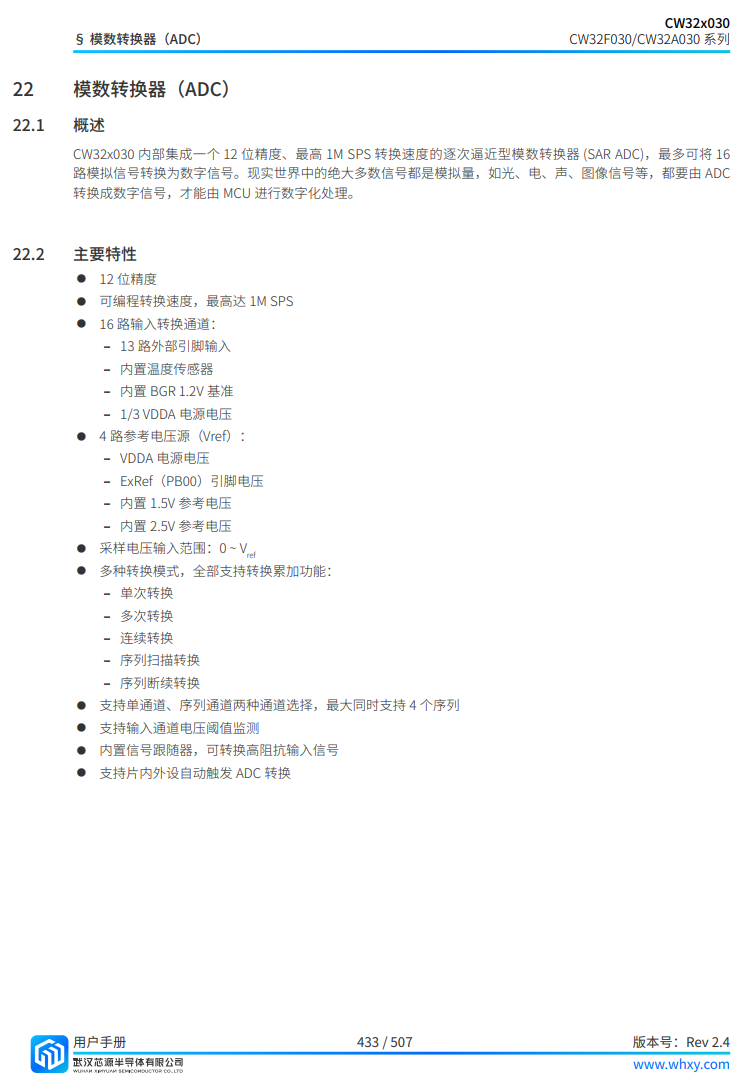
The main characteristics of the CW32 ADC need to be focused on in this project. The content is from the "CW32x030 User Manual".
3. Difficulties encountered and solutions during debugging:
1. Poor soldering skills + inadequate soldering tools resulted in the soldering of some important and usable components.
2. The LDO overheated upon power-up, and the power indicator light did not illuminate. Initially, it was thought to be a short circuit, and even a resoldering of the LDO was performed before it was discovered that the parallel reverse diode of the LDO was soldered backwards.
3. During ADC sampling, the sampled value is full value, and adjusting the potentiometer has no effect. A multimeter shows the voltage at the ADC sampling point is consistently 4.1V, but the voltage input from the potentiometer is lower than 4.1V. Inspection revealed that the voltage is clamped.
 
4. Demonstration video:
https://www.bilibili.com/video/BV1DcH1exEar/?spm_id_from=333.999.0.0&vd_source=e431ef29bac3cec707d741e5705ef7a2
 
 
参考设计图片
×
 
 
Search Datasheet?

Supported by EEWorld Datasheet

Forum More
Update:2026-03-28 17:20:37

EEWorld
subscription
account

EEWorld
service
account

Automotive
development
community

Robot
development
community

About Us Customer Service Contact Information Datasheet Sitemap LatestNews



Room 1530, 15th Floor, Building B, No.18 Zhongguancun Street, Haidian District, Beijing, Postal Code: 100190 China Telephone: 008610 8235 0740

Copyright © 2005-2024 EEWORLD.com.cn, Inc. All rights reserved 京ICP证060456号 京ICP备10001474号-1 电信业务审批[2006]字第258号函 京公网安备 11010802033920号