
Telephone remote control circuit
Source: InternetPublisher:54tGgY Keywords: Remote control circuit remote control Updated: 2026/01/06
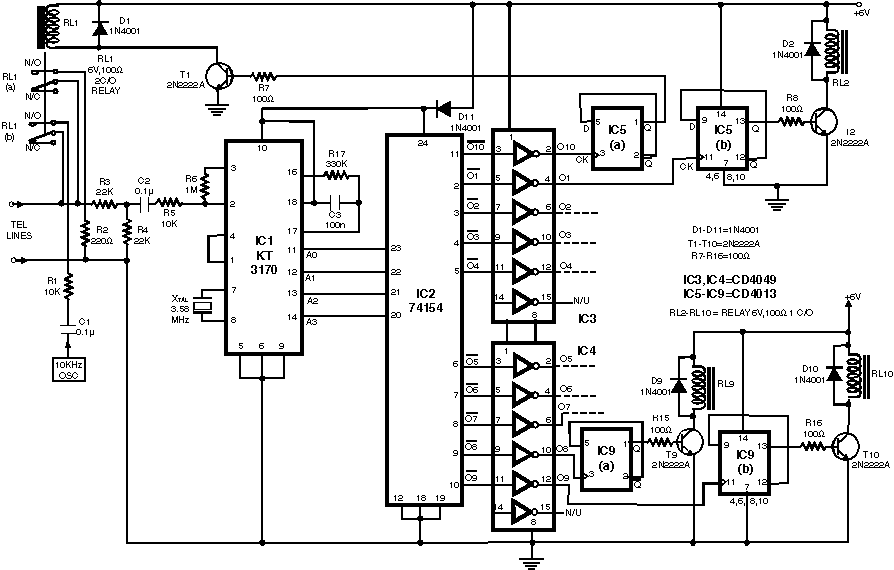
Remote control using a telephone
This is a telephone remote control circuit that allows you to switch appliances on and off via a telephone line. It can be used to switch appliances on and off from any distance, overcoming the range limitations of infrared and radio remote control.
The circuit described here can be used to switch up to nine electrical appliances (corresponding to numbers 1 to 9 on a telephone keypad). DTMF signals on the telephone are used as control signals. In DTMF mode, the number "0" is used to switch between appliance mode and normal telephone operation mode. Therefore, the telephone can be used for both normal calls and switching electrical appliances on and off simultaneously.
This circuit uses IC KT3170 (DTMF to BCD converter), 74154 (4 to 16 line demultiplexer), and five CD4013 (D flip-flop) ICs. The circuit operates as follows.
Once the call is established (after hearing the ringback tone), dial "0" in DTMF mode. IC1 decodes this as "1010," which is then further demultiplexed by IC2 to output O10 (on pin 11) of IC2 (74154). The effective low output of IC2, after being inverted by the inverter gate of IC3 (CD4049), becomes logic 1. This is used to toggle flip-flop -1 (F/F-1), and relay RL1 is energized. Relay RL1 has two toggle contacts, RL1(a) and RL1(b). The energized RL1(a) contact provides a 220-ohm loop on the telephone line, while the RL1(b) contact injects a 10kHz tone into the line, indicating to the caller that the electrical mode has been selected. The 220-ohm loop on the telephone line disconnects the ringer from the telephone line at the exchange. The line is now connected to electrical operating mode.
If the number "0" (in DTMF) is not dialed after a call is established, the ringing continues, and the phone can be used for normal conversation. After selecting the appliance operating mode, if the number "1" is dialed, it is decoded by IC1, whose output is "0001". This BCD code is then demultiplexed by the 4-to-16 line demultiplexer IC2, and its corresponding output is inverted by the CD4049 inverter gate, becoming a logic 1 state. This pulse toggles the corresponding trigger to an alternating state. The trigger output is used to drive a relay (RL2), which can switch connected appliances through its contacts. Other appliances can also be "on" or "off" by dialing other numbers in a similar manner.
Once the switching operation is complete, the 220-ohm loop resistor and the 10kHz tone need to be removed from the telephone line. To do this, dial "0" again (in DTMF mode) to toggle trigger -1, de-energizing relay RL1 and terminating the loop on the line, thus disconnecting the 10kHz tone. The telephone line is then freed to receive normal calls. This circuit needs to be connected in parallel with the telephone.
- A remote-controlled electronic firecracker
- Production of radio-controlled and light-controlled golden rooster
- Factory Driving Remote Control Production
- Dual motor wireless remote control circuit production
- Infrared detection switch circuit
- Production of wireless proportional remote control circuit
- Receiving circuit composed of SJ04E
- Microwave automatic lamp I
- Application circuit of CSJ-R05A and microcontroller
- The internal circuit of TDA7000 and its basic receiving circuit
- Simple and practical remote control detector circuit diagram
- Mobile phone production of remote home appliance remote control circuit diagram
- Household advance working remote control circuit-receiving circuit
- Household appliances remote control circuit
- Remote control circuit a composed of RX5019 and RX5020
- Proximity switch remote control circuit
- desk lamp remote control circuit
- Telephone DTMF remote control circuit diagram
- Game console controller remote control circuit
- Practical DTMF encoding and decoding wireless remote control circuit







 京公网安备 11010802033920号