
Electromagnetic compatibility requirements for industrial drives
Source: InternetPublisher:newlandmark Keywords: Industrial drives EMC Updated: 2025/06/27
Variable speed and industrial drive design engineers need to understand electromagnetic compatibility (EMC) immunity and electromagnetic interference (EMI) and isolation safety requirements. Do you know your requirements? Each end equipment design must meet its own standards to ensure that the product is compliant and safe for use in the desired end equipment category and environment.
The corresponding terminal equipment standards for variable speed drive systems published by the International Electrotechnical Commission (IEC) are IEC 61800-3 for EMC and EMI and IEC 61800-5-1 for system safety requirements including isolation. The EMC and EMI requirements specified in the IEC 61800-3 standard depend on the category to which the variable speed drive belongs. The categories range from C1 to C4 and specify the maximum rated voltage of the variable speed drive and the environment in which it can be installed and used. The maximum rated voltage of the drive can be less than 1000V or greater than 1000V. There are two environments:
The first environment refers to the use of variable speed drives powered by the public mains in domestic locations such as residences or office buildings. The second environment specifies requirements for use in industrial areas powered by dedicated transformers providing three-phase voltages such as 480V, 560V or 690VAC. In this blog post, I will focus on categories 2 and 3 and direct you to the corresponding training video series.
Category C2 drivers are rated less than 1000V and are used in the first environment, but cannot be inserted or moved and must be installed by a professional. Category 3 drivers are also rated less than 1000V but are limited to use in the second environment.
Semiconductors have their own specific EMC and isolation standards at the component level. Some examples are shown in Table 1.
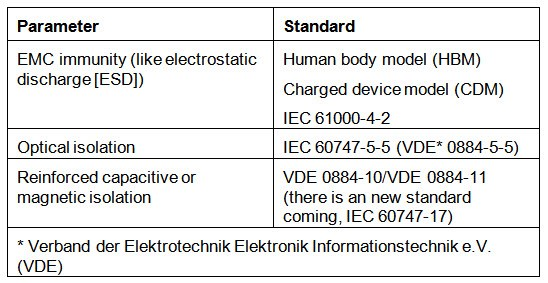
Table 1: Component-level semiconductor standards
How do EMC immunity, EMI, and isolation requirements apply to industrial drives? What does testing look like? Figure 1 shows a simplified architecture of an industrial drive divided into various subsystems with interfaces and connectors accessible outside the cabinet. EMC immunity test signals such as surge, electrical fast transient (EFT), or ESD are applied to the interface connectors of each subsystem. Typical subsystems with accessible interfaces or connectors include communications, user input and output (I/O) interfaces, position feedback interfaces, power interfaces, and AC power input.
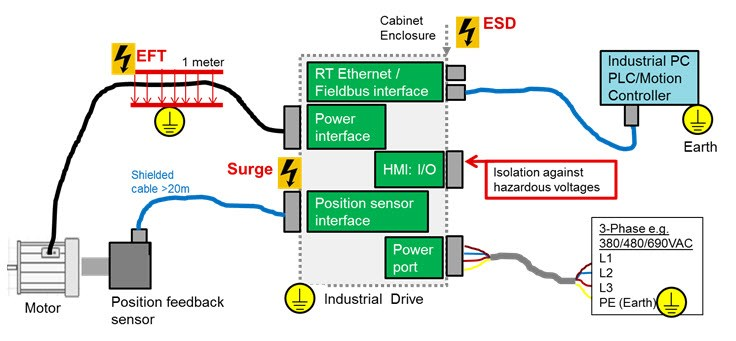
Figure 1: Example EMC immunity test signal in an industrial drive
Each interface or port must pass the corresponding EMC immunity requirements as well as EMI and isolation requirements. In particular, semiconductor interface ICs such as Ethernet PHY, RS-485 transceivers, or isolated gate drivers have a significant impact on passing system-level standards. Therefore, EMC immunity, EMI, or isolation performance at the semiconductor component level, as shown in Table 1, becomes a key selection criterion.
To learn more about EMC, EMI, and isolation standards requirements for industrial drives, and how to design and test hardware to comply with the standards, watch Part 1 of this training video series.
EMC Immunity
Let’s look at the EMC immunity requirements and test methods. IEC 61800-3 specifies EMC immunity requirements such as voltage levels and pass criteria, and references the IEC 61000-4-x standards, which describe test methods and test setups for ESD, EFT, and surge. The EMC immunity requirements for the second environment are higher, while the EMC immunity requirements for the first environment are lower. Therefore, we focus on the second environment. Figure 2 shows an excerpt of the EMC immunity requirements of IEC 61800-3 for the second environment.
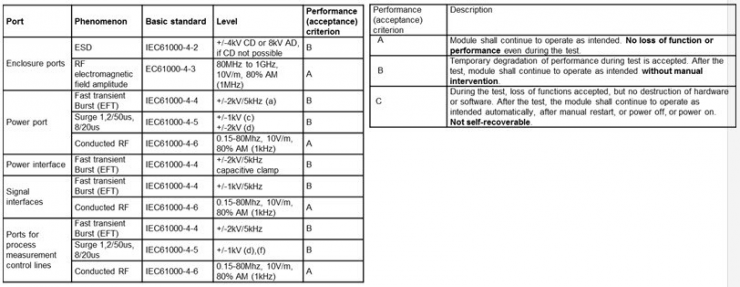
Table 2: IEC 61800-3 EMC immunity requirements for the second environment
Each port is required to pass specific overvoltage events such as fast transient bursts (EFT) at +/- 2kV voltage levels as specified in standards such as IEC 61000-4-4.
How do we verify that the drive has passed the test? Therefore, the performance acceptance criteria shown in Table 2 is a very important factor in verifying the relevant EMC testing of the end equipment.
Criterion A states that the performance of the drive must not be affected during or after EMC testing.
Criterion B states that temporary performance degradation is acceptable only during the EMC test. After the EMC test, the drive must operate at full performance without any human intervention.
Criterion C specifies that a temporary loss of functionality or performance during testing is acceptable and allows manual intervention, such as a power cycle or hardware reset, to restore normal operation and full performance.
Unlike most semiconductors, which are usually verified according to standard C, end equipment must meet at least standard B or A, where A stipulates that the system must maintain specified performance even during EMC events. For many suppliers, immunity to fast transient bursts (EFT) according to IEC61000-4-4 is the most important EMC immunity test to prove the robustness of industrial drives. This is because impulse noise coupled to cables or printed circuit boards through the inverter PWM switching voltage has a similar impact on drive performance as fast transient bursts (EFT).
How do you design an EMC-compliant subsystem? TI industrial drive reference designs are designed to meet the EMC immunity requirements of industrial drives. For example, the Universal Digital Interface for Absolute Position Encoders reference design implements an EMC-compliant RS-485 interface for four-wire and two-wire encoders. The reference design passes twice the required test voltage, exceeding the requirements of IEC 61800-3.
To learn more about EMC immunity requirements, test setup, and how to design IEC EMC-compliant industrial hardware based on the position encoder reference design, watch Part 2 and Part 3 of the training video series.
Electromagnetic Interference
IEC 618000-3 also specifies emission requirements for variable speed drives and refers to the standard CISPR 11 Class A and the equivalent European standard EN 55011 Class A for specific test setups. CISPR is the abbreviation of Comité International Spécial des Perturbations Radioélectriques. Radiated emissions are measured in the frequency band from 30MHz to 1GHz. For industrial equipment that belongs to Class 2 or 3 according to IEC61000-3, the limits for the quasi-peak value of the electric field strength component are in decibels (microvolts per meter) as shown in Table 3.

Table 3: Electromagnetic radiation interference limits for the frequency band from 30MHz to 1000MHz (see IEC 61800-3, Table 15)
The EMI/EMC Compliant Industrial Temperature Dual-Port Gigabit Ethernet PHY Reference Design is a good example of a design that passes the IEC 61800-3 EMC immunity requirements and exceeds the EN 55011/CISPR 11 Class A radiated requirements by 4.3dB.
- LED taillights/brake lights
- Automotive voltage indicator
- Fun and interesting electronic number selector
- Industrial interface circuit using a standard isolator
- How to improve SiC traction inverter efficiency with real-time variable gate drive strength
- DIY a practical audio-visual doorbell
- Telephone cipher circuit
- Differential voltage or differential current alarm
- RF leak detector circuit diagram
- 220V AC mains directly drives small relay circuit_3
- PCB skill analysis, do you know?
- Do you know EMC/EMI simulation during PCB design process?
- Why is EMC rectification difficult? Do you understand?
- How much do you know about the working principle of common mode inductors?
- Some knowledge about electromagnetic compatibility laboratory in engineering design
- Some important knowledge about electromagnetic compatibility shielding design
- Some small details you have to pay attention to in EMC analysis and design
- Do you understand the management and control of EMI and EMC?
- Do you know some methods to eliminate ground loop interference?







 京公网安备 11010802033920号