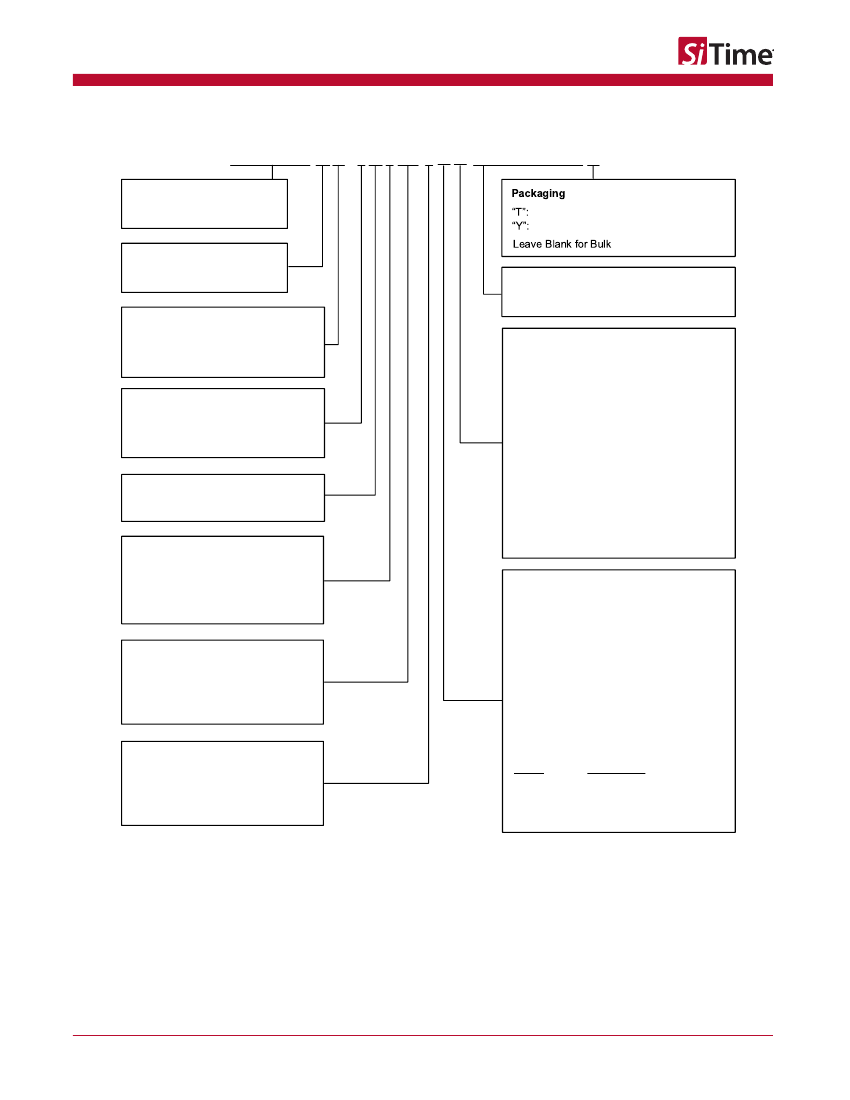
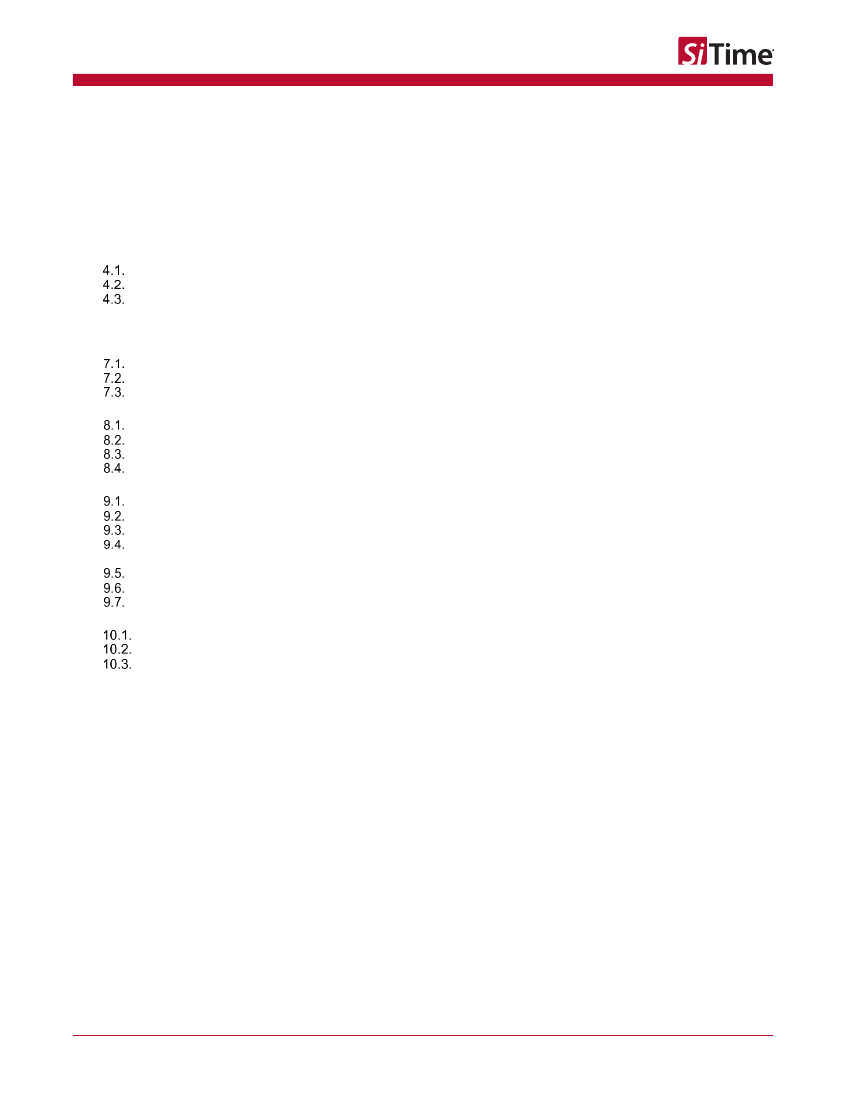
Ordering Information .................................................................................................................................................................... 2
User Programming Interface ..................................................................................................................................... 18
Start-up output frequency and signaling types ........................................................................................................... 18
Any-frequency function ............................................................................................................................................. 19
C/SPI Control Registers...................................................................................................................................................... 28
9 I
Register Address: 0x00. DCO Frequency Control Least Significant Word (LSW) .................................................... 28
Register Address: 0x01. OE Control, DCO Frequency Control Most Significant Word (MSW) ................................. 29
Register Address: 0x02. DCO PULL RANGE CONTROL ........................................................................................ 29
Register Address: 0x03. Frac-N PLL Feedback Divider Integer Value and Frac-N PLL Feedback Divider Fraction
Value MSW ............................................................................................................................................................... 30
Register Address: 0x05. Forward Divider, Driver Control ......................................................................................... 30
Register Address: 0x06. Driver Divider, Driver Control ............................................................................................. 31
2
C Operation ........................................................................................................................................................................ 32
10 I
I
2
C protocol ............................................................................................................................................................... 32
I
2
C Timing Specification ............................................................................................................................................ 35
I
2
C Device Address Modes ....................................................................................................................................... 36
Dimensions and Patterns ........................................................................................................................................................... 43
Additional Information ................................................................................................................................................................ 44
Revision History ......................................................................................................................................................................... 45
Rev 1.01
Page 3 of 45
www.sitime.com
SiT3521
1 to 340 MHz Elite Platform I2C/SPI Programmable Oscillator
1 Electrical Characteristics
All Min and Max limits in the Electrical Characteristics tables are specified over temperature and rated operating voltage with
standard output terminations shown in the termination diagrams. Typical values are at 25°C and nominal supply voltage.
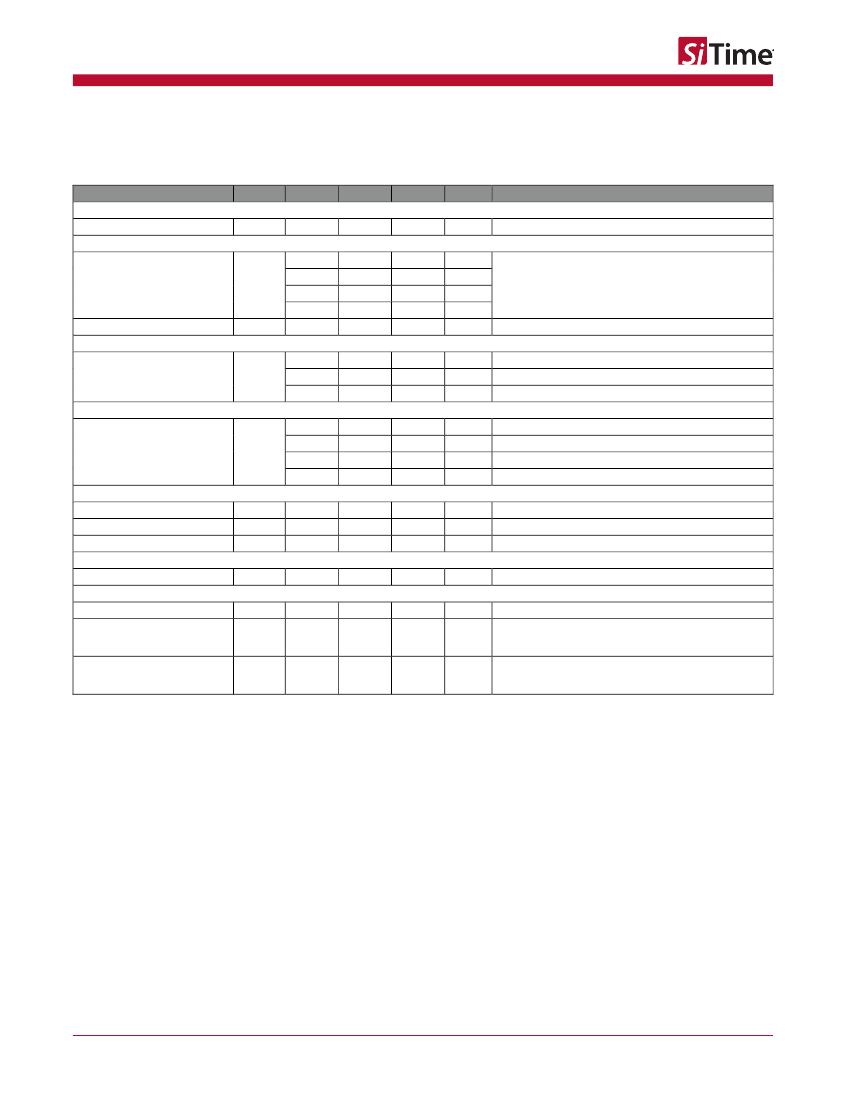
Table 1. Electrical Characteristics – Common to LVPECL, LVDS and HCSL
Parameter
Output Frequency Range
Symbol
f
Min.
1
Typ.
–
–
–
–
–
±1
–
–
–
Max.
340
Unit
MHz
Condition
Factory or user programmable, accurate to 6 decimal places
Frequency Range
Frequency Stability
Frequency Stability
F_stab
-10
-20
-25
-50
First Year Aging
F_1y
–
+10
+20
+25
+50
–
ppm
ppm
ppm
ppm
ppm
°C
°C
°C
1
st
-year aging at 25°C
Inclusive of initial tolerance, operating temperature, rated
power supply voltage and load variations.
Temperature Range
Operating Temperature Range
T_use
-20
-40
-40
+70
+85
+105
Supply Voltage
Supply Voltage
Vdd
2.97
2.7
2.52
2.25
3.3
3.0
2.8
2.5
–
–
100
–
–
–
3.63
3.3
3.08
2.75
–
30%
–
V
V
V
V
Extended Commercial
Industrial
Extended Industrial. Available only for I
2
C operation, not SPI.
Input Characteristics – OE Pin
Input Voltage High
Input Voltage Low
Input Pull-up Impedance
VIH
VIL
Z_in
70%
–
–
Vdd
Vdd
kΩ
OE pin
OE pin
OE pin, logic high or logic low
Output Characteristics
Duty Cycle
DC
45
–
–
55
%
Startup and Output Enable/Disable Timing
Start-up Time
Output Enable/Disable Time –
Hardware control via OE pin
Output Enable/Disable Time –
Software control via I
2
C/SPI
T_start
T_oe_hw
3.0
3.8
ms
µs
Measured from the time Vdd reaches its rated minimum value
Measured from the time OE pin reaches rated VIH and VIL to
the time clock pins reach 90% of swing and high-Z.
See
Figure 9
and
Figure 10
Measured from the time the last byte of command is
transmitted via I
2
C/SPI (reg1) to the time clock pins reach 90%
of swing and high-Z. See
Figure 30
and
Figure 31
T_oe_sw
–
–
6.5
µs
Rev 1.01
Page 4 of 45
www.sitime.com
SiT3521
1 to 340 MHz Elite Platform I2C/SPI Programmable Oscillator
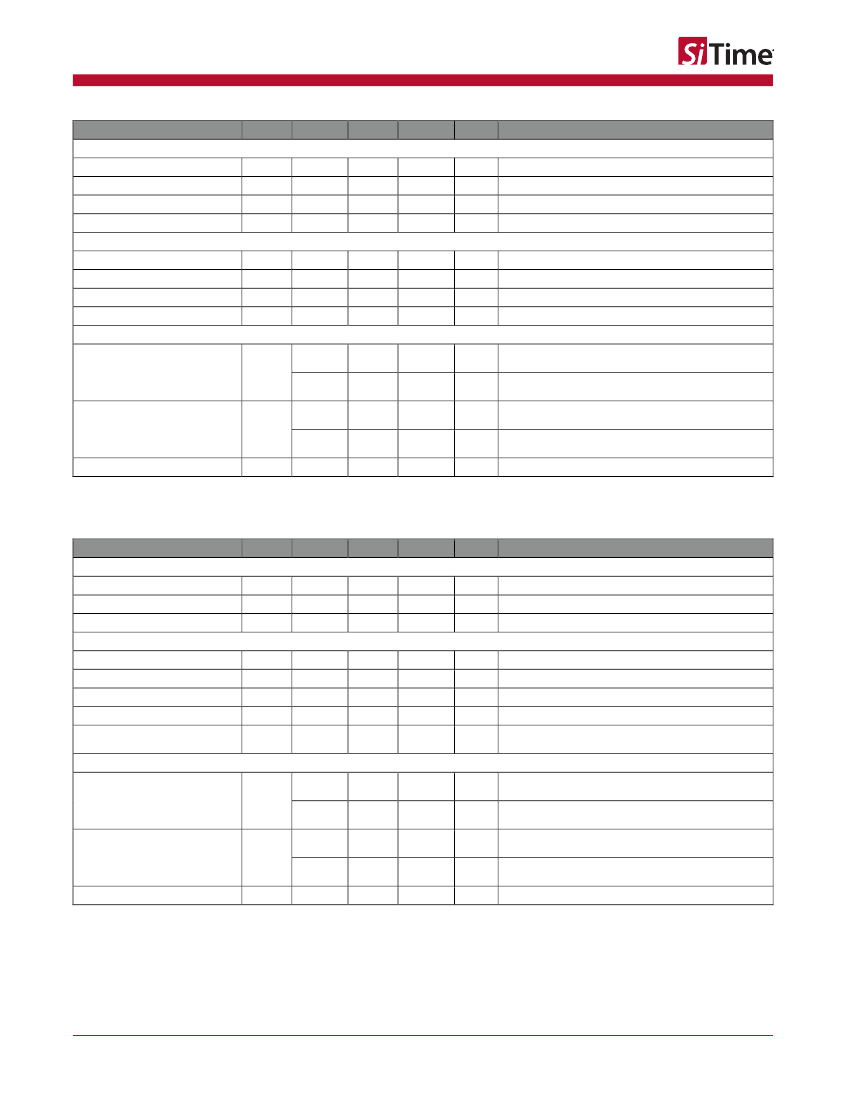
Table 2. Electrical Characteristics – LVPECL Specific
Parameter
Symbol
Min.
Typ.
Max.
Unit
Condition
Current Consumption
Current Consumption
OE Disable Supply Current
Output Disable Leakage Current
Maximum Output Current
Idd
I_OE
I_leak
I_driver
–
–
–
–
–
–
0.15
–
89
58
–
32
mA
mA
A
mA
Excluding Load Termination Current, Vdd = 3.3 V or 2.5 V
OE = Low
OE = Low
Maximum average current drawn from OUT+ or OUT-
Output Characteristics
Output High Voltage
Output Low Voltage
Output Differential Voltage Swing
Rise/Fall Time
VOH
VOL
V_Swing
Tr, Tf
Vdd - 1.1V
Vdd - 1.9V
1.2
–
–
–
1.6
225
Vdd - 0.7V
Vdd - 1.5V
2.0
290
Jitter
RMS Phase Jitter (random) –
DCO Mode Only
T_phj
–
–
RMS Phase Jitter (random) –
Any-frequency Mode Only
T_phj
–
–
RMS Period Jitter
[3]
Note:
3. Measured according to JESD65B.
T_jitt
–
0.225
0.1
0.225
0.11
1
0.340
0.14
0.340
0.15
1.6
ps
ps
ps
ps
ps
f = 156.25 MHz, Integration bandwidth = 12 kHz to 20 MHz,
all Vdd levels
f = 156.25, IEEE802.3-2005 10 GbE jitter mask integration
bandwidth = 1.875 MHz to 20 MHz, all Vdd levels
f = 156.25 MHz, Integration bandwidth = 12 kHz to 20 MHz,
all Vdd levels
f = 156.25, IEEE802.3-2005 10 GbE jitter mask integration
bandwidth = 1.875 MHz to 20 MHz, all Vdd levels
f = 100, 156.25 or 212.5 MHz, Vdd = 3.3 V or 2.5 V
V
V
V
ps
See
Figure 5
See
Figure 5
See
Figure 6
20% to 80%, see
Figure 6
Table 3. Electrical Characteristics – LVDS Specific
Parameter
Symbol
Min.
Typ.
Max.
Unit
Condition
Current Consumption
Current Consumption
OE Disable Supply Current
Output Disable Leakage Current
Idd
I_OE
I_leak
–
–
–
–
–
0.15
80
61
–
mA
mA
A
Excluding Load Termination Current, Vdd = 3.3 V or 2.5 V
OE = Low
OE = Low
Output Characteristics
Differential Output Voltage
Delta VOD
Offset Voltage
Delta VOS
Rise/Fall Time
VOD
ΔVOD
VOS
ΔVOS
Tr, Tf
250
–
1.125
–
–
–
–
–
–
400
455
50
1.375
50
470
Jitter
RMS Phase Jitter (random) –
DCO Mode Only
T_phj
–
–
RMS Phase Jitter (random) –
Any-frequency Mode Only
T_phj
–
–
RMS Period Jitter
[4]
Note:
4. Measured according to JESD65B.
T_jitt
–
0.21
0.1
0.21
0.1
1
0.275
0.12
0.367
0.12
1.6
ps
ps
ps
ps
ps
f = 156.25 MHz, Integration bandwidth = 12 kHz to 20 MHz,
all Vdd levels
f = 156.25, IEEE802.3-2005 10 GbE jitter mask integration
bandwidth = 1.875 MHz to 20 MHz, all Vdd levels
f = 156.25 MHz, Integration bandwidth = 12 kHz to 20 MHz,
all Vdd levels
f = 156.25, IEEE802.3-2005 10 GbE jitter mask integration
bandwidth = 1.875 MHz to 20 MHz, all Vdd levels
f = 100, 156.25 or 212.5 MHz, Vdd = 3.3 V or 2.5 V
mV
mV
V
mV
ps
f = 156.25MHz See
Figure 7
See
Figure 7
See
Figure 7
See
Figure 7
Measured with 2 pF capacitive loading to GND, 20% to 80%,
This is a simple taskwhile(1) { _tv.tv_sec = 0; _tv.tv_usec = time; /* If using 10000 us, then the system hang will not occur. */res = select(0, NULL, NULL, NULL, _tv); if (res0errno != EINTRerrno != ...
Today I saw a blog post that says: Assuming the system clock is 72Mhz, TIM1 is derived from PCLK2 (72MHz), and TIM2-7 is derived from PCLK1. The key is to set the clock pre-division number and the val...
There is no serial port protocol between the upper and lower computers. When one side is ready to receive, the other side can send. Now the question is how can the receiver know that the data stream h...
When running naked, I debugged with ADS and this problem occurred after running for a few minutes. The time is not fixed, sometimes a few minutes, sometimes more than ten minutes. But if it is burned ...
Why choose CY7C68013 as USB2.0 chip: 1. High cost performance, the largest market share in the world among general USB2.0 interface chips, and the largest foreign market share. 2. Maximum 4K USB endpo...
Dear experts, please help me find the error. This is a single-chip computer program of mine. It is a clock. It uses ATMEL89C51 single-chip computer and is displayed on the digital tube 7SEG-MPX8-CC-BL...
1. Design Overview
1. Design Intent
The rapid development of medical imaging technology continues to promote the progress of modern medicine. CT, MRI, and PET are widely ...[Details]
1. Introduction
At present, with the continuous development of modern medical devices, especially electronic instruments directly connected to the human body, in addition to the increasingly high...[Details]
With the development of the automobile industry, the complexity and information density of automobile information systems are increasing. Displays are no longer just basic centralized instrument di...[Details]
0 Introduction to the direct method of feedback linearization based on dynamic equilibrium state theory
The basic idea of the direct method of feedback linearization based on dynamic equilib...[Details]
AD8302
Introduction
AD8302 is a monolithic integrated circuit for RF/IF amplitude and phase measurement from ADI. It is mainly composed of two precisely matched broadband logarithmic det...[Details]
Compared with traditional light sources, light-emitting diodes (LEDs) have many advantages, such as low operating voltage, high energy efficiency, small size and directional light. They can provide...[Details]
DC regulated power supply is a commonly used electronic device, which can ensure stable output voltage when the grid voltage fluctuates or the load changes. A low ripple, high-precision regulated p...[Details]
In order to ensure the reliability of the driving assistance system and the basic functions of the car, and also to leave suitable connection interfaces for the car's future new entertainment and ...[Details]
In a Class D audio power amplifier, the preamplifier is a relatively important module. It is located at the front of the entire topology and completes the processing of the input signal source,...[Details]
MIPS Technologies Inc. has introduced the CI10084tg, a next-generation global positioning system (GPS) RF tuner IP solution. The silicon-proven, integrated low-noise RF front end for GPS receivers...[Details]
Introduction
High voltage power supply is an indispensable part of nuclear radiation detection instrument, which supplies high voltage to nuclear radiation detection devices (such as prop...[Details]
0 Introduction
Implantable medical devices can be divided into two types: passive and active. Most passive implantable medical devices are non-electronic products, such as contact lenses, hear...[Details]
1.
Introduction
With the rapid development of modern computer technology and Internet technology, embedded systems have begun to occupy the mainstream of the market. Due to the high ...[Details]
Introduction
DFT (Discrete Fourier Transformation) is an important transformation tool for digital signal analysis and processing such as graphics, speech and images.
The amount of calcula...[Details]
1 Introduction
Many test systems require real-time data acquisition while continuously moving. If the test process is discontinuous, or the test position is in front and the acquisition is...[Details]

 Real-time operating system RTOS
 京公网安备 11010802033920号
 EEWORLD