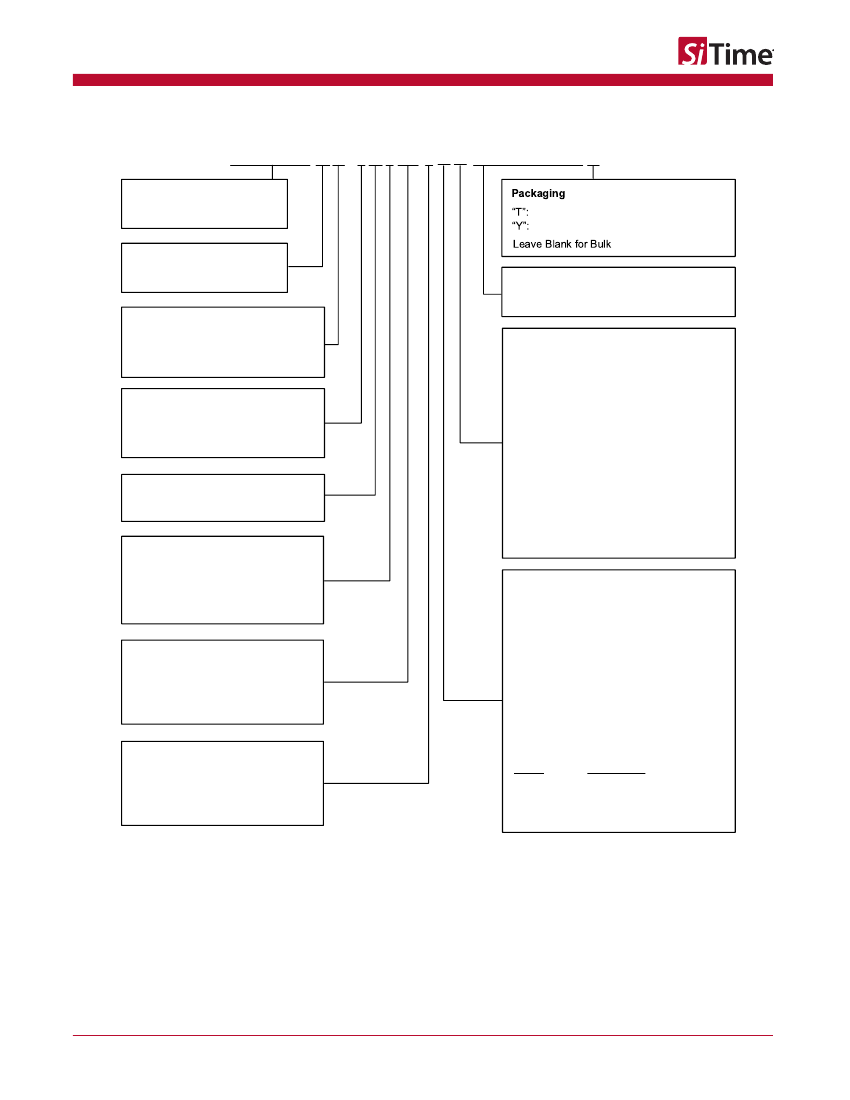
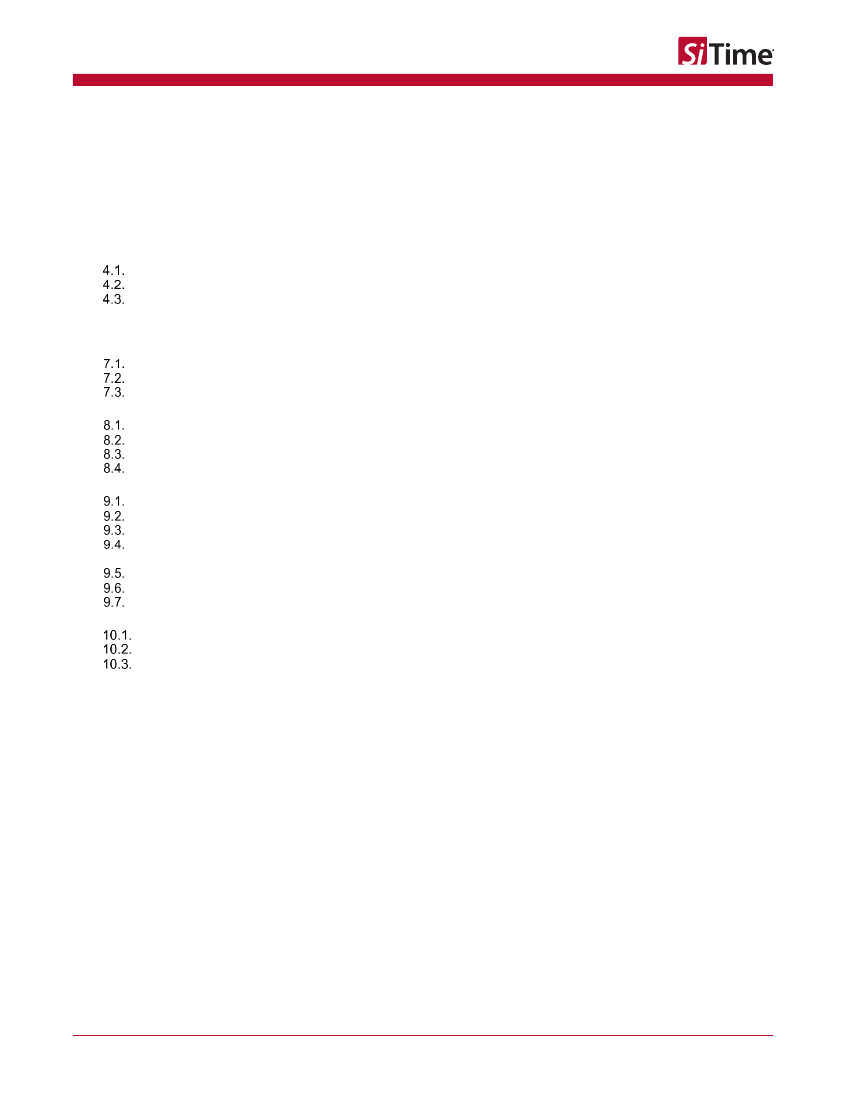
Ordering Information .................................................................................................................................................................... 2
User Programming Interface ..................................................................................................................................... 18
Start-up output frequency and signaling types ........................................................................................................... 18
Any-frequency function ............................................................................................................................................. 19
C/SPI Control Registers...................................................................................................................................................... 28
9 I
Register Address: 0x00. DCO Frequency Control Least Significant Word (LSW) .................................................... 28
Register Address: 0x01. OE Control, DCO Frequency Control Most Significant Word (MSW) ................................. 29
Register Address: 0x02. DCO PULL RANGE CONTROL ........................................................................................ 29
Register Address: 0x03. Frac-N PLL Feedback Divider Integer Value and Frac-N PLL Feedback Divider Fraction
Value MSW ............................................................................................................................................................... 30
Register Address: 0x05. Forward Divider, Driver Control ......................................................................................... 30
Register Address: 0x06. Driver Divider, Driver Control ............................................................................................. 31
2
C Operation ........................................................................................................................................................................ 32
10 I
I
2
C protocol ............................................................................................................................................................... 32
I
2
C Timing Specification ............................................................................................................................................ 35
I
2
C Device Address Modes ....................................................................................................................................... 36
Dimensions and Patterns ........................................................................................................................................................... 43
Additional Information ................................................................................................................................................................ 44
Revision History ......................................................................................................................................................................... 45
Rev 1.01
Page 3 of 45
www.sitime.com
SiT3521
1 to 340 MHz Elite Platform I2C/SPI Programmable Oscillator
1 Electrical Characteristics
All Min and Max limits in the Electrical Characteristics tables are specified over temperature and rated operating voltage with
standard output terminations shown in the termination diagrams. Typical values are at 25°C and nominal supply voltage.
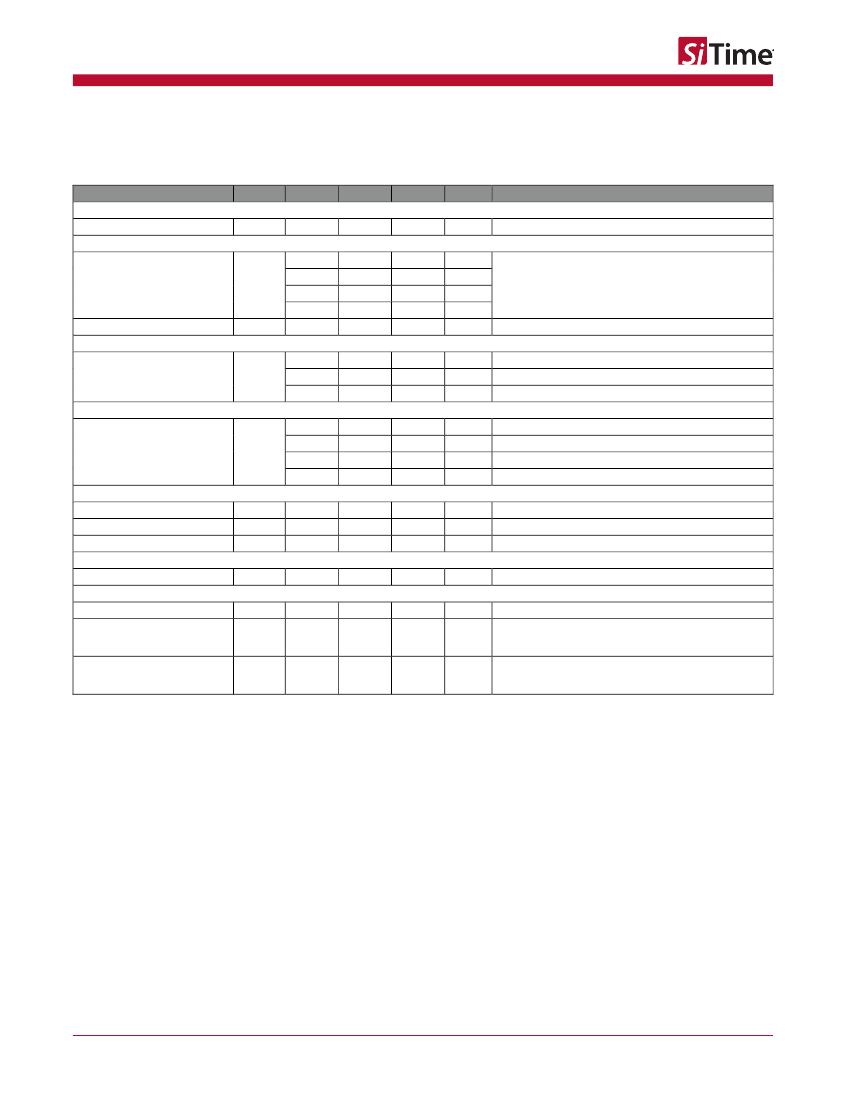
Table 1. Electrical Characteristics – Common to LVPECL, LVDS and HCSL
Parameter
Output Frequency Range
Symbol
f
Min.
1
Typ.
–
–
–
–
–
±1
–
–
–
Max.
340
Unit
MHz
Condition
Factory or user programmable, accurate to 6 decimal places
Frequency Range
Frequency Stability
Frequency Stability
F_stab
-10
-20
-25
-50
First Year Aging
F_1y
–
+10
+20
+25
+50
–
ppm
ppm
ppm
ppm
ppm
°C
°C
°C
1
st
-year aging at 25°C
Inclusive of initial tolerance, operating temperature, rated
power supply voltage and load variations.
Temperature Range
Operating Temperature Range
T_use
-20
-40
-40
+70
+85
+105
Supply Voltage
Supply Voltage
Vdd
2.97
2.7
2.52
2.25
3.3
3.0
2.8
2.5
–
–
100
–
–
–
3.63
3.3
3.08
2.75
–
30%
–
V
V
V
V
Extended Commercial
Industrial
Extended Industrial. Available only for I
2
C operation, not SPI.
Input Characteristics – OE Pin
Input Voltage High
Input Voltage Low
Input Pull-up Impedance
VIH
VIL
Z_in
70%
–
–
Vdd
Vdd
kΩ
OE pin
OE pin
OE pin, logic high or logic low
Output Characteristics
Duty Cycle
DC
45
–
–
55
%
Startup and Output Enable/Disable Timing
Start-up Time
Output Enable/Disable Time –
Hardware control via OE pin
Output Enable/Disable Time –
Software control via I
2
C/SPI
T_start
T_oe_hw
3.0
3.8
ms
µs
Measured from the time Vdd reaches its rated minimum value
Measured from the time OE pin reaches rated VIH and VIL to
the time clock pins reach 90% of swing and high-Z.
See
Figure 9
and
Figure 10
Measured from the time the last byte of command is
transmitted via I
2
C/SPI (reg1) to the time clock pins reach 90%
of swing and high-Z. See
Figure 30
and
Figure 31
T_oe_sw
–
–
6.5
µs
Rev 1.01
Page 4 of 45
www.sitime.com
SiT3521
1 to 340 MHz Elite Platform I2C/SPI Programmable Oscillator
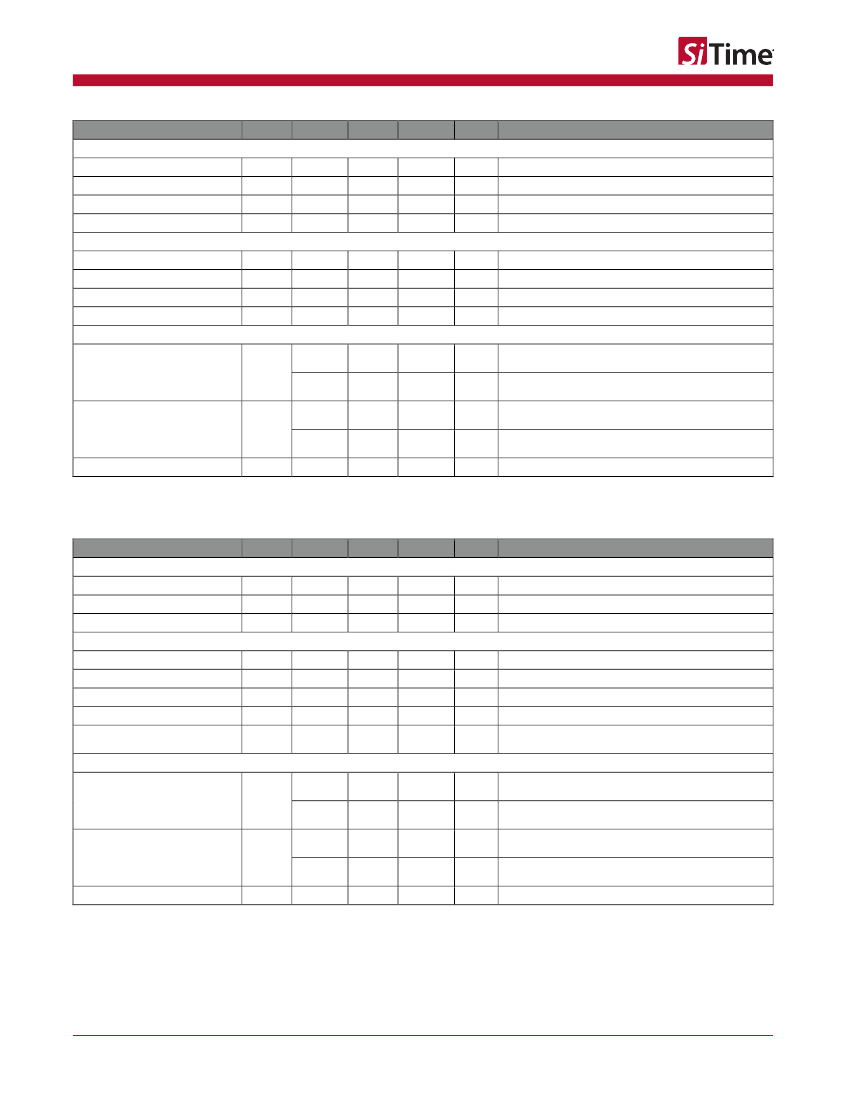
Table 2. Electrical Characteristics – LVPECL Specific
Parameter
Symbol
Min.
Typ.
Max.
Unit
Condition
Current Consumption
Current Consumption
OE Disable Supply Current
Output Disable Leakage Current
Maximum Output Current
Idd
I_OE
I_leak
I_driver
–
–
–
–
–
–
0.15
–
89
58
–
32
mA
mA
A
mA
Excluding Load Termination Current, Vdd = 3.3 V or 2.5 V
OE = Low
OE = Low
Maximum average current drawn from OUT+ or OUT-
Output Characteristics
Output High Voltage
Output Low Voltage
Output Differential Voltage Swing
Rise/Fall Time
VOH
VOL
V_Swing
Tr, Tf
Vdd - 1.1V
Vdd - 1.9V
1.2
–
–
–
1.6
225
Vdd - 0.7V
Vdd - 1.5V
2.0
290
Jitter
RMS Phase Jitter (random) –
DCO Mode Only
T_phj
–
–
RMS Phase Jitter (random) –
Any-frequency Mode Only
T_phj
–
–
RMS Period Jitter
[3]
Note:
3. Measured according to JESD65B.
T_jitt
–
0.225
0.1
0.225
0.11
1
0.340
0.14
0.340
0.15
1.6
ps
ps
ps
ps
ps
f = 156.25 MHz, Integration bandwidth = 12 kHz to 20 MHz,
all Vdd levels
f = 156.25, IEEE802.3-2005 10 GbE jitter mask integration
bandwidth = 1.875 MHz to 20 MHz, all Vdd levels
f = 156.25 MHz, Integration bandwidth = 12 kHz to 20 MHz,
all Vdd levels
f = 156.25, IEEE802.3-2005 10 GbE jitter mask integration
bandwidth = 1.875 MHz to 20 MHz, all Vdd levels
f = 100, 156.25 or 212.5 MHz, Vdd = 3.3 V or 2.5 V
V
V
V
ps
See
Figure 5
See
Figure 5
See
Figure 6
20% to 80%, see
Figure 6
Table 3. Electrical Characteristics – LVDS Specific
Parameter
Symbol
Min.
Typ.
Max.
Unit
Condition
Current Consumption
Current Consumption
OE Disable Supply Current
Output Disable Leakage Current
Idd
I_OE
I_leak
–
–
–
–
–
0.15
80
61
–
mA
mA
A
Excluding Load Termination Current, Vdd = 3.3 V or 2.5 V
OE = Low
OE = Low
Output Characteristics
Differential Output Voltage
Delta VOD
Offset Voltage
Delta VOS
Rise/Fall Time
VOD
ΔVOD
VOS
ΔVOS
Tr, Tf
250
–
1.125
–
–
–
–
–
–
400
455
50
1.375
50
470
Jitter
RMS Phase Jitter (random) –
DCO Mode Only
T_phj
–
–
RMS Phase Jitter (random) –
Any-frequency Mode Only
T_phj
–
–
RMS Period Jitter
[4]
Note:
4. Measured according to JESD65B.
T_jitt
–
0.21
0.1
0.21
0.1
1
0.275
0.12
0.367
0.12
1.6
ps
ps
ps
ps
ps
f = 156.25 MHz, Integration bandwidth = 12 kHz to 20 MHz,
all Vdd levels
f = 156.25, IEEE802.3-2005 10 GbE jitter mask integration
bandwidth = 1.875 MHz to 20 MHz, all Vdd levels
f = 156.25 MHz, Integration bandwidth = 12 kHz to 20 MHz,
all Vdd levels
f = 156.25, IEEE802.3-2005 10 GbE jitter mask integration
bandwidth = 1.875 MHz to 20 MHz, all Vdd levels
f = 100, 156.25 or 212.5 MHz, Vdd = 3.3 V or 2.5 V
mV
mV
V
mV
ps
f = 156.25MHz See
Figure 7
See
Figure 7
See
Figure 7
See
Figure 7
Measured with 2 pF capacitive loading to GND, 20% to 80%,
Asus 1005he, with XP system installed. C drive is a bit large, I want to split it out. I tried Partition Magic and Acronis Disk Director Suite but they didn't work. Finally I split out 40g but I can't...
1. Webench software: WEBENCH design tools include powerful software algorithms and video interfaces that can provide complete power, lighting and sensor applications in just a few seconds, allowing us...
As the title says, where is the explanation about jtag?I have looked at several picturesof the STM32F105RCT6 I am using now , and found that they are not the same (seeking pictures)...
This is a callback function for registering a service instance. I would like to ask what the parameters are. The first one is the event type, etc. What is the second one? Some cases assign values to i...
[align=center][size=5][color=#ff0000]EEworld Download Center Dedicated--MSP430 Learning Tutorial Special Topic[/color][/size][/align] [size=4] [/size] [size=4]In the past two years, EE Forum has coope...
[i=s]This post was last edited by Aguilera on 2018-2-21 18:39[/i] There are many ways to learn a module. One of them is to first understand how to use the module, experience the general functions of t...
Today's computer peripherals are pursuing high speed and high versatility. In order to meet user needs, seven companies led by Intel launched the USB (Universal Serial Bus) bus protocol in 1994, wh...[Details]
In early 2002, I started to write a working program for an IC card prepaid electricity meter. The meter used Philips' 8-bit 51-expanded single-chip microcomputer
87LPC764
, and wa...[Details]
introduction
Since the beginning of the 21st century, the world of information has changed rapidly. Maybe a high-tech product will be released today and a better similar product will be releas...[Details]
introduction
1 The significance of using RTOS on MSP430
It is understandable that it is meaningless to use RTOS on MSP430. Because the hardware resources of MSP430 are limited (for exampl...[Details]
1. Introduction
RFID (radio frequency identification) is a non-contact automatic identification technology that emerged in the 1990s. It uses the characteristics of radio frequency signal prop...[Details]
1. Introduction
This design was made for participating in an electronic design competition. It effectively solved the problem of the operation and control of an electric car on a seesaw. The s...[Details]
With the advent of increasingly powerful processors, image sensors, memory, and other semiconductor devices, as well as the algorithms that enable them, computer vision can be implemented in a wide...[Details]
Abstract: In order to generate a stable excitation signal, the design of a digital frequency synthesizer is implemented on FPGA using Verilog hardware language. The design includes accumulator, wav...[Details]
Electronic systems are located at different points on the automotive power bus and therefore often need to operate under very stringent power requirements. These include load dump, cold crank, very lo...[Details]
Images in science fiction movies often break through the limits of reality, such as in the movie "Minority Report." Tom Cruise uses a multi-touch screen to browse information. Capacitive sensing te...[Details]
The solidification and modularization of intelligent video analysis algorithms are the current trends in the application of intelligent video analysis technology. It perfectly combines intelligent ...[Details]
1. What is temperature?
Heat is a type of molecular motion. The hotter an object is, the faster its molecules move. Absolute zero is defined as the temperature at which all molecular motion ...[Details]
AD8205 is
a single-supply high-performance differential
amplifier
launched by
Analog
Devices of the United States
. The typical single-supply voltage is 5V, and its common-mode volta...[Details]
1. With the development of modern industry and the continuous improvement of automation, some medium and large control systems have been greatly facilitated, which not only makes control easier, bu...[Details]
1. Overview
The Virtual CAN Interface (VCI) function library is an application program interface specifically provided for the use of ZLGCAN devices on PCs. The functions in the library ar...[Details]

 Embedded System
 京公网安备 11010802033920号
 EEWORLD