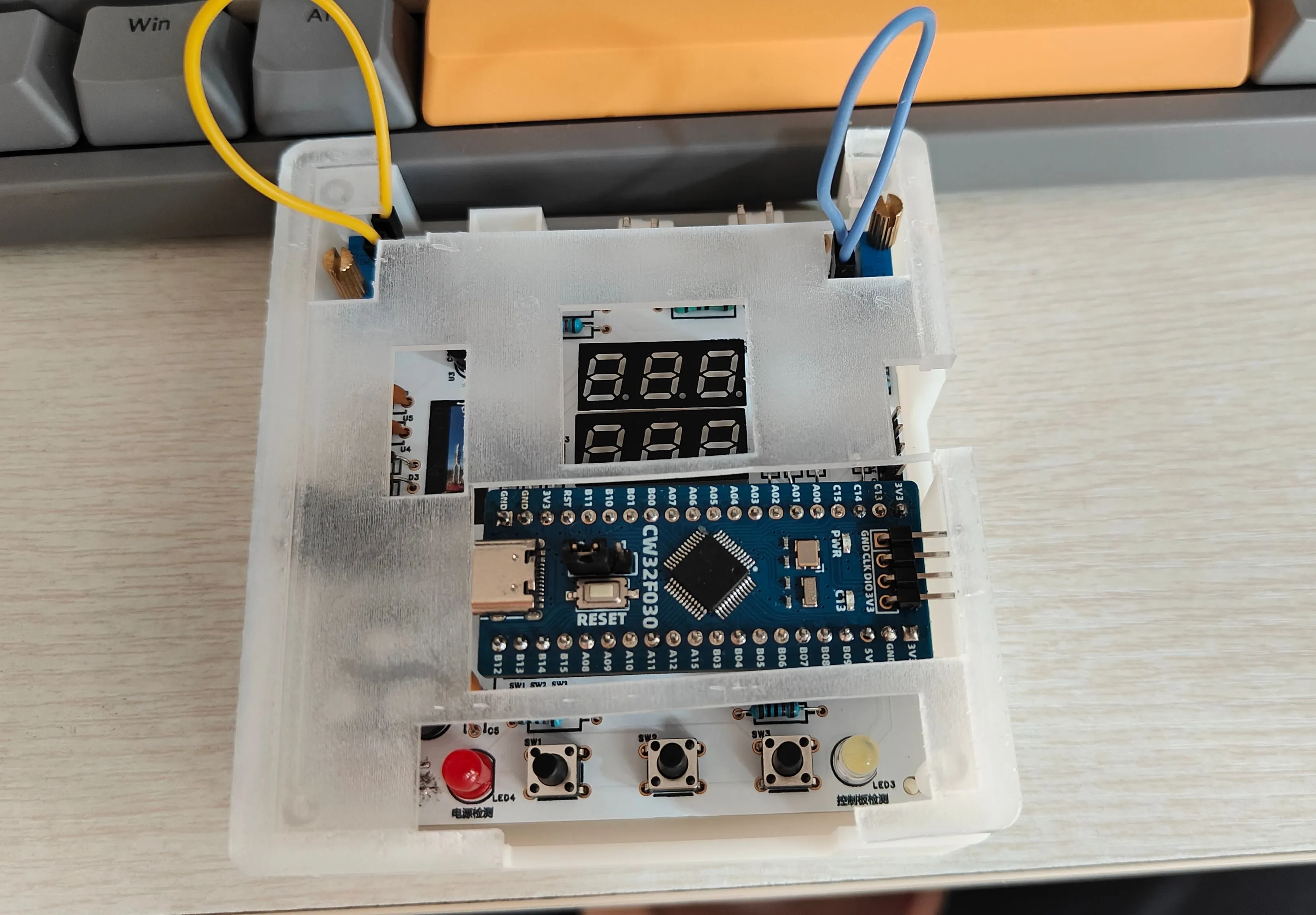
The voltage and current meter I built in the LCSC training camp was a successful replica overall, but it had many flaws in the details. For example, the 3D-printed shell and circuit board didn't align properly, and I didn't read the documentation carefully beforehand, which caused me some trouble (but the documentation and hardware explanation videos are definitely worth studying).
Hardware-wise:
The project was developed based on the ARM® Cortex®-M0+ 32-bit microcontroller CW32F030 series, which boasts powerful computing capabilities and rich peripheral integration. This series of microcontrollers features 64KB of embedded FLASH and 8KB of SRAM, supports a main frequency of up to 64MHz, and has a wide voltage support range (1.65V to 5.5V), enabling stable operation in harsh environments (-40℃ to 105℃). The microcontroller also integrates various peripherals, such as a 12-bit high-speed ADC (analog-to-digital converter), advanced PWM timers, general-purpose timers, and rich communication interfaces (I2C, UART, and SPI), meeting the needs of various sensor data acquisition and control. The hardware design employs low-power modes (Sleep and DeepSleep) to enable the system to enter a low-power state when not in use, improving overall energy efficiency. In terms of pin configuration, the system supports up to 39 I/O interfaces, all configurable as interrupt inputs, flexibly adapting to various peripheral control needs. Furthermore, the internally integrated CRC hardware calculation unit can efficiently verify the integrity of data transmission, enhancing system reliability.
Software-wise
, based on the CW32F030 series microcontroller, it adopts a standard embedded development framework, with a focus on modularity and scalability in program design. For the bootloader, the system supports firmware upgrades and flashing via the UART interface, facilitating subsequent functional expansion and maintenance. The software architecture follows interrupt priority management, utilizing a nested vector interrupt controller (NVIC) to ensure efficient and non-blocking processing of multiple interrupt sources. Additionally, through a direct memory access (DMA) controller, the system can achieve high-speed data transfer between peripherals and memory without CPU intervention, significantly improving system response speed and performance. To ensure data security and consistency, the program employs hardware-supported CRC check technology during data processing, further enhancing communication reliability. The software also implements sampling and processing of multi-channel ADCs, and combines RTC clock to realize timed data acquisition and recording functions, providing a solid foundation for real-time monitoring and control of key parameters such as voltage and current.







 京公网安备 11010802033920号


 CR021130G301



