
Infrared remote control extender
Source: InternetPublisher:2OEn3baMo Keywords: Infrared remote control Updated: 2026/01/27
If you want to control your living room DVD or TV/AV system from your bedroom with a remote, this infrared extender will make that possible. Essentially, it acts as a repeater, redirecting the infrared signal to different locations. This is an improved infrared remote control extender circuit. It features high noise immunity, resistance to ambient light and reflected light, and increases the range from the remote control to the extender circuit to approximately 7 meters. It should work with any home appliances using a 36-38kHz infrared carrier frequency.
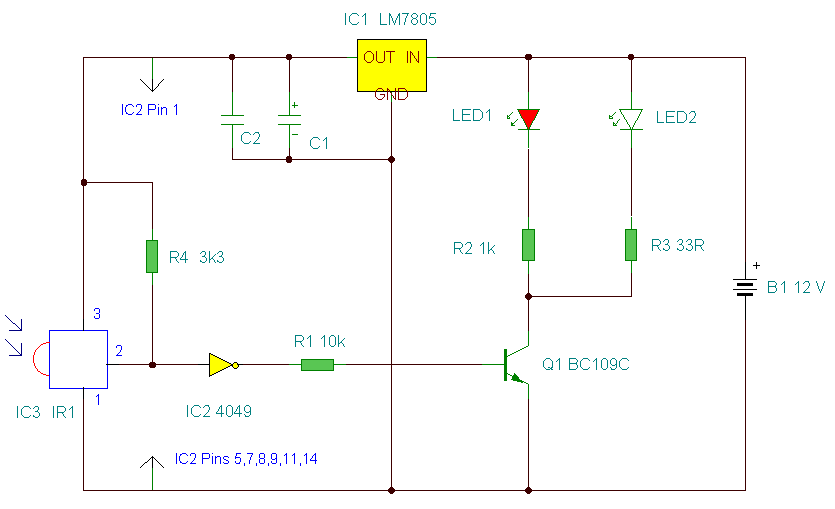

Working principle:
The main difference between this version and the previous circuit is that this design uses a commercially available infrared module. This module, part number IR1, is available from Harrison Electronics in the UK. The IR module contains a built-in photodiode, amplifier circuitry, buffer, and decoder. It is based on the common 38kHz carrier frequency used in most infrared controls. The module removes most of the carrier, allowing the decoded pulses to be delivered to the device. Home televisions and VCRs use additional filtering to completely remove the carrier. The IR1 is packaged in a small aluminum case, and the connections are shown below from the bottom:
The IR1 module (IC3) operates at 5V DC. This is provided by the 7805 voltage regulator IC1. In static (no infrared signal) conditions, the voltage on the output pin is high, approximately 5V DC. This requires inversion and buffering to drive the infrared emitting LED, LED2. The buffer is provided by a gate (pins 2 and 3) of a hex inverter CMOS 4049 (IC2). The IR1 module can directly drive TTL logic, but requires a pull-up resistor R4 to interface with the CMOS IC. This resistor ensures that the signal from the remote control alternates between 0V and 5V. Because TTL logic levels are slightly different from CMOS, a 3.3kΩ resistor R4 is connected to the +5V power supply line to ensure that the logic high signal is 5V, not the TTL level of 3.3V. This resistor does not affect the performance of the IR module, but ensures that the module can correctly drive the CMOS buffer without causing instability.
The output of pin 2 of the 4049 directly drives transistor Q1, and a 10kΩ resistor R1 limits the base current. LED1 is a red LED that blinks to indicate when a remote control signal is received. Note that in this circuit, the carrier wave is still present, but at a reduced level, along with the decoded infrared signal. The CMOS 4049 and BC109C transistors amplify both the carrier and the signal, driving LED2 with a peak current of approximately 120 mA when a signal is received. If you try to measure this with a digital multimeter, the reading will be much lower, possibly around 30 mA, because the meter measures the average DC value, not the peak current. Any device designed to operate between 36 and 40 kHz should work; any control with a carrier frequency outside this range will have a reduced range but should still function. An exception is some satellite receivers whose infrared controls use a higher modulated carrier wave of around 115 kHz. Currently, these don't work with my circuit, but I'm developing a Mark 3 version to reintroduce the carrier wave.
Parts list:
C1 100u 10V
C2 100n polyester film
R1 10k
R2 1k
R3 33R 1W
R4 3k3
Q1 BC109C
IC1 LM7805
IC2 CMOS 4049B
IC3 IR1 module
LED1: Red LED (or any visible color)
LED2 TIL38 or component YH70M
test:
This circuit shouldn't have too many problems. If it doesn't work, have a multimeter ready and perform these checks: Check if the power supply has 12V DC. Check if the regulator output has 5V DC. Check if the input of the IR module and pin 1 of the 4049 IC have 5V DC. Without the remote control, the output of pin 2 should be zero volts. With the remote control, pin 2 will read 5V, and the red LED will flash. Measure the current connected in series with the 12V power supply; it should be approximately 11mA in quiescent mode and approximately 40/50mA with an infrared signal. If the problem persists, measure the voltage between the base and emitter of Q1. This should be zero volts without a signal and rise to 0.6-0.7V DC with an infrared signal. For any other questions, please email me, but please perform the above tests first.
PCB template:
Furthermore, Domenico meticulously designed the PCB template for this project.
Alternatives to IC3:
Harrison Electronics part number IR1 is no longer available. They do offer an alternative infrared decoder, which I have tested and it works. Other alternative infrared decoders are shown below, but note that none of them share the same pinout. I recommend that anyone building this circuit check the relevant datasheet.
Vishay TSOP 1738
Vishay TSOP 1838
Radio Shack 276-0137
Sony SBX 1620-12
Sharp GP1U271R


- Infrared RC5 remote control transmitter
- PIC-based infrared/radio remote control transceiver
- CD4013 remote control socket circuit
- Simple infrared remote control light switch circuit
- 315M remote control transmitting and receiving circuit
- Simple sensitivity tester circuit diagram based on infrared remote control
- Long-distance infrared emission circuit diagram analysis
- Pillow school circuit
- Remote control infrared detection circuit
- TA8859 pillow calibration circuit
- Simple and practical remote control detector circuit diagram
- Infrared remote control receiving circuit using PH302
- Infrared remote control dimming circuit
- Remote control circuit a composed of RX5019 and RX5020
- Proximity switch remote control circuit
- desk lamp remote control circuit
- Radio wireless remote control circuit c
- Infrared remote control distribution board transmitting circuit
- Electric hoist remote control circuit
- Infrared remote control receiver with 60 commands







 京公网安备 11010802033920号