
Very loud pulse buzzer
Source: InternetPublisher:s739sI Keywords: buzzer Updated: 2025/11/11
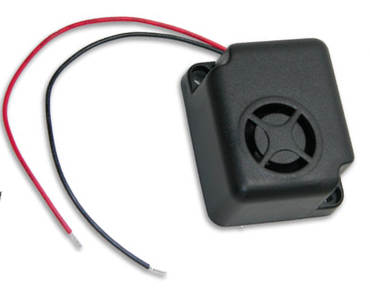
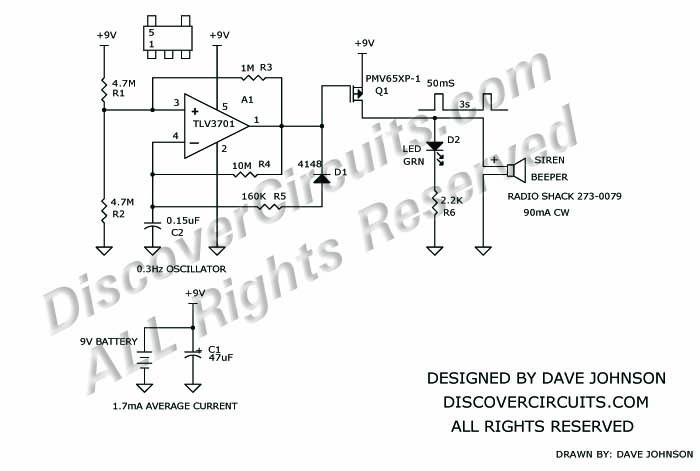
Many battery-powered alarms consume excessive current during operation. Some of the most notable noise generators, such as the unit shown below, use piezoelectric sound generators with swept tones. When operating with a 9-volt battery, these units typically consume 100 mA or more. In many applications, a continuous alarm sound is not required. Locating balloons or rockets are examples where a loud sound is needed but with low average power consumption. To reduce the average current, the device can operate with pulses of short, 0.05-second chimes, occurring every two to three seconds. This reduces the average current by a factor of 60. Therefore, by making the alarm chirp, the current consumption drops from 100 mA to just 2 mA. The circuit below generates the pulse sequence required to produce these short but very loud chimes.
- Temperature-controlled fan
- USB relay board
- Electronic fuses for DC short circuit protection
- Parking Assist
- Automotive dome light delay dimmer
- Safe and novel mother-and-child electronic sound and light firecrackers
- What problems will be encountered when designing a constant temperature controller?
- Create a Smart Brightness Controlled Lamp Using a Motion Sensor
- Tips for Current Regulation When Microstepping a Stepper Motor
- What is a soft starter? Soft starter working principle diagram
- Homemade disinfectant circuit
- Pyroelectric automatic door control circuit
- Multi-channel patrol detection control circuit b
- fire smoke control circuit
- Assembly line outage monitoring circuit
- PLC chain alarm control circuit used in production process
- Multi-pole leakage protector circuit b
- Photoelectric detection output control circuit
- Steam iron temperature detection control circuit
- Small power electric heater temperature detection control circuit







 京公网安备 11010802033920号