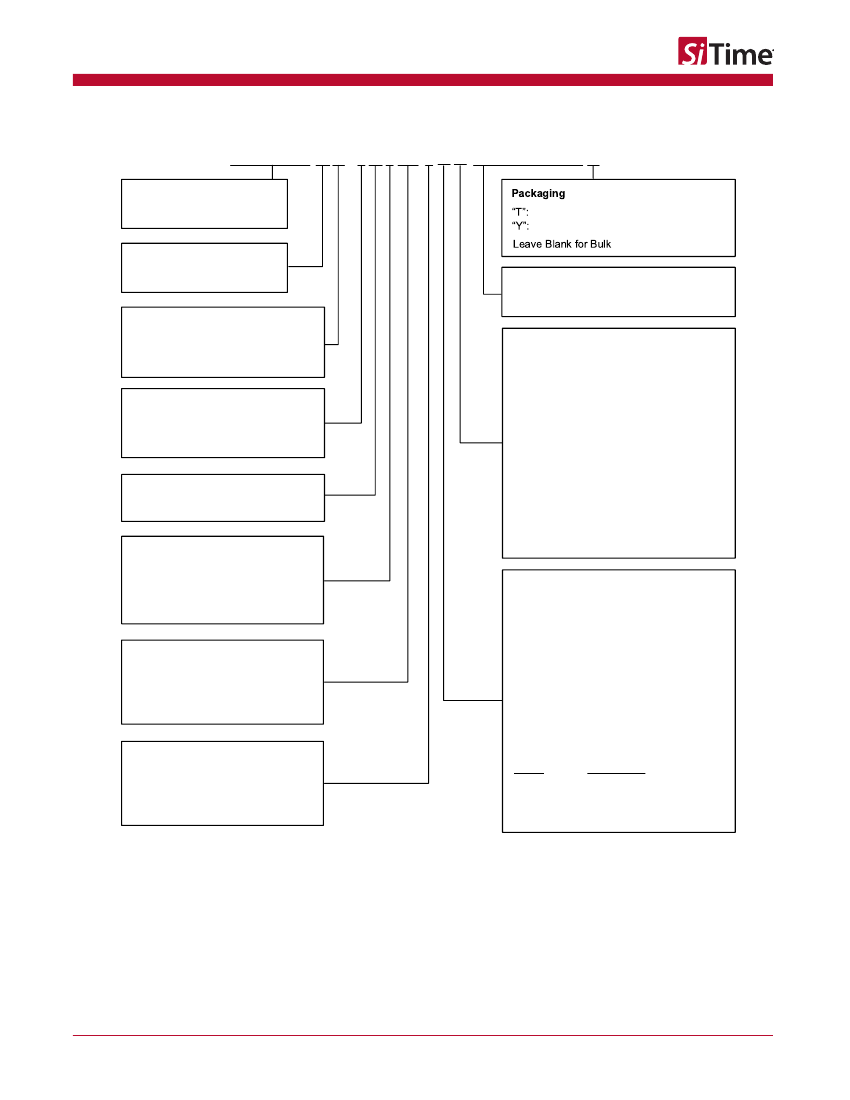
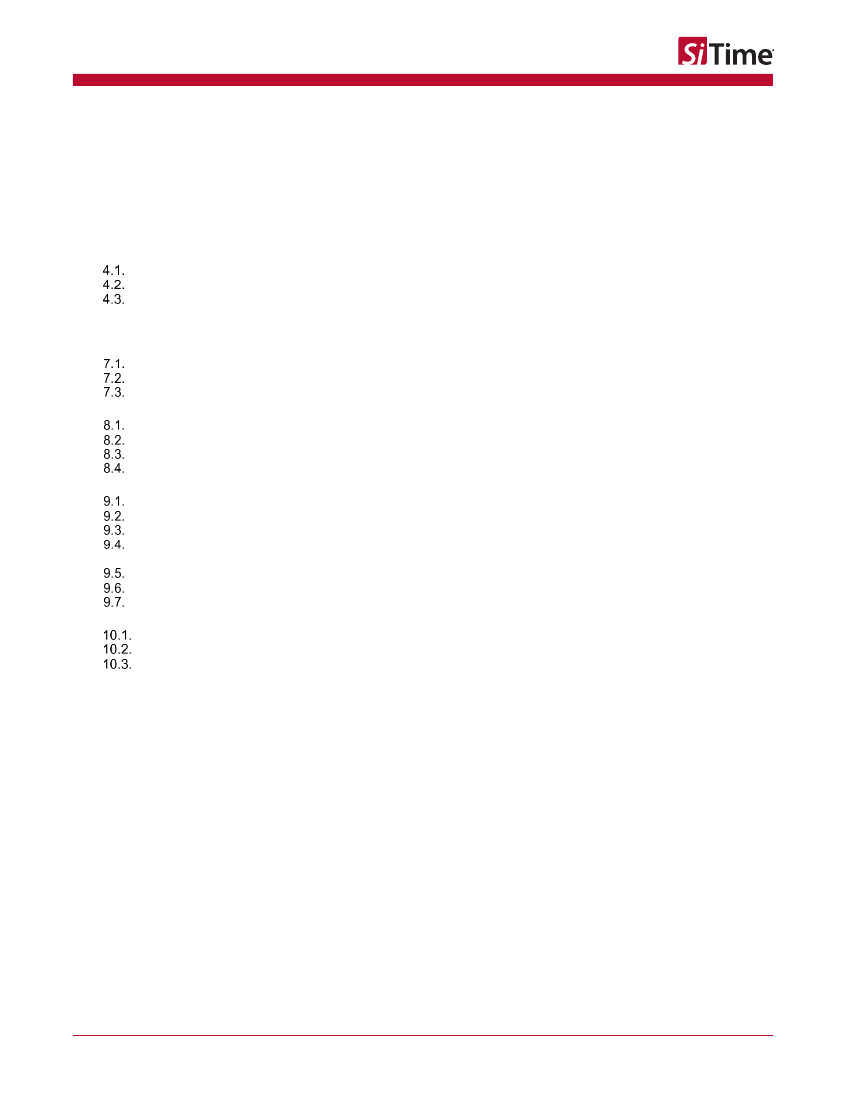
Ordering Information .................................................................................................................................................................... 2
User Programming Interface ..................................................................................................................................... 18
Start-up output frequency and signaling types ........................................................................................................... 18
Any-frequency function ............................................................................................................................................. 19
C/SPI Control Registers...................................................................................................................................................... 28
9 I
Register Address: 0x00. DCO Frequency Control Least Significant Word (LSW) .................................................... 28
Register Address: 0x01. OE Control, DCO Frequency Control Most Significant Word (MSW) ................................. 29
Register Address: 0x02. DCO PULL RANGE CONTROL ........................................................................................ 29
Register Address: 0x03. Frac-N PLL Feedback Divider Integer Value and Frac-N PLL Feedback Divider Fraction
Value MSW ............................................................................................................................................................... 30
Register Address: 0x05. Forward Divider, Driver Control ......................................................................................... 30
Register Address: 0x06. Driver Divider, Driver Control ............................................................................................. 31
2
C Operation ........................................................................................................................................................................ 32
10 I
I
2
C protocol ............................................................................................................................................................... 32
I
2
C Timing Specification ............................................................................................................................................ 35
I
2
C Device Address Modes ....................................................................................................................................... 36
Dimensions and Patterns ........................................................................................................................................................... 43
Additional Information ................................................................................................................................................................ 44
Revision History ......................................................................................................................................................................... 45
Rev 1.01
Page 3 of 45
www.sitime.com
SiT3521
1 to 340 MHz Elite Platform I2C/SPI Programmable Oscillator
1 Electrical Characteristics
All Min and Max limits in the Electrical Characteristics tables are specified over temperature and rated operating voltage with
standard output terminations shown in the termination diagrams. Typical values are at 25°C and nominal supply voltage.
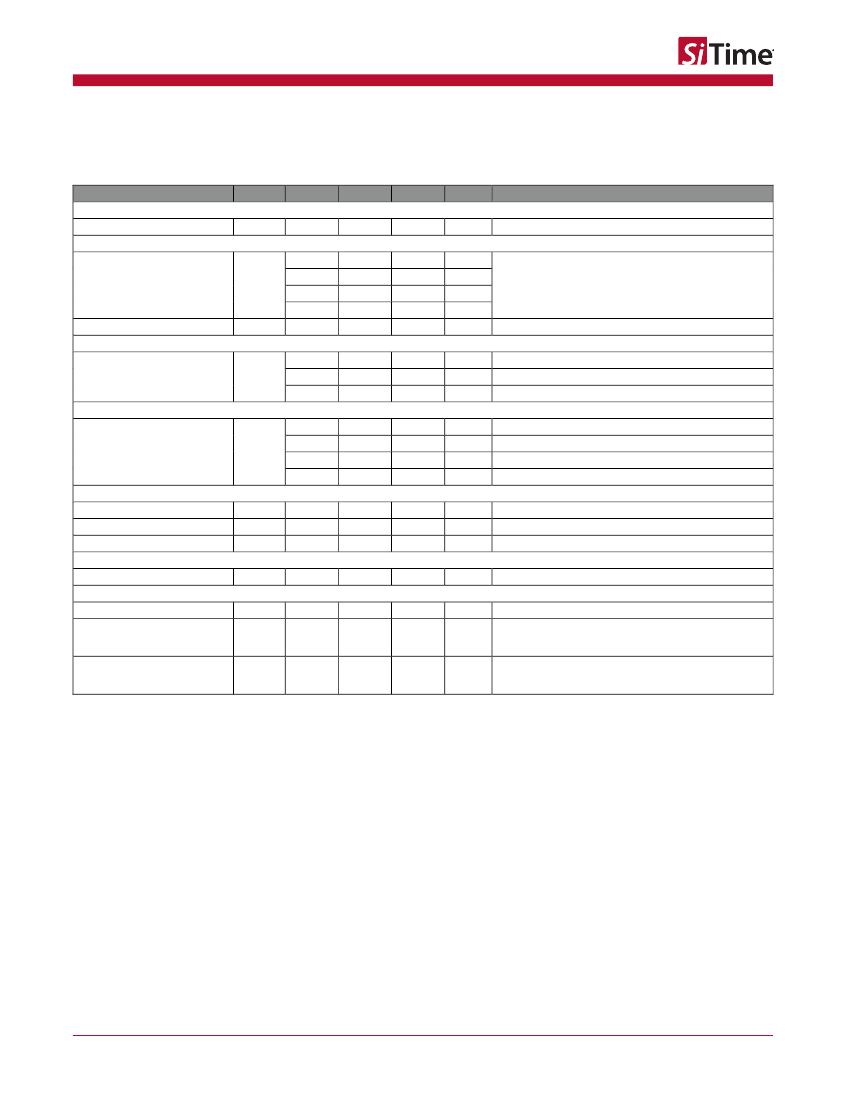
Table 1. Electrical Characteristics – Common to LVPECL, LVDS and HCSL
Parameter
Output Frequency Range
Symbol
f
Min.
1
Typ.
–
–
–
–
–
±1
–
–
–
Max.
340
Unit
MHz
Condition
Factory or user programmable, accurate to 6 decimal places
Frequency Range
Frequency Stability
Frequency Stability
F_stab
-10
-20
-25
-50
First Year Aging
F_1y
–
+10
+20
+25
+50
–
ppm
ppm
ppm
ppm
ppm
°C
°C
°C
1
st
-year aging at 25°C
Inclusive of initial tolerance, operating temperature, rated
power supply voltage and load variations.
Temperature Range
Operating Temperature Range
T_use
-20
-40
-40
+70
+85
+105
Supply Voltage
Supply Voltage
Vdd
2.97
2.7
2.52
2.25
3.3
3.0
2.8
2.5
–
–
100
–
–
–
3.63
3.3
3.08
2.75
–
30%
–
V
V
V
V
Extended Commercial
Industrial
Extended Industrial. Available only for I
2
C operation, not SPI.
Input Characteristics – OE Pin
Input Voltage High
Input Voltage Low
Input Pull-up Impedance
VIH
VIL
Z_in
70%
–
–
Vdd
Vdd
kΩ
OE pin
OE pin
OE pin, logic high or logic low
Output Characteristics
Duty Cycle
DC
45
–
–
55
%
Startup and Output Enable/Disable Timing
Start-up Time
Output Enable/Disable Time –
Hardware control via OE pin
Output Enable/Disable Time –
Software control via I
2
C/SPI
T_start
T_oe_hw
3.0
3.8
ms
µs
Measured from the time Vdd reaches its rated minimum value
Measured from the time OE pin reaches rated VIH and VIL to
the time clock pins reach 90% of swing and high-Z.
See
Figure 9
and
Figure 10
Measured from the time the last byte of command is
transmitted via I
2
C/SPI (reg1) to the time clock pins reach 90%
of swing and high-Z. See
Figure 30
and
Figure 31
T_oe_sw
–
–
6.5
µs
Rev 1.01
Page 4 of 45
www.sitime.com
SiT3521
1 to 340 MHz Elite Platform I2C/SPI Programmable Oscillator
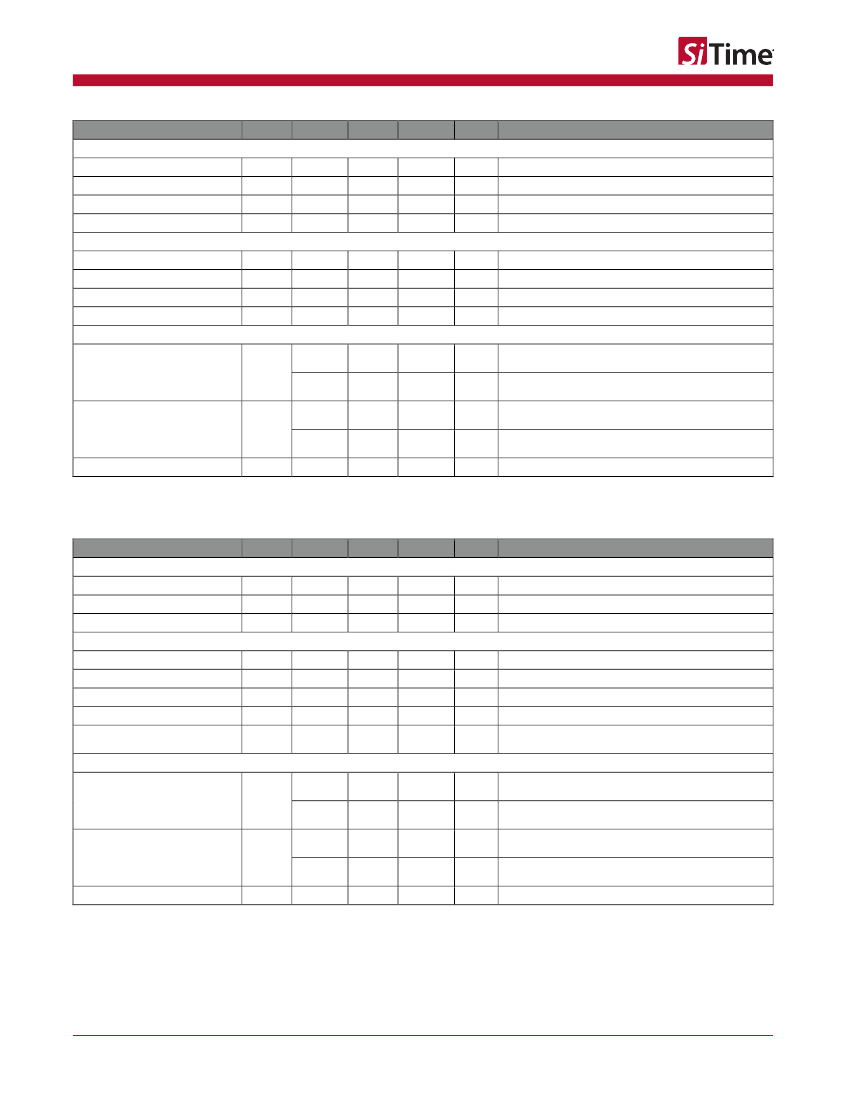
Table 2. Electrical Characteristics – LVPECL Specific
Parameter
Symbol
Min.
Typ.
Max.
Unit
Condition
Current Consumption
Current Consumption
OE Disable Supply Current
Output Disable Leakage Current
Maximum Output Current
Idd
I_OE
I_leak
I_driver
–
–
–
–
–
–
0.15
–
89
58
–
32
mA
mA
A
mA
Excluding Load Termination Current, Vdd = 3.3 V or 2.5 V
OE = Low
OE = Low
Maximum average current drawn from OUT+ or OUT-
Output Characteristics
Output High Voltage
Output Low Voltage
Output Differential Voltage Swing
Rise/Fall Time
VOH
VOL
V_Swing
Tr, Tf
Vdd - 1.1V
Vdd - 1.9V
1.2
–
–
–
1.6
225
Vdd - 0.7V
Vdd - 1.5V
2.0
290
Jitter
RMS Phase Jitter (random) –
DCO Mode Only
T_phj
–
–
RMS Phase Jitter (random) –
Any-frequency Mode Only
T_phj
–
–
RMS Period Jitter
[3]
Note:
3. Measured according to JESD65B.
T_jitt
–
0.225
0.1
0.225
0.11
1
0.340
0.14
0.340
0.15
1.6
ps
ps
ps
ps
ps
f = 156.25 MHz, Integration bandwidth = 12 kHz to 20 MHz,
all Vdd levels
f = 156.25, IEEE802.3-2005 10 GbE jitter mask integration
bandwidth = 1.875 MHz to 20 MHz, all Vdd levels
f = 156.25 MHz, Integration bandwidth = 12 kHz to 20 MHz,
all Vdd levels
f = 156.25, IEEE802.3-2005 10 GbE jitter mask integration
bandwidth = 1.875 MHz to 20 MHz, all Vdd levels
f = 100, 156.25 or 212.5 MHz, Vdd = 3.3 V or 2.5 V
V
V
V
ps
See
Figure 5
See
Figure 5
See
Figure 6
20% to 80%, see
Figure 6
Table 3. Electrical Characteristics – LVDS Specific
Parameter
Symbol
Min.
Typ.
Max.
Unit
Condition
Current Consumption
Current Consumption
OE Disable Supply Current
Output Disable Leakage Current
Idd
I_OE
I_leak
–
–
–
–
–
0.15
80
61
–
mA
mA
A
Excluding Load Termination Current, Vdd = 3.3 V or 2.5 V
OE = Low
OE = Low
Output Characteristics
Differential Output Voltage
Delta VOD
Offset Voltage
Delta VOS
Rise/Fall Time
VOD
ΔVOD
VOS
ΔVOS
Tr, Tf
250
–
1.125
–
–
–
–
–
–
400
455
50
1.375
50
470
Jitter
RMS Phase Jitter (random) –
DCO Mode Only
T_phj
–
–
RMS Phase Jitter (random) –
Any-frequency Mode Only
T_phj
–
–
RMS Period Jitter
[4]
Note:
4. Measured according to JESD65B.
T_jitt
–
0.21
0.1
0.21
0.1
1
0.275
0.12
0.367
0.12
1.6
ps
ps
ps
ps
ps
f = 156.25 MHz, Integration bandwidth = 12 kHz to 20 MHz,
all Vdd levels
f = 156.25, IEEE802.3-2005 10 GbE jitter mask integration
bandwidth = 1.875 MHz to 20 MHz, all Vdd levels
f = 156.25 MHz, Integration bandwidth = 12 kHz to 20 MHz,
all Vdd levels
f = 156.25, IEEE802.3-2005 10 GbE jitter mask integration
bandwidth = 1.875 MHz to 20 MHz, all Vdd levels
f = 100, 156.25 or 212.5 MHz, Vdd = 3.3 V or 2.5 V
mV
mV
V
mV
ps
f = 156.25MHz See
Figure 7
See
Figure 7
See
Figure 7
See
Figure 7
Measured with 2 pF capacitive loading to GND, 20% to 80%,
My MSP430UIF forced to quit when I upgraded the firmware library. As a result, I can't download the program now. I checked online and found that the firmware is damaged. How can I fix it?...
Recently I have been working on using op amps to drive inductive loads. I use TI's THS3120 for power amplification, but I can't get the driving current up to par. Later I found that the DATASHEETs all...
[url=https://download.eeworld.com.cn/detail/patoC198x/560930]EMC FOR PRODUCT DESIGNERS - TIM WILLIAMS[/url][url=https://download.eeworld.com.cn/detail/patoC198x/560929]GROUNDING AND SHIELDING - RALPH ...
I use the SKD2812 development board. After modifying the example program that comes with the board, I have completed the serial port control motor rotation program, which is summarized as follows:1. S...
{:1_142:}I'm very tight on money recently, and I hope to make some extra money in my spare time. If you have any needs in FPGA and MATLAB, you can chat with me privately. Just send me my QQ. We can co...
On August 24th, Jin Yuzhi, CEO of Huawei's Intelligent Automotive Solutions BU, announced the first automotive application of Huawei Qiankun's unique Limera technology. This technology eliminates t...[Details]
Capable of providing precise and efficient thermal management for artificial intelligence computing power, intelligent sensing and autonomous driving systems
Shenzhen, ...[Details]
On August 25th, TSMC, the world's leading contract chip manufacturer, attracted significant attention for its decision to build a chip manufacturing facility in Arizona. TSMC primarily manufactures...[Details]
Permanent magnets are essential components in a wide range of household and industrial devices. They are particularly crucial in the renewable energy sector, including electric vehicle motors. Curr...[Details]
Electric vehicles are powered by electricity, and charging is a device that supplements the vehicle's energy source. It is common to need to recharge the vehicle when driving. But can you charge th...[Details]
Tools/Materials
Yitong Chuanglian MODBUS to PROFIBUS Gateway YT-PB-03
Siemens s7-300
This article describes how to configure the YT-PB-03 MODBUS to PROFIBUS gat...[Details]
In camera and display systems, the demand for high-performance and low-power data interfaces is driving continuous technological evolution. The evolution of MIPI D-PHY and MIPI C-PHY clearly ...[Details]
With the development of vehicle technology, there are more types of cars. Cars are divided into hybrid, pure electric vehicles, and fuel vehicles. For hybrid cars, they are divided into plug-in hyb...[Details]
The transition to SDVs (software-defined vehicles) involves more than just replacing parts; rather, it involves the organic connection of various elements, from internal vehicle systems to ext...[Details]
Arm helps automakers bring new models to market at least a year earlier.
Zena CSS accelerates software and silicon development, enabling faster and more efficient delivery of AI cap...[Details]
System Principle
According to the average imbalance rate of the branch three-phase phase line load and the average value of the branch phase line current, the adjustment of the phase line load...[Details]
introduction
By the end of 2014, people aged 60 and above in China accounted for 15.5% of the total population, reaching 212 million; those aged 65 and above accounted for 10.1% of the total, ...[Details]
HEVO, a developer of wireless charging infrastructure for electric vehicles, and STEER Tech, a company specializing in high-precision autonomous vehicle technology for fleet garage operations, anno...[Details]
In recent years, portable electronic devices such as mobile phones, digital cameras, music players, tablets, ultrabooks, and laptops have become almost a necessity, raising safety concerns. Besides...[Details]
From August 8 to 12, 2025, the highly anticipated 2025 World Robotics Conference (WRC) will be held at the Beiren Yichuang International Convention and Exhibition Center in the Beijing Economic and...[Details]

 Microcontroller MCU
 京公网安备 11010802033920号
 EEWORLD