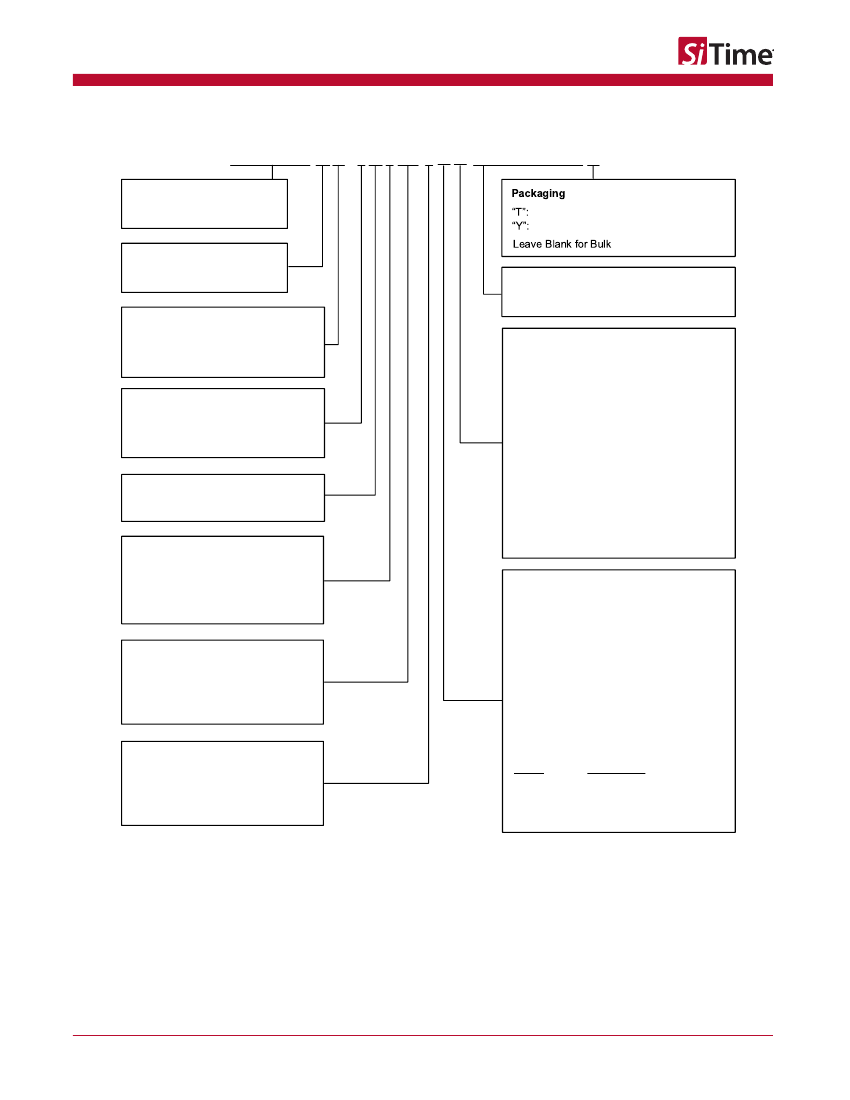
Ordering Information .................................................................................................................................................................... 2
User Programming Interface ..................................................................................................................................... 18
Start-up output frequency and signaling types ........................................................................................................... 18
Any-frequency function ............................................................................................................................................. 19
C/SPI Control Registers...................................................................................................................................................... 28
9 I
Register Address: 0x00. DCO Frequency Control Least Significant Word (LSW) .................................................... 28
Register Address: 0x01. OE Control, DCO Frequency Control Most Significant Word (MSW) ................................. 29
Register Address: 0x02. DCO PULL RANGE CONTROL ........................................................................................ 29
Register Address: 0x03. Frac-N PLL Feedback Divider Integer Value and Frac-N PLL Feedback Divider Fraction
Value MSW ............................................................................................................................................................... 30
Register Address: 0x05. Forward Divider, Driver Control ......................................................................................... 30
Register Address: 0x06. Driver Divider, Driver Control ............................................................................................. 31
2
C Operation ........................................................................................................................................................................ 32
10 I
I
2
C protocol ............................................................................................................................................................... 32
I
2
C Timing Specification ............................................................................................................................................ 35
I
2
C Device Address Modes ....................................................................................................................................... 36
Dimensions and Patterns ........................................................................................................................................................... 43
Additional Information ................................................................................................................................................................ 44
Revision History ......................................................................................................................................................................... 45
Rev 1.01
Page 3 of 45
www.sitime.com
SiT3521
1 to 340 MHz Elite Platform I2C/SPI Programmable Oscillator
1 Electrical Characteristics
All Min and Max limits in the Electrical Characteristics tables are specified over temperature and rated operating voltage with
standard output terminations shown in the termination diagrams. Typical values are at 25°C and nominal supply voltage.
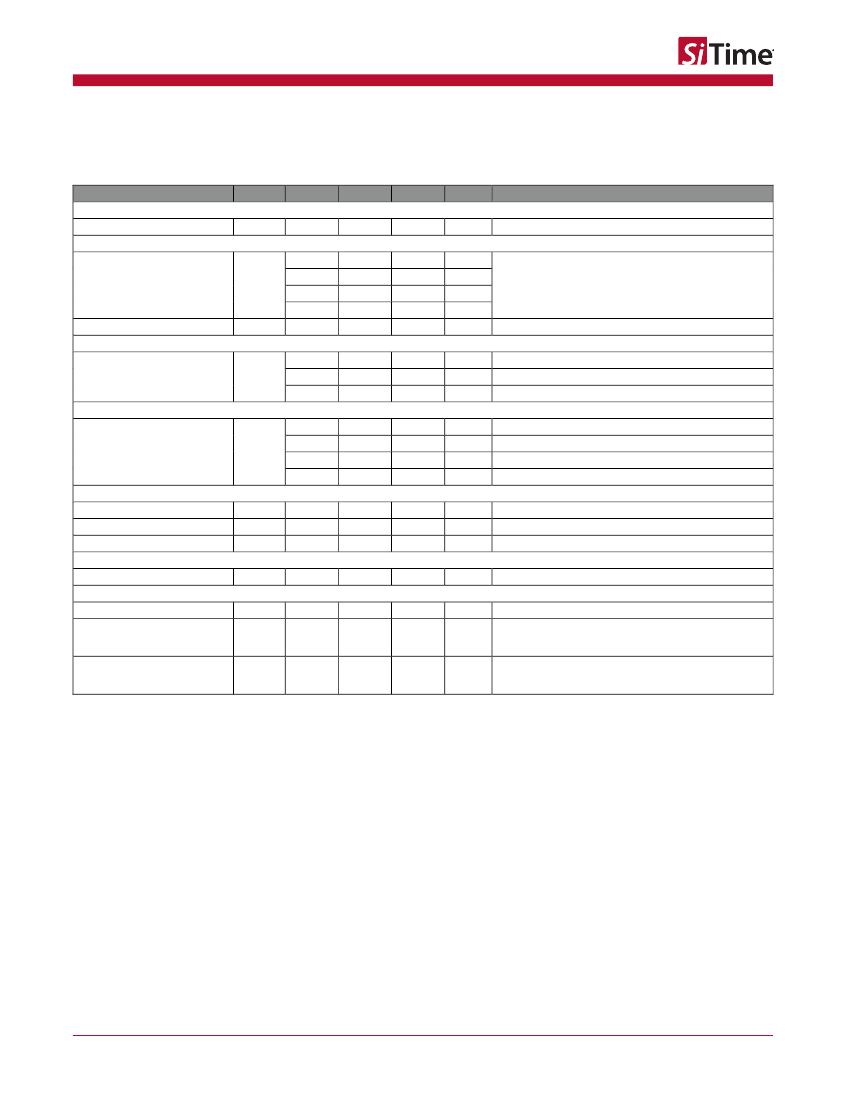
Table 1. Electrical Characteristics – Common to LVPECL, LVDS and HCSL
Parameter
Output Frequency Range
Symbol
f
Min.
1
Typ.
–
–
–
–
–
±1
–
–
–
Max.
340
Unit
MHz
Condition
Factory or user programmable, accurate to 6 decimal places
Frequency Range
Frequency Stability
Frequency Stability
F_stab
-10
-20
-25
-50
First Year Aging
F_1y
–
+10
+20
+25
+50
–
ppm
ppm
ppm
ppm
ppm
°C
°C
°C
1
st
-year aging at 25°C
Inclusive of initial tolerance, operating temperature, rated
power supply voltage and load variations.
Temperature Range
Operating Temperature Range
T_use
-20
-40
-40
+70
+85
+105
Supply Voltage
Supply Voltage
Vdd
2.97
2.7
2.52
2.25
3.3
3.0
2.8
2.5
–
–
100
–
–
–
3.63
3.3
3.08
2.75
–
30%
–
V
V
V
V
Extended Commercial
Industrial
Extended Industrial. Available only for I
2
C operation, not SPI.
Input Characteristics – OE Pin
Input Voltage High
Input Voltage Low
Input Pull-up Impedance
VIH
VIL
Z_in
70%
–
–
Vdd
Vdd
kΩ
OE pin
OE pin
OE pin, logic high or logic low
Output Characteristics
Duty Cycle
DC
45
–
–
55
%
Startup and Output Enable/Disable Timing
Start-up Time
Output Enable/Disable Time –
Hardware control via OE pin
Output Enable/Disable Time –
Software control via I
2
C/SPI
T_start
T_oe_hw
3.0
3.8
ms
µs
Measured from the time Vdd reaches its rated minimum value
Measured from the time OE pin reaches rated VIH and VIL to
the time clock pins reach 90% of swing and high-Z.
See
Figure 9
and
Figure 10
Measured from the time the last byte of command is
transmitted via I
2
C/SPI (reg1) to the time clock pins reach 90%
of swing and high-Z. See
Figure 30
and
Figure 31
T_oe_sw
–
–
6.5
µs
Rev 1.01
Page 4 of 45
www.sitime.com
SiT3521
1 to 340 MHz Elite Platform I2C/SPI Programmable Oscillator
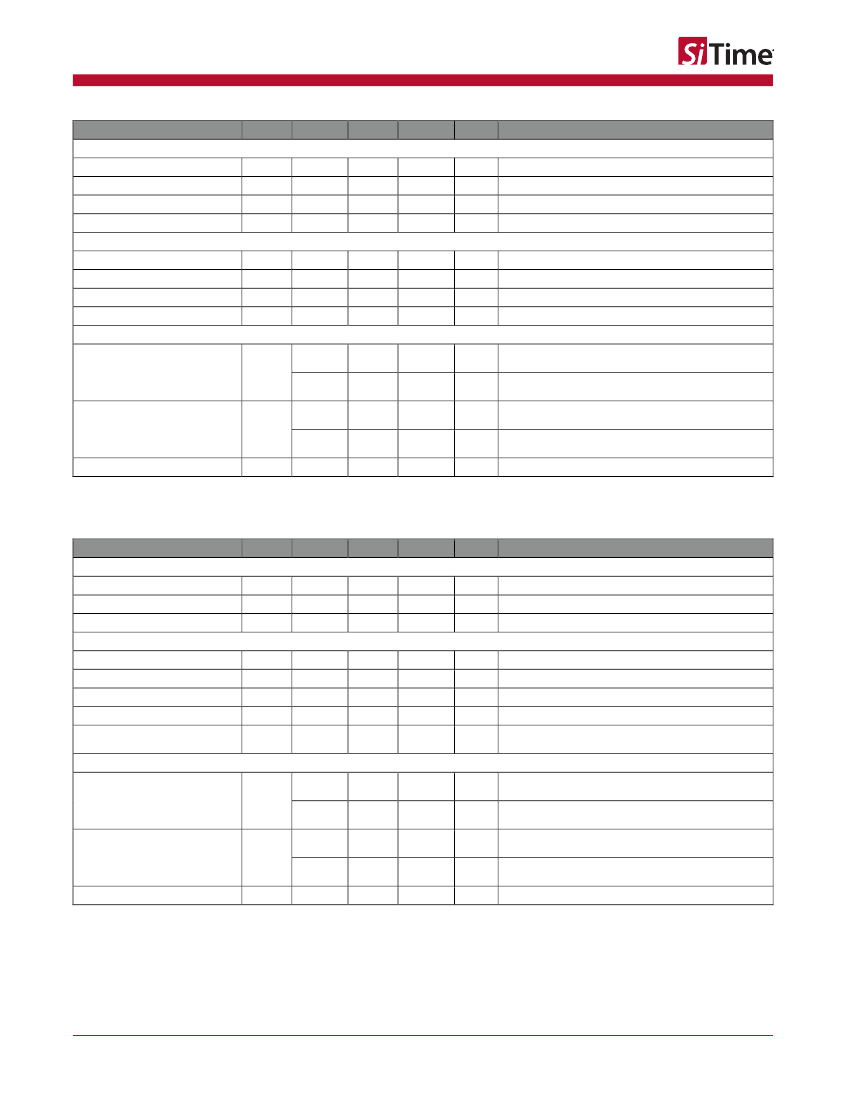
Table 2. Electrical Characteristics – LVPECL Specific
Parameter
Symbol
Min.
Typ.
Max.
Unit
Condition
Current Consumption
Current Consumption
OE Disable Supply Current
Output Disable Leakage Current
Maximum Output Current
Idd
I_OE
I_leak
I_driver
–
–
–
–
–
–
0.15
–
89
58
–
32
mA
mA
A
mA
Excluding Load Termination Current, Vdd = 3.3 V or 2.5 V
OE = Low
OE = Low
Maximum average current drawn from OUT+ or OUT-
Output Characteristics
Output High Voltage
Output Low Voltage
Output Differential Voltage Swing
Rise/Fall Time
VOH
VOL
V_Swing
Tr, Tf
Vdd - 1.1V
Vdd - 1.9V
1.2
–
–
–
1.6
225
Vdd - 0.7V
Vdd - 1.5V
2.0
290
Jitter
RMS Phase Jitter (random) –
DCO Mode Only
T_phj
–
–
RMS Phase Jitter (random) –
Any-frequency Mode Only
T_phj
–
–
RMS Period Jitter
[3]
Note:
3. Measured according to JESD65B.
T_jitt
–
0.225
0.1
0.225
0.11
1
0.340
0.14
0.340
0.15
1.6
ps
ps
ps
ps
ps
f = 156.25 MHz, Integration bandwidth = 12 kHz to 20 MHz,
all Vdd levels
f = 156.25, IEEE802.3-2005 10 GbE jitter mask integration
bandwidth = 1.875 MHz to 20 MHz, all Vdd levels
f = 156.25 MHz, Integration bandwidth = 12 kHz to 20 MHz,
all Vdd levels
f = 156.25, IEEE802.3-2005 10 GbE jitter mask integration
bandwidth = 1.875 MHz to 20 MHz, all Vdd levels
f = 100, 156.25 or 212.5 MHz, Vdd = 3.3 V or 2.5 V
V
V
V
ps
See
Figure 5
See
Figure 5
See
Figure 6
20% to 80%, see
Figure 6
Table 3. Electrical Characteristics – LVDS Specific
Parameter
Symbol
Min.
Typ.
Max.
Unit
Condition
Current Consumption
Current Consumption
OE Disable Supply Current
Output Disable Leakage Current
Idd
I_OE
I_leak
–
–
–
–
–
0.15
80
61
–
mA
mA
A
Excluding Load Termination Current, Vdd = 3.3 V or 2.5 V
OE = Low
OE = Low
Output Characteristics
Differential Output Voltage
Delta VOD
Offset Voltage
Delta VOS
Rise/Fall Time
VOD
ΔVOD
VOS
ΔVOS
Tr, Tf
250
–
1.125
–
–
–
–
–
–
400
455
50
1.375
50
470
Jitter
RMS Phase Jitter (random) –
DCO Mode Only
T_phj
–
–
RMS Phase Jitter (random) –
Any-frequency Mode Only
T_phj
–
–
RMS Period Jitter
[4]
Note:
4. Measured according to JESD65B.
T_jitt
–
0.21
0.1
0.21
0.1
1
0.275
0.12
0.367
0.12
1.6
ps
ps
ps
ps
ps
f = 156.25 MHz, Integration bandwidth = 12 kHz to 20 MHz,
all Vdd levels
f = 156.25, IEEE802.3-2005 10 GbE jitter mask integration
bandwidth = 1.875 MHz to 20 MHz, all Vdd levels
f = 156.25 MHz, Integration bandwidth = 12 kHz to 20 MHz,
all Vdd levels
f = 156.25, IEEE802.3-2005 10 GbE jitter mask integration
bandwidth = 1.875 MHz to 20 MHz, all Vdd levels
f = 100, 156.25 or 212.5 MHz, Vdd = 3.3 V or 2.5 V
mV
mV
V
mV
ps
f = 156.25MHz See
Figure 7
See
Figure 7
See
Figure 7
See
Figure 7
Measured with 2 pF capacitive loading to GND, 20% to 80%,
In Project - Options for Target - Debug, select Use: ULINK ARM Debugger , then you can open the Settings dialog box. Click the Settings buttonThe LPC214X chip on the board has lost its logo. Has the c...
[i=s]This post was last edited by yin_wu_qing on 2021-9-6 09:50[/i]As mentioned in the previous post, the development board integrates the Si7021 temperature and humidity sensor, which uses the IIC in...
In WINCE, how can I allow the application to register a callback function in the stream interface driver I wrote myself? I see that there are many drivers that register callback functions in the WINCE...
Recently I need to write an AXI to Avalon bridge. Since I have never been exposed to system buses before, I have read both bus protocols. However, there are too few diagrams of the AXI protocol, so I ...
In public places such as schools, government agencies, factories and mines, as well as public corridors in residential areas, the phenomenon of long-burning lights is very common, which causes a h...[Details]
Since the late 1990s, with the demand for higher system efficiency and lower power consumption, the technological update of telecommunications and data communication equipment has promoted the deve...[Details]
Introduction
In industrial control, speed measurement is often required. Generally, a contact tachometer is used. This tachometer must be placed against the center of the shaft to measure. It...[Details]
The DisplayPort interface standard is approved by the Video Electronics Standards Association (VESA) to provide an open, scalable standard for the entire industry. The development of DisplayPort ca...[Details]
Rated capacity refers to the maximum output power of the UPS (the product of voltage V and current A).
Usually, the UPS power supplies sold on the market are marked with "W" (watt) for smaller...[Details]
System Block Diagram
The system uses DSP56F826 chip as the core control module and CMOS digital image sensor chip. The image acquisition resolution can reach 640×480 pixels. When high-re...[Details]
When selecting EMC test equipment, we often encounter the following questions: What is the difference between an EMI receiver and a spectrum analyzer? Why should a receiver be used for EMI testing?...[Details]
1. Overview
Infrared temperature measurement technology plays an important role in product quality control and monitoring, online equipment fault diagnosis and safety protection, and energy co...[Details]
The automotive environment is very demanding for electronics: any circuit connected to the 12V power supply must operate within the nominal voltage range of 9V to 16V. Other pressing issues include...[Details]
Abstract: The video decoding chip ADV7183A is used to complete the acquisition and quantification of analog video signals, and then the ADSP-BF561 completes the compression of video data. The compr...[Details]
VGA (Video Graphics Array) is a graphics display standard proposed by IBM in 1987. Although it is no longer an advanced display standard, it is still widely used due to its mature technology and pr...[Details]
1 Introduction
With the development of transmission systems in recent years, multi-motor transmission systems have been widely used in various fields. In order to improve the dynamic performan...[Details]
The power consumption of digital cameras is a big problem. Even if you have enough batteries, it will cause a lot of trouble because you have to replace the batteries frequently, not to mention the...[Details]
Hardware designers have begun to adopt FPGA technology in high-performance DSP designs because it can provide 10-100 times faster computing than PC-based or microcontroller-based solutions. Previou...[Details]
The Cirrus CS485xx DSP family provides high-performance post-processing and mixing of digital audio. Dual clock domains provided on the PCM input allow mixing of audio streams with different sampli...[Details]

 stm32/stm8
 京公网安备 11010802033920号
 EEWORLD