The
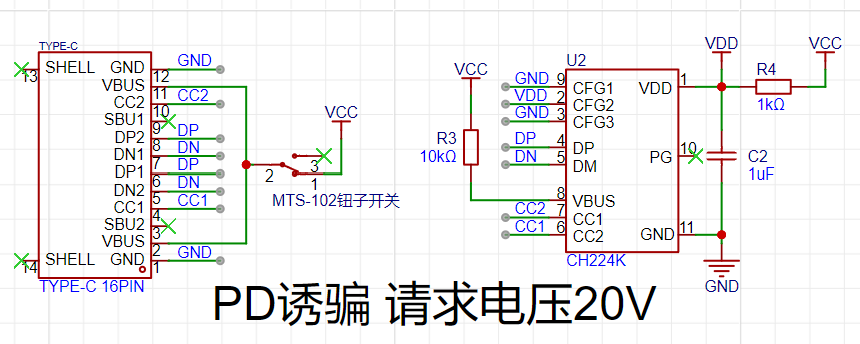
Type-C interface provides power, supporting PD fast charging (chargers that support brand-specific fast charging protocols are generally compatible with PD fast charging). The Type-C charger itself is the power cable, making it very convenient
for PD charging of the CH224K solution. It requires 20V. The preamplifier
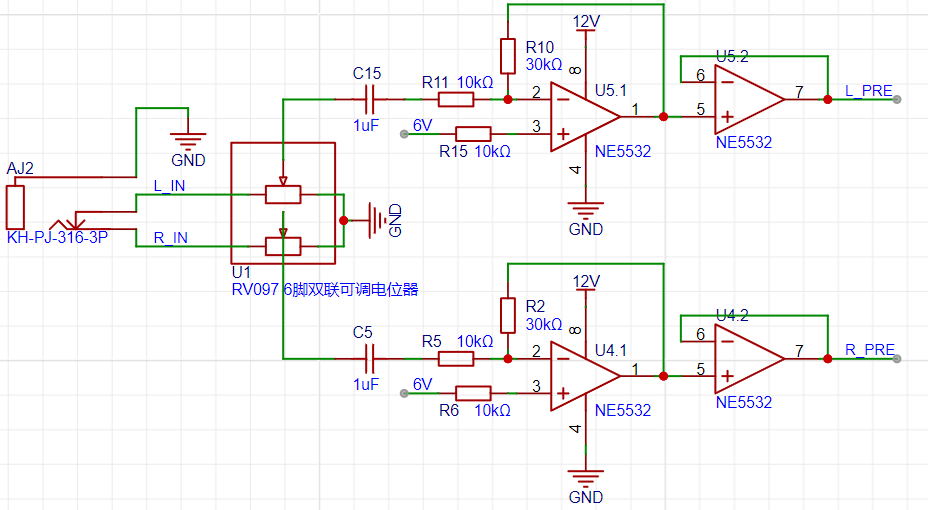
uses the NE5532 op-amp, offering excellent value for money, and the sound quality is sufficient for most needs (except for audiophiles).
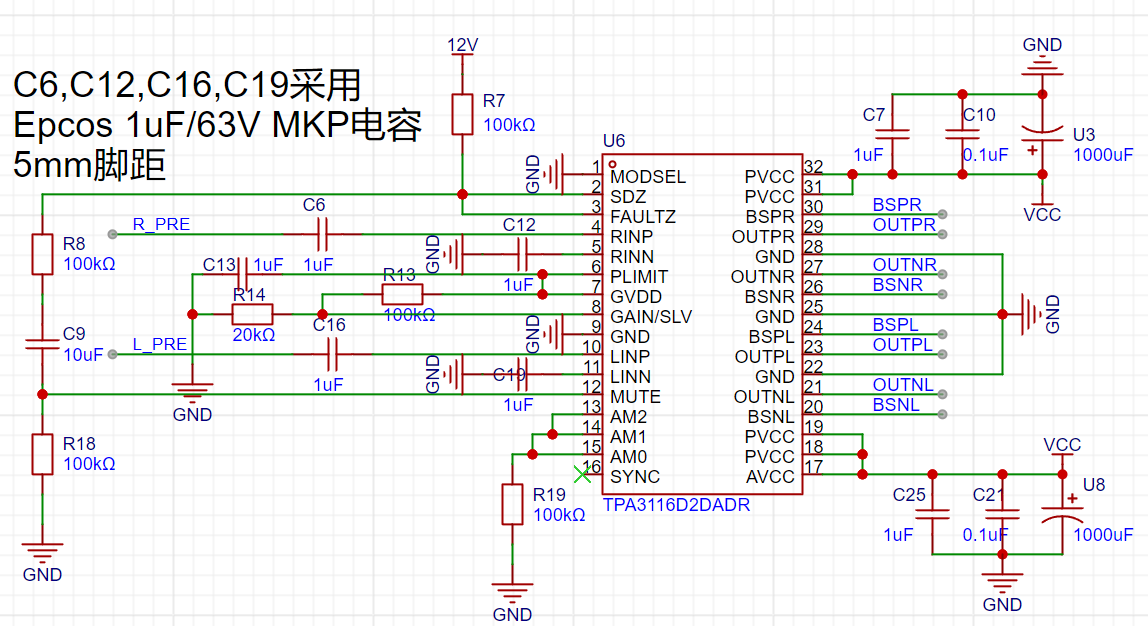
The core amplifier is the Texas Instruments TPA3116, supporting a maximum of 2*50W. The PWM frequency is selectable (higher frequencies result in better treble performance but significantly increase power consumption and heat generation).
Both audio input and output use 3.5mm audio jacks (AUX interfaces). Since the audio output directly shorts the left and right... The negative terminal of the channel may prevent dual-channel output (mono output is perfectly fine).
Unless otherwise specified, all resistors and capacitors are packaged as 0805. The power supply section
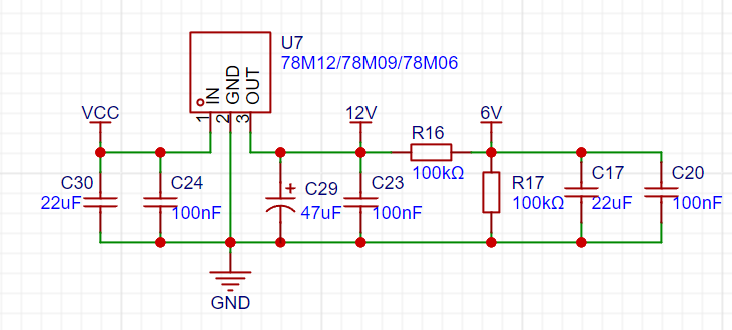
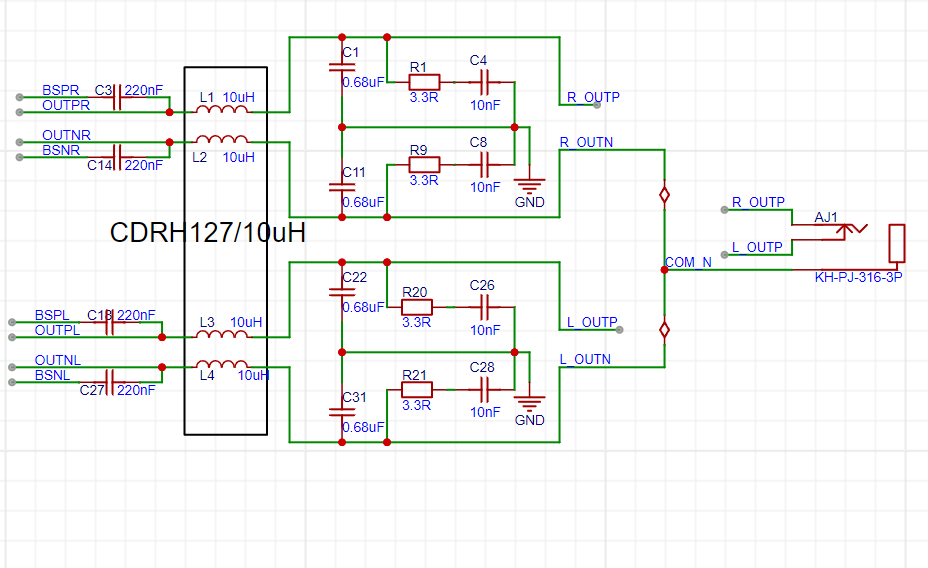
is detailed below. It uses a 16-pin Type-C connector (this requires skilled soldering, but can be easily done with solder paste and a hot air gun). The CH224k solution is used to trick PD fast charging, requesting 20V (the maximum voltage of the PD protocol) to ensure sufficient power. Note: It is recommended to use a 65W or higher charger that supports PD fast charging; otherwise, you may experience blurry sound quality or various problems due to insufficient power. The preamp uses a 3.5mm audio input interface (AUX interface), and the author used a PJ-316 connector. After the signal input, a dual RV097 potentiometer is used to divide the voltage and adjust the signal strength. For the coupling capacitors (C5, C15), the author used Epcos 1uF MKP capacitors (5mm lead pitch). Personally, I think the sound quality is almost identical to that of Weima MKP capacitors, but Epcos MKP capacitors are much cheaper (less than ¥1 each in some cases), making them a cost-effective choice. Of course, those seeking the ultimate sound quality can replace the capacitors with higher-end ones. The preamplifier uses the classic NE5532 op-amp, with a preamplification factor of 3x. The op-amp and amplification factor can be changed according to needs (the author used a dual op-amp package; the first op-amp is used for amplification, and the second op-amp is configured as a voltage follower for buffering and adjusting input/output impedance). The op-amp power supply uses the 78Mxx series; theoretically, 78M12/78M09/78M06 can be used. However, considering that the maximum voltage of the TPA3116's audio input pin is 6.3V, it is recommended to use 78M09 or 78M06 for safety (the author used 78M09). The bias voltage of the signal input to the TPA3116 is approximately half of the regulated value (through voltage division via R16 and R17). Additionally, C29 is a surface-mount aluminum electrolytic capacitor (6.3*5.4mm), and the core amplifier (single chip) is a Texas Instruments TPA3116(D2). It has high internal integration and a relatively simple peripheral circuit; the reference circuit in the datasheet is almost entirely copied. It defaults to a 400kHz PWM frequency, resulting in acceptable treble quality and excellent mid and bass. The second version will adjust the PWM frequency to be adjustable to improve treble quality. (The author's skill and budget are limited; audiophiles please refrain from criticism.) The coupling capacitors (C6, C12, C16, C19) still use Epcos 1uF MKP capacitors (5mm lead pitch). The author used a mobile phone charger as the power supply, resulting in relatively low ripple. Power filtering using two 1000uF high-frequency electrolytic capacitors and four small ceramic surface-mount capacitors is sufficient. Furthermore, the negative terminal of the audio output is isolated from the power ground (GND), and no audible power noise was detected in actual testing. (The pursuit of ripple is endless. The author's skill and budget are limited; please refrain from criticism if you have extremely high requirements for power supply ripple.) Regarding heat: The author tested in a summer room without air conditioning (temperature 30°C+), the amplifier got hot after a few minutes of use (estimated temperature 40~45°C), and the inductor got slightly warm, but nothing serious. It is recommended to use a heatsink (currently, a 10mm*10mm heatsink is usable in version V1.0; the second version will expand the space around the chip to accommodate larger heatsinks). For filtering and output , refer to the official datasheet. The output still uses a 3.5mm audio jack (AUX interface). When connecting speakers, select the appropriate adapter cable (e.g., 3.5mm to RCA) based on the speaker's input interface. The output inductor is a CDRH127 10uH power inductor. During testing, it became slightly warm (in summer, without air conditioning, at 30°C+), but this did not affect normal use. The author directly shorted the negative terminals of the left and right channel outputs, which may cause a failure to output stereo sound (the author's usage scenario was a single mono speaker). Mono output worked perfectly. If stereo is required, you can modify the wiring or change the output interface (e.g., change to RCA connectors for the left and right channels respectively). The stereo issue will be resolved in version 2 (V2.0). ** Important Note:** The Type-C power supply must support PD fast charging! And the power output should ideally be above 65W! Otherwise, it will not work properly or the effect will be extremely poor!








 京公网安备 11010802033920号


 240-382JM20-11PSPCNN



