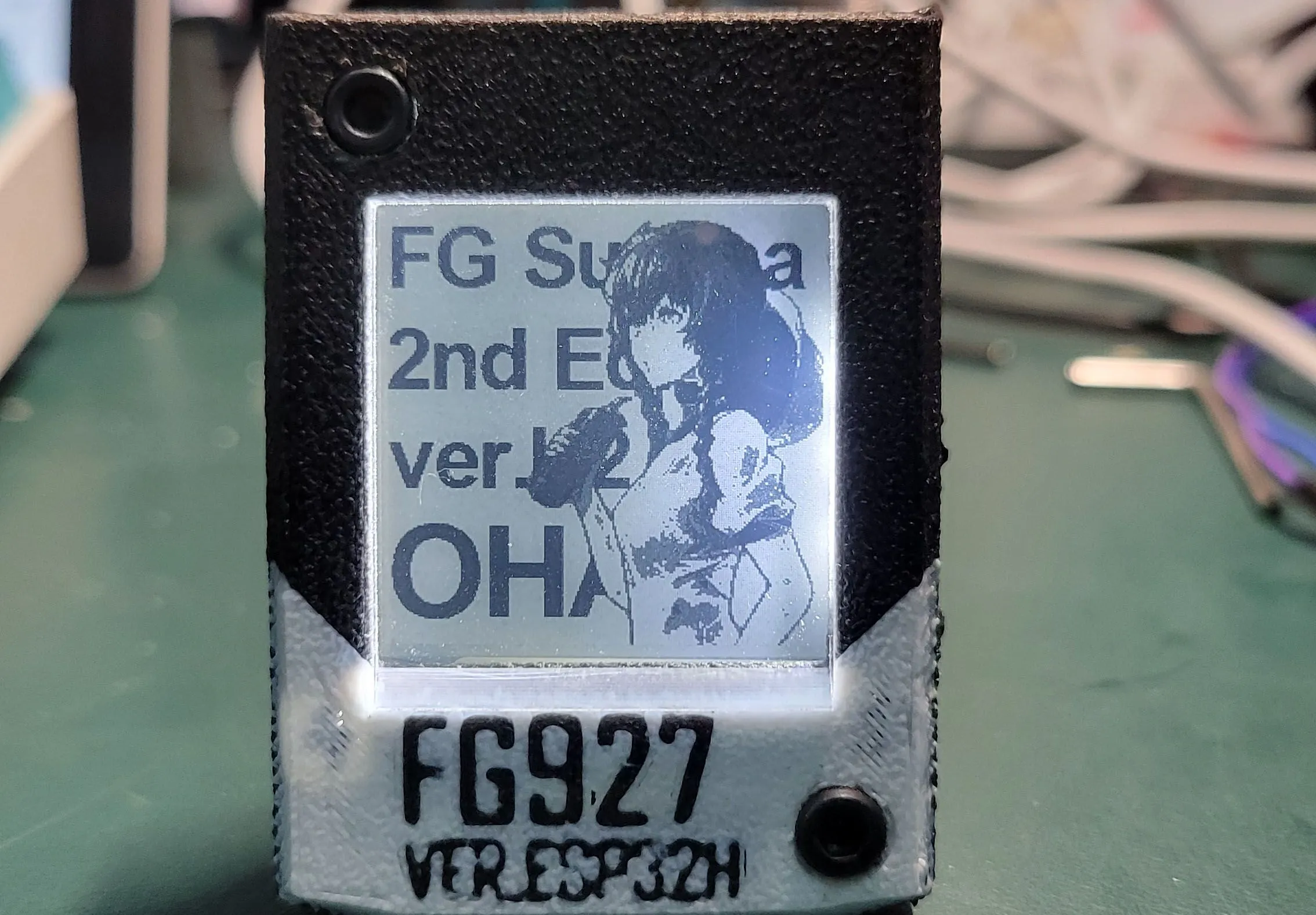
The FG927 is an e-ink GPS cycling computer.
First, I want to clarify that I share the same birthday as Lingyu, hence the name of this project: FG927. Because it uses the ESP32H2, it's the ver. ESP32H2. This is a demonstration video
of an e-ink GPS cycling computer project. Features to be added include: GPS-based speed display (one decimal place); magnetometer-based cycling direction corrected by GPS; gyroscope-based hill-climbing angle (not very useful, it flies over speed bumps); single-trip average speed, single-trip top speed, single-trip mileage, single-trip riding time, total mileage; average speed and top speed statistics over the past twelve hours (accurate to the minute); night vision lighting (brightest enough to be used as a flashlight); GPS-corrected UTC+8 time ; single-trip calorie calculation (assuming you weigh 70kg); temperature, air pressure, and altitude; automatic standby after 4 minutes of stopping, automatically waking up upon monitoring vehicle movement; approximately nine hours of battery life (shorter with lights on); low battery standby (about a week from when it can't be turned on to when it's completely out of power); 128Mb. The cycling route recording function, composed of flash and BLE (to be developed), displays images of Suzuha. Key hardware used includes: MCU: ESP32-H2-MINI-1 ; Gyroscope: ICM20948; Power Management: AXP2101 (DC-CDC1 default voltage must be 3.3V!!!) ; Barometer: MS5611 ; LED Management: LP5009; E-ink Screen: GDEY0154D67; GPS: ATGM336H-5N31; Flash: W25Q128JVPIQ (unused) ; Power Meter: INA219; LCD screen compatible with ST7789, but no matching casing; 3D modeling file; 603035 600mAh lithium battery; Ceramic Antenna: BWGPSCNX18-18B1. The GitHub repository and 3D printing files are available at https://github.com/Evil-Ender/FG927. The shell cover is printed in two colors, but it's not a big problem if it's not. The layer height is 0.08mm. I haven't tried other methods to see if they would work. In short, being precise is never a bad thing, as it doesn't need to withstand any huge strain. There are two types of brackets: one extends out and requires assembly, and the other sits on the handle. You can print them according to your preference. It's best to use materials with a high glass transition temperature, such as ABS; PLA might bend after being exposed to sunlight. You will need to prepare M5 screws and nuts, as well as M3 knurled nuts (3mm high, 4mm outer diameter), M3 flathead screws (5mm high, 6mm head diameter, 0.8mm thickness), and M3*8 hex socket screws. Debugging requires an ESP32 development board library version 3.0 or higher to compile the ESP32H2 files. Please be aware of this. To test the success of the soldering, you can uncomment the `#define D_BUG` line in `BIANCHI.h` to receive error data from the serial port (error messages other than those indicating communication failure are quite messy). You can use the included `pic_gen.py` to convert a 200*200 image into a grayscale image suitable for e-ink displays; remember to adjust the threshold according to the image's style.







 京公网安备 11010802033920号


 RM462-196-843-9624



