Simple Digital Oscilloscope
(I) Engineering Characteristics:
Oscilloscopes are indispensable tools for electronic engineers. They are divided into analog and digital oscilloscopes based on the type of signal. Analog oscilloscopes use analog circuits and electron guns to display waveforms on the screen via electron beams, while digital oscilloscopes use digital circuits and digital storage technology to digitize and display the waveforms.
(II) Engineering Applications:
In the process of oscilloscope upgrades and iterations, traditional analog oscilloscopes can hardly meet the needs of modern electronic measurements. Compared to analog oscilloscopes, digital oscilloscopes have advantages such as higher measurement accuracy and more stable display. With the development of technology, the performance and functions of oscilloscopes are constantly improving. Modern oscilloscopes use high-speed ADCs and FPGAs, featuring high bandwidth, high sampling rate, and deep storage depth. In addition, digital oscilloscopes also support various triggering methods and signal analysis functions, such as FFT transformation and spectrum analysis.
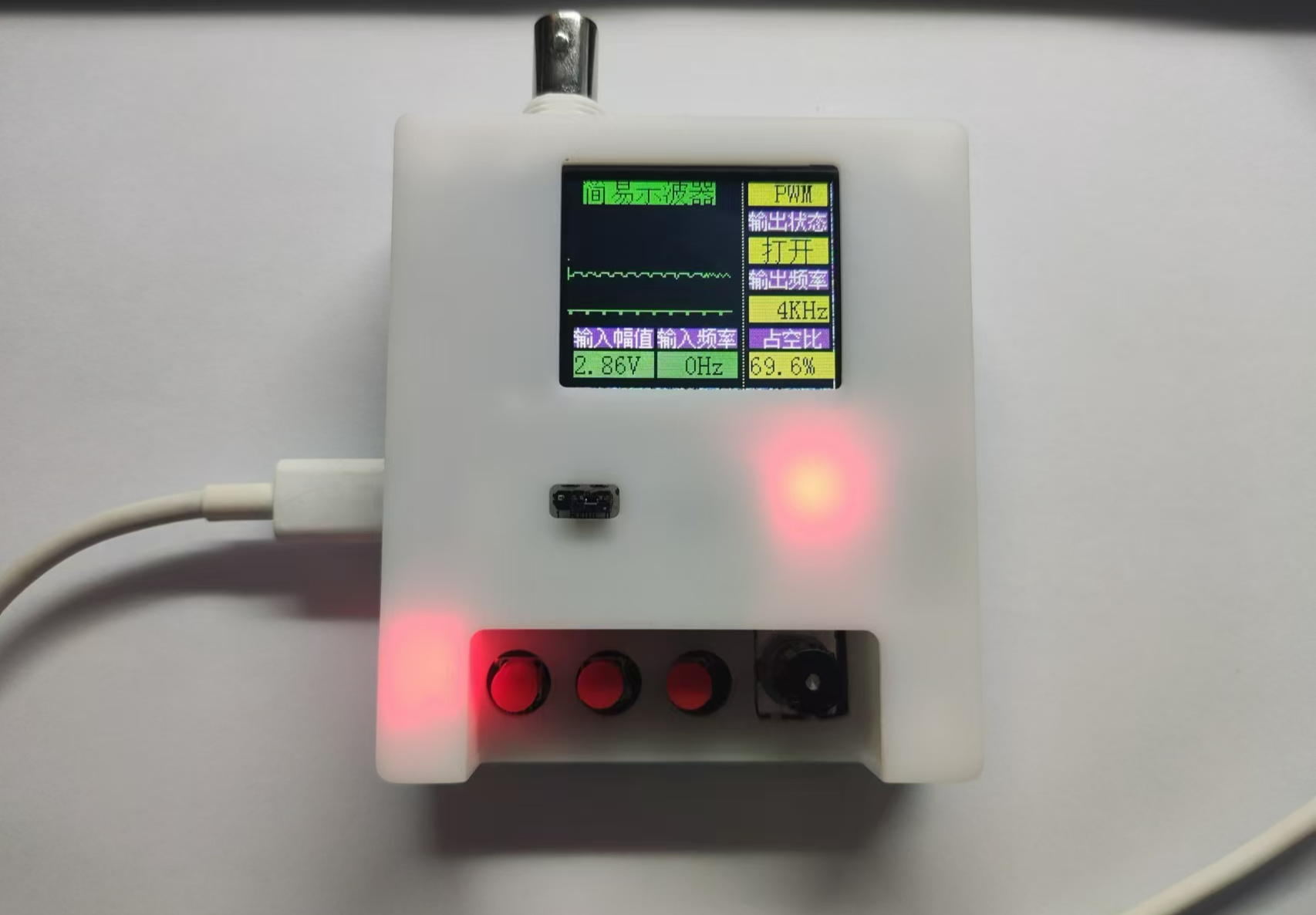
Learning to design and build a digital oscilloscope is highly beneficial for developing comprehensive personal abilities. This digital oscilloscope project includes the design and development of microcontroller circuits, calculations for signal conditioning circuits, design of human-computer interaction, and design of the enclosure model. It integrates knowledge of analog circuits, microcontroller design, circuit and PCB design, and enclosure design. Considering the learning pace of beginners, this introductory digital oscilloscope project is specifically designed for electronic introductory training and microcontroller learning. This project has the following features: it
adopts a core board plus expansion board design concept and uses plug-in components to simplify learning;
the core board uses the domestic GD32 as the main controller, while also being compatible with other similar development boards;
the project is highly comprehensive and practical, and the completed design can be used as a desktop instrument;
the project has abundant learning materials, including circuit design tutorials, PCB design, and code programming lessons.
(III) Notes:
1. All PCB files, panel files, and 3D files for this project can be downloaded and ordered directly. They have been verified to be correct.
2. PCB and panel files can be ordered directly through the JLCSC order assistant. The 3D files are in the attachments. After unzipping the compressed file, drag all files into 3DMonkey for printing.
If incompatibility is found in the 3D files during testing, minor modifications can be made using a utility knife. Resin-printed models are easier to modify.
3. All components used on the PCB board were purchased from the LCSC online store. The Gd32 mini-system version was also purchased from there (STM32 is under investigation...).
4. The four corners of the 3D shell are secured with M3 screws (3mm diameter). Select screws with a length of 4mm. Both the cable for the alligator clip and the adapter can be purchased directly from online shopping platforms for approximately 5 yuan.
5. After completing all the models, directly burn the .hex file (located in project-objects). There should only be one file, which is included in the attachment. For a practical demonstration, please refer to the video showing the unzipped package in the attachment.
6. Unzipping can be done using WinRAR or by right-clicking and selecting "Unzip". WinRAR can handle more types of compressed files, but all attachments in this project can be unzipped using either method.







 京公网安备 11010802033920号


 DBI15-04



