1. Project Background
: With the rapid development of IoT, smart homes, industrial automation, and other fields, the demand for microcontrollers is increasing. The STC32G12K128-LQFP64, as a high-performance 32-bit microcontroller, has become the first choice for many developers and engineers due to its rich peripheral interfaces, powerful processing capabilities, and flexible programming environment. To meet the needs of rapid development and field debugging, implementing a stable and efficient serial port download program is particularly important.
Chip: STC32G12K128-LQFP64
Development Board: STC32G12K128-LQFP64 core board
Download Method: Onboard CH340N, downloading via serial port
2. Project Objectives
The core objective of this project is to achieve a comprehensive design of the STC32G12K128-LQFP64 core board, including hardware design, firmware programming, and the implementation of the serial communication protocol. The design aims to create a stable, efficient, and easy-to-use development platform to facilitate subsequent program development and debugging.
3. Design Concept
In the hardware design phase, we fully exposed all 64 pins of the STC32G12K128-LQFP64 chip, ensuring users can access and utilize every pin's
hardware connection: The STC32G12K128-LQFP64 core board has an onboard CH340N chip, which connects to a computer via a TYPE-C port for programming. ADC Module Design:
A precise
reference voltage design was provided for the chip's analog-to-digital converter (ADC) module, ensuring the ADC module can accurately acquire and convert analog signals. Power Supply Control:
The overall power supply of the development board is controlled via a toggle switch, allowing users to easily turn the power on or off for convenient power management.
FLASH Storage Circuit: A FLASH storage circuit is designed on the back of the development board, providing users with additional non-volatile storage space for convenient storage of programs and data.
Function Buttons: Three onboard function buttons, including a reset button, KEY1, and KEY2, provide users with convenient control methods for resetting the system, triggering specific functions, or performing user interactions.
Download Protocol: Briefly describe the download protocol or tools used, such as STC-ISP, STC-Flash, etc.
4. Test Results
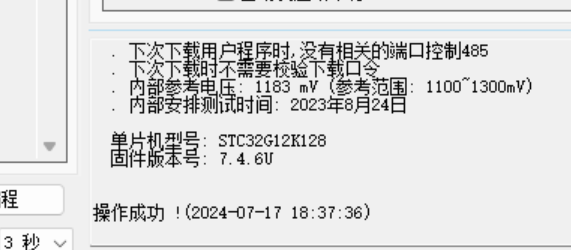
Functional Test: Using STC-ISP for MCU detection, the MUC (STC32G12K128) was successfully detected.
5. Conclusion and Outlook
Conclusion: Through the implementation of this personal design project, I successfully completed the design and development of the STC32G12K128-LQFP64 core board. This process not only deepened my understanding of the characteristics of the STC32G12K128-LQFP64 chip but also improved my hardware design and firmware programming capabilities. The comprehensive pinout of the core board, the precise ADC module reference voltage design, the convenient power supply control switch, the rear FLASH storage circuit, and the integration of onboard function buttons together constitute a powerful and easy-to-use development platform.
During the project implementation, I encountered several technical challenges, such as power management stability and FLASH memory circuit compatibility. Through continuous learning and practice, I gradually overcame these challenges, which not only honed my problem-solving skills but also boosted my confidence. Through repeated testing and verification, I ensured the performance and stability of the core board, laying a solid foundation for subsequent program development and debugging.
The completion of this project marks my personal growth and progress in this field. I look forward to applying this core board to real-world projects to further verify its performance and optimize the design based on actual usage. At the same time, I hope to provide reference and assistance to other developers through this experience, jointly promoting technological development and innovation.
Overall, this personal design project is not only a process of technical practice but also a valuable experience in my career. I will continue to dedicate myself to learning and exploring the field of microcontrollers, constantly improving my technical skills to prepare for more complex and challenging projects in the future.








 京公网安备 11010802033920号


 10-1004818-E2F0



