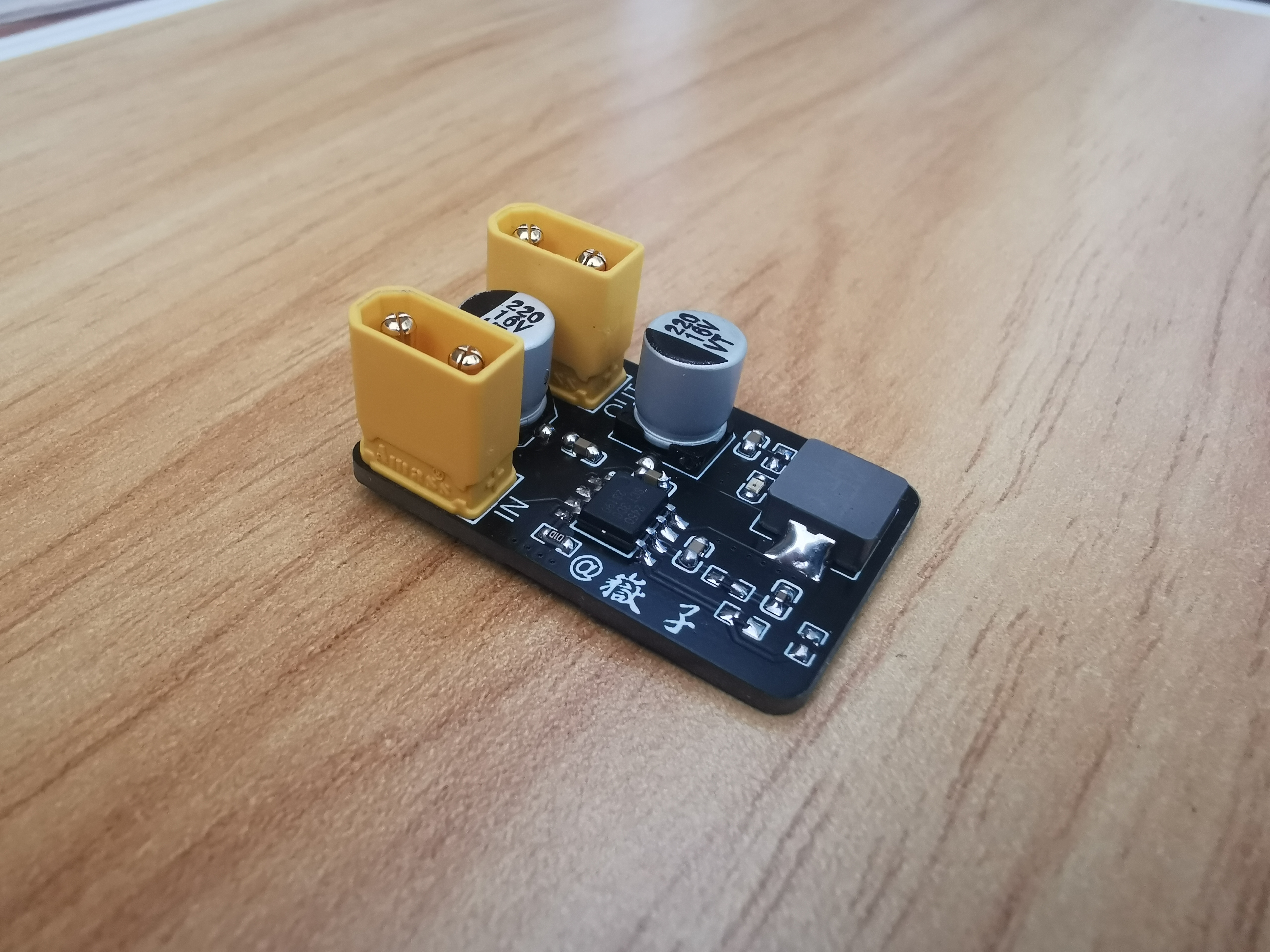
This product is a DC-DC power supply based on the SCT2450 chip, which is suitable for various high-voltage to low-voltage conversion applications. It is also being used in intelligent vehicle competitions, and the actual test results show stable performance. Therefore, this step-down module was designed.
Let me explain why I chose this chip.
Before this, I had used many DC-DC step-down chips. Driven by the desire to reduce module size, I used the MP2236G chip. While the MP2236G's input and output voltage range was sufficient, it had a fatal flaw: poor current handling. Instantaneous current overload caused the chip to constantly "blow up" (prone to short circuits). Initially, I didn't know the cause, and several different versions failed to resolve the issue. Due to time constraints and a heavy workload, I chose the SCT2450 chip, which offers a wider input and output voltage range, peak current limiting, overcurrent hiccup protection, overheat shutdown protection, output overvoltage protection, and input undervoltage protection, providing multiple layers of safety for practical applications. In actual testing, it worked flawlessly, exhibited excellent stability, and provided highly accurate output voltage.
The SCT2450 chip offers several advantages:
an input voltage range of 3.8V to 36V, support for transient overshoot voltages up to 38V, an adjustable switching frequency from 100kHz to 1.1MHz, peak current control mode, a quiescent current of 25μA in sleep mode, peak current limiting and overcurrent hiccup protection, overheat shutdown protection, output overvoltage protection, and input undervoltage protection. It also comes in a standard 8-pin ESOP-8 package with a simple pinout.
Regarding the design,
I consulted the SCT2450 chip datasheet and studied the circuit and resistor values. My specific output voltage is 6.8V, so I located the adjustable resistor. By increasing the resistor value, the output voltage increases. The 75K resistor in the schematic is the adjustable resistor, which can be adjusted according to your desired output voltage.
This adapter card brings out the USB ports on the MiniPCIe interfaces inside some ThinkPad T60/X60 laptops, which can be used to build a Unifying mouse receiver. This has been verified.
ThinkPad T60/X60 machines have an unused MiniPCIe interface that only supports USB, not PCIe, so it can't accommodate NVMe SSDs. Therefore, it's ideal for using it to house a Unifying mouse receiver.
This adapter card brings out the USB port on the MiniPCIe interface.
Logitech mouse online pairing webpage: https://logiwebconnect.com/select-receiver
Detailed article: https://www.ibmnb.com/thread-2040850-1-1.html