1. Project Description:
The digital voltmeter and ammeter combines ADC technology with circuit measurement principles, accurately converting analog voltage and current signals into digital displays for easy reading and analysis by electronic engineers. This device not only improves the accuracy and efficiency of circuit measurements but also helps engineers better understand circuit behavior, making it a powerful tool for electronic design and troubleshooting, and playing a significant supporting role in the work of electronic engineers. Through participating in the training camp, I learned about a 32-bit MCU from Chipsource Semiconductor—the LCSC CW32F030C8T6 development board. By studying the CW32F030C8T6 in LCSC's official documentation and the practical tutorials from Mr. Li in the training camp, I understood why the training camp used the CW32F030C8T6 development board to design this voltmeter and ammeter—primarily due to the high precision of the CW32F030C8T6 chip in ADC technology. This is a major advantage of Sinyuan Semiconductor compared to other 32-bit MCU manufacturers, and it also shows that domestically produced chips are becoming increasingly powerful. I'm also grateful to Mr. Li from LCSC for his detailed explanations and to LCSC EDA for providing this excellent learning opportunity.
Since this is my first time working with this chip, there's still a lot to learn. While ensuring successful replication, I'll add an LCD interface, OLED, serial port debugging, DHT11, temperature and humidity sensor, etc. It can also be used as a simple CW32F030C8T6 development board for future learning. To reduce the purchase of consumables, I'll make full use of existing surface-mount components. Resistors, capacitors, and LEDs have all been replaced with 0603 surface-mount packages, which also helps me improve my soldering skills for surface-mount components.
2. Voltage and Current Measurement Principle:
This voltage and current meter primarily uses a high-precision 12-bit high-speed ADC controlled by a CW32 microcontroller (with multiple Vref reference voltages available: 1.5V and 2.5V). This design uses the 1.5V internal reference voltage of the MCU (a 2.5V internal reference voltage is also available, but lower reference voltages offer higher accuracy), meaning 0~4096 corresponds to a range of 0~1.5V. For comparison, testing, or calibration, the board also provides a TL431 voltage reference chip, offering a 2.5V reference voltage with relatively high accuracy. Current measurement is calculated by measuring the voltage and using a 100mΩ current sensing resistor. The 100mΩ current sensing resistor is used for current measurement, and to improve measurement accuracy, a classic Kelvin connection is employed for current sensing. It must be said that LCSC EDA engineers have put considerable effort into the hardware design.
3. Function Demonstration:
Button 1: Function selection and mode switching ; Button
2: Set calibration value;
Button 3: Return to voltage and current measurement display mode
. Voltage measurement range: 0-3VDC/0-30VDC,
Note: For safety reasons, this project uses 30V (actual maximum display is 99.9V or 100V);
Current measurement range: 0-3A,
Note: The sampling current designed for this project is 3A, and the selected sampling resistor (R0) is 100mΩ.
4. Design Rendering:
1) PCB 3D rendering:
front
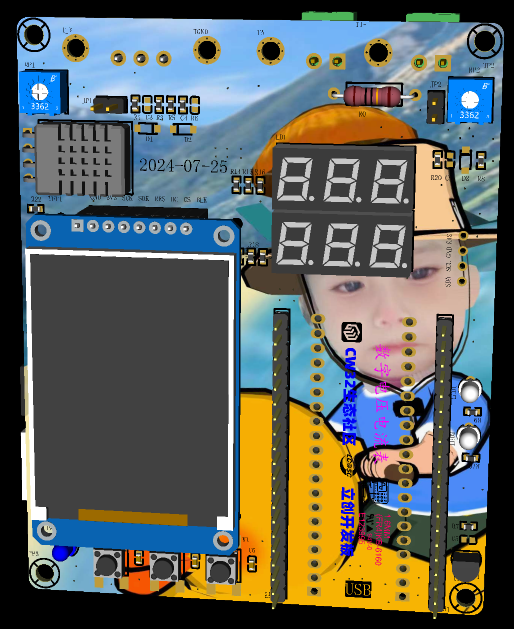
and back;
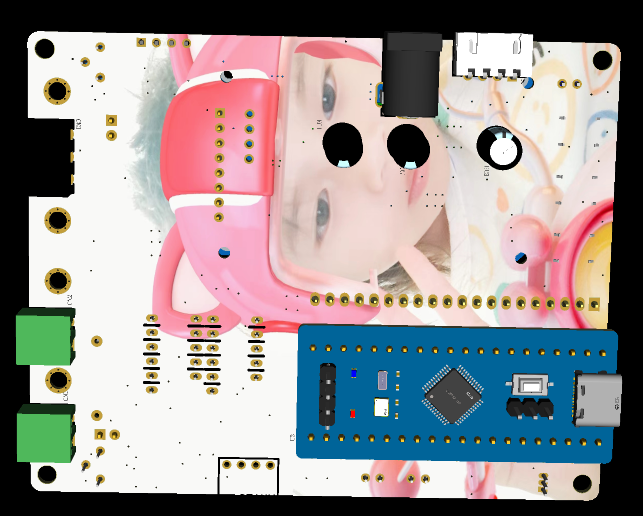
2) 3D shell rendering;
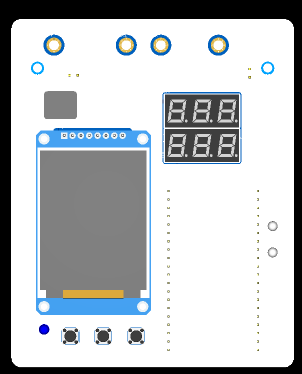
3) 3D panel rendering.
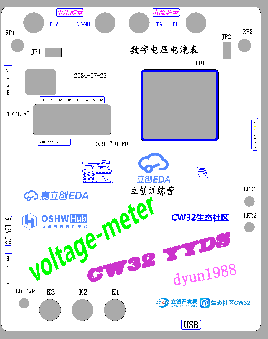
5. Physical Rendering:
Replacing physical images :
1. Voltage and current measurement
①, Voltage measurement
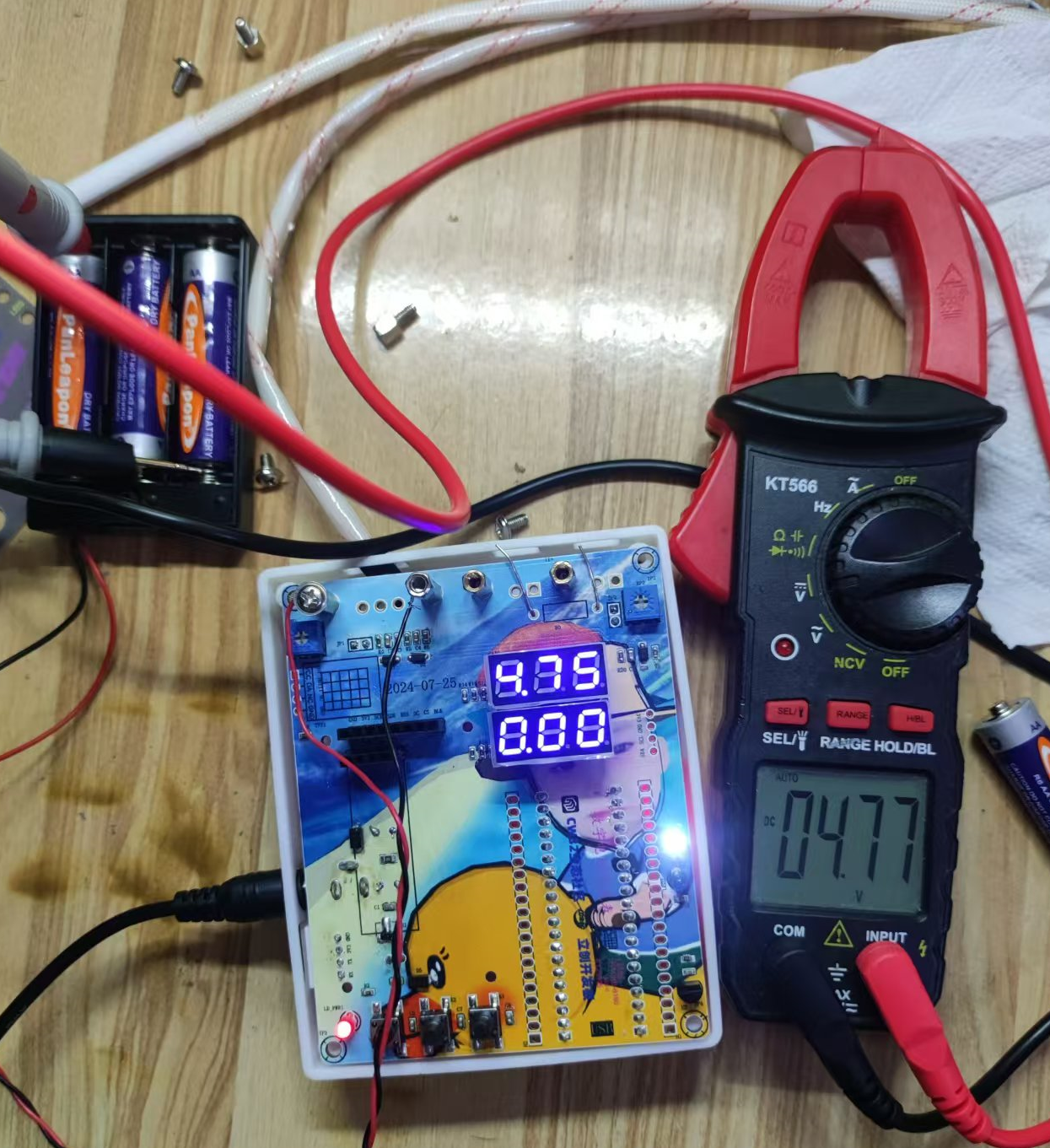
②, Current measurement display (
images to be replaced...);
2. Calibration interface (
images to be replaced...);
6. Video Demonstration:
To be completed...








 京公网安备 11010802033920号


 LPS1T60R1KRN4BF1U