
Portable microphone preamplifier
Source: InternetPublisher:zfZ1OODMq Keywords: Preamplifier Updated: 2025/12/19
Circuit diagram:
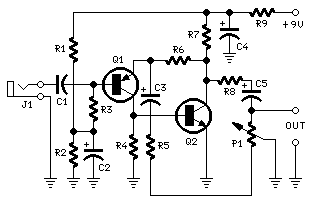
Component:
P1______________2K2 Linear potentiometer
R1,R2,R3______100K 1/4W Resistor
R4______________8K2 1/4W Resistor
R5_____________68R 1/4W Resistor
R6______________6K8 1/4W Resistor
R7,R8___________1K 1/4W Resistor
R9____________150R 1/4W Resistor
C1______________1µF 63V Polyester capacitor
C2,C3,C4______100µF 25V Electrolytic capacitor
C5_____________22µF 25V Electrolytic capacitor
Q1___________BC560C 45V 100mA Low noise high gain PNP transistor
Q2___________BC550C 45V 100mA Low noise high gain NPN transistor
J1_____________ Jack/Socket (Mono 3 or 6) (millimeters.)
Equipment application:
This circuit is primarily used to provide a microphone input for a typical home stereo amplifier. Battery power is a good compromise: it protects the input circuitry from low-frequency power supply hum, and connecting to the amplifier is simpler due to the absence of power cords and a power source.
When using a stereo microphone, the circuitry must be doubled. In this case, two independent level controls are better than dual stereo potentiometers.
Low current consumption (approximately 2mA) ensures long battery life.
Circuit operation:
This circuit is based on a low-noise, high-gain two-stage PNP and NPN transistor amplifier, which uses DC negative feedback via R6 to stabilize operating conditions very precisely. The output level is attenuated by P1, but at the same time, the stage gain decreases due to the increase in the value of R5. This unusual connection of P1 helps to obtain a high input headroom, allowing it to handle a wide range of input sources (0.2 to 200mV RMS, corresponding to a 1V RMS output).
Note:
- Harmonic distortion is approximately 0.1% @ 1V RMS output (all frequencies).
- Maximum input voltage (level control cursor set to maximum) = 25mV RMS
- Maximum input voltage (level control cursor set to center position) = 200mV RMS
- It is strongly recommended that the circuit be encapsulated in a metal casing.
- Simply connect the output of this device to the auxiliary input of the amplifier using a shielded cable and a suitable connector.
- Class A headphone amplifier
- USB Audio Digital-to-Analog Converter
- General purpose 2-watt stereo power amplifier
- Guitar Faz effects pedal
- High-fidelity headphone amplifier
- 10W audio amplifier with bass boost
- High-fidelity tube amplifier
- Microphone amplifier using TDA7050 integrated circuit
- 5 Watt Class A Audio Amplifier
- Low voltage multi-song music integrated circuit using K482G
- Preamplifier with audio controls
- Transformerless symmetrical input microphonic preamplifier circuit
- Ultra-low noise playback preamplifier circuit
- Server preamplifier circuit diagram of parallel op amp
- Ultra-small preamplifier circuit with very small input capacitance
- High Input Impedance Preamplifier Circuit
- Increase gain 20dB preamplifier
- 432MHz preamplifier
- Medical instrument preamplifier
- Preamplifier for infrared remote control system







 京公网安备 11010802033920号