
Two-wire flashing light
Source: InternetPublisher:q9AKi6 Keywords: flasher Updated: 2025/12/05
Circuit diagram:
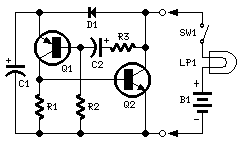
Component:
R1______________6K8 1/4W resistor
R2____________270K 1/4W resistor
R3_____________22K 1/4W resistor
C1____________220µF 25V electrolytic capacitor
C2_____________10µF 25V electrolytic capacitor
D1___________1N4002 100V 1A Diode
Q1____________BC557 45V 100mA PNP transistor
Q2____________BD139 80V 1.5A NPN transistor
LP1___________ Existing incandescent bulb: any type in the 3-24V 10W maximum range.
SW1___________ Existing switch
B1____________Existing DC power supply: Any type within the 3-24V range, suitable for the lamp used.
Equipment application:
This circuit is designed to change a continuously lit light already connected to a circuit to a flashing light. Simply plug the circuit between the existing light and the negative power supply. Particularly suitable for automotive or panel indicator lights, this device can drive lights up to 10W.
Notice:
- Disconnect the lamp from the negative power supply, then insert the circuit between the existing lamp connection and the negative power supply (note the polarity!).
- The value of C1 can vary from 100 to 1000µF or higher to change the flicker frequency.
- Although somewhat oversized, this circuit can also drive any LED, provided that a suitable resistor is connected in series with the light-emitting device.
- The resistance should be in the range of 47 ohms to 2 kJ/m², depending on the power supply voltage.
- Flashing LED circuit
- LED or light flasher
- 3V low battery voltage flasher
- Simple portable fluorescent lamp circuit
- DIY a hat with a programmable LED display
- Six LED stereo VU display circuit built with IC LM3915
- Use MC1455PIG to make automatic cycle light-emitting diode circuit
- Use NE555 to make a lighting and sound changing circuit
- Infrared detection alarm
- Driving circuit for driving light-emitting diodes by IR53HD420
- 555 timer disconnection photoelectric isolation safety protection circuit
- Breathing light circuit diagram designed by NE555
- Micromotor pedal speed regulator circuit and improvement
- The battery fast charging circuit is composed of BQ2002 battery fast charging control integrated circuit
- Use 555 to make DC-DC boost circuit







 京公网安备 11010802033920号