
FM transmitter
Source: InternetPublisher:28CHkVGwK2 Keywords: FM transmitter Updated: 2026/01/30
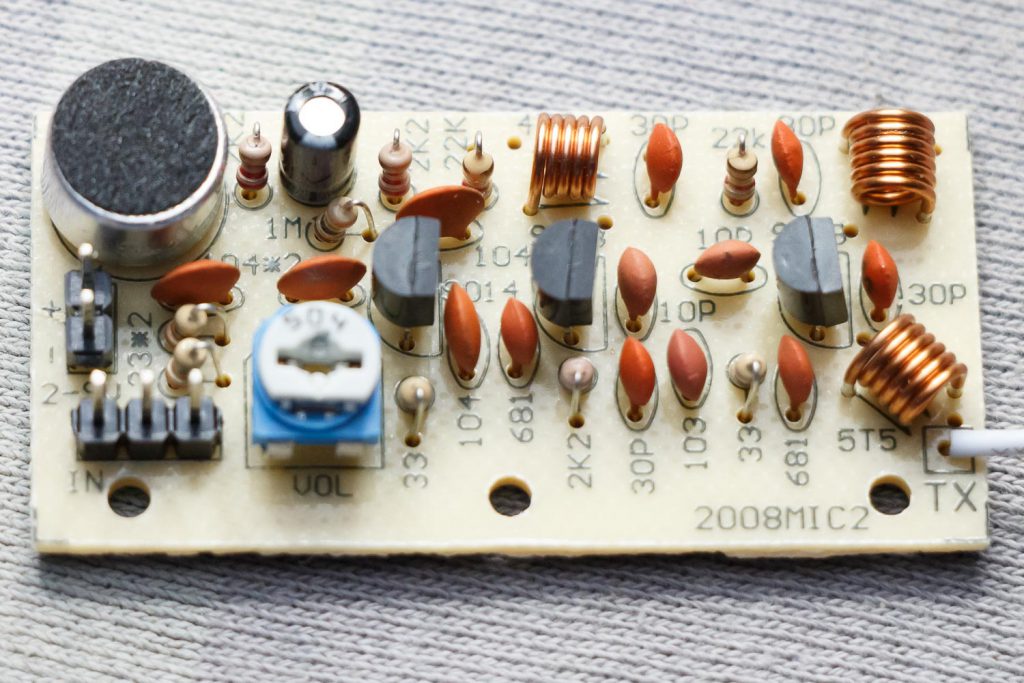
FM radio transmitter
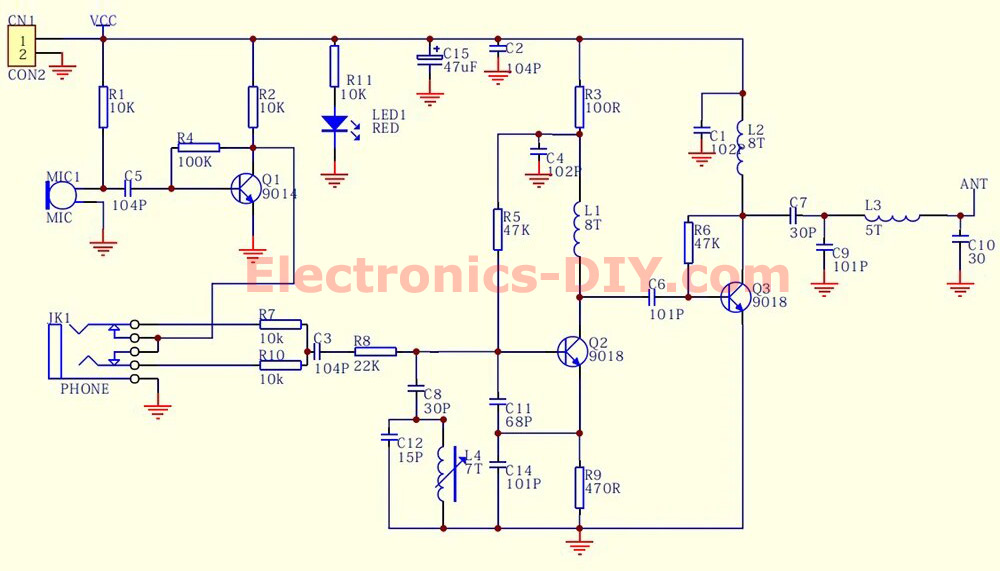
Using this three-stage transistor transmitter, we can create and broadcast our small radio station. We use the S9018 transistor because it can handle very high frequencies, up to the VHF band. The first transistor on the left is a microphone audio amplifier for modulation. The gain can be adjusted via a potentiometer. The second transistor is an oscillator, ranging from 80 to 103 MHz. The frequency can be changed by slightly pulling the upper coil 4T5. The signal from the oscillator is very weak, so it still needs to be amplified. Therefore, the rightmost transistor is an RF amplifier. This amplifies the oscillator signal before feeding it to the antenna. This transistor also immediately provides more stability because the oscillator is not directly connected to the antenna.
Function of RF oscillator
A transistor itself is not an oscillator. It only amplifies itself when you feed its output back to its input. Compare it to a microphone you hold in front of a speaker; a scream is also an oscillation. You can influence the pitch of a scream with your hand. That's how an RF oscillator works. By connecting a coil (4T5 mentioned here) and a capacitor in parallel with the transistor's input, the transistor is sensitive only to a specific frequency. This frequency is called the resonant frequency. Therefore, if you change the values of the coil and/or the capacitor, you can change the frequency. That's exactly what you do when you pull the 4T5 apart. There's a small parasitic capacitance in the transistor that's voltage-dependent. By supplying music (with a changing voltage), the capacitance at the base of T2 changes slightly. This affects the resonant circuit, and the transmitter will slightly change its frequency in sync with the rhythm of the music. This is frequency modulation (FM). In a "real" FM radio station, this is done in a better way, for example, using a varactor diode.
RF filter
Therefore, a coil and a capacitor connected in parallel form a frequency-specific unit. This is called a resonant circuit. However, you can also use this principle as a filter by connecting them to other things. For example, all signals above 120 MHz are filtered out. The rightmost coil at the output has this filtering function. And it allows the amplifier to operate optimally at around 100 MHz.
stability
Stability has always been a concern with FM transmitters, but the oscillator is somewhat isolated due to the design with a buffer amplifier at the output and an audio amplifier at the input. However, it's best not to place it too close to the antenna, as this can cause significant frequency instability.
sound quality
I only tested it with a microphone. Despite the modulation method, the sound quality is by no means disappointing. For example, there are no varactor diodes or anything like that inside. The audio is full, but could be a bit higher. It's sufficient for speech. The amount of noise in the audio isn't too bad, and it's quite neat for an FM transmitter.
power supply
As a power source, it's best to use a 9V battery, not an adapter or power supply. Otherwise, you'll quickly get a buzzing sound due to the moderate disconnection (even if the power source is clean; I believe it's related to a loop in the AC power). Current consumption is approximately 34mA at 9V.
- 8W Broadband FM Radio Frequency Amplifier
- MAX2606 VHF FM Transmitter
- Simple MP3 FM transmitter
- FM transmitter
- Miniature FM receiver
- How to make an FM transmitter
- TDA7012 Single-chip FM receiver
- The simplest FM microphone circuit diagram (wireless microphone circuit diagram)
- J-type communication antenna production
- nRF904 FSK 915 MHz Transmitter
- USB communication circuit
- Indoor unit communication circuit
- Crystal oscillator 80mW FM transmitter production circuit diagram
- Two-way communication circuit circuit diagram
- 2m, 2W phase-locked FM transmitter
- Long distance serial communication circuit
- CAN bus communication circuit
- Wireless transmitter circuit diagram
- Time division multiplexing stereo decoder circuit
- Design of wireless transmitting and receiving circuit based on Bluetooth







 京公网安备 11010802033920号