
AC power failure alarm
Source: InternetPublisher:MbPmmd Keywords: AC power supply power failure alarm Updated: 2026/03/03
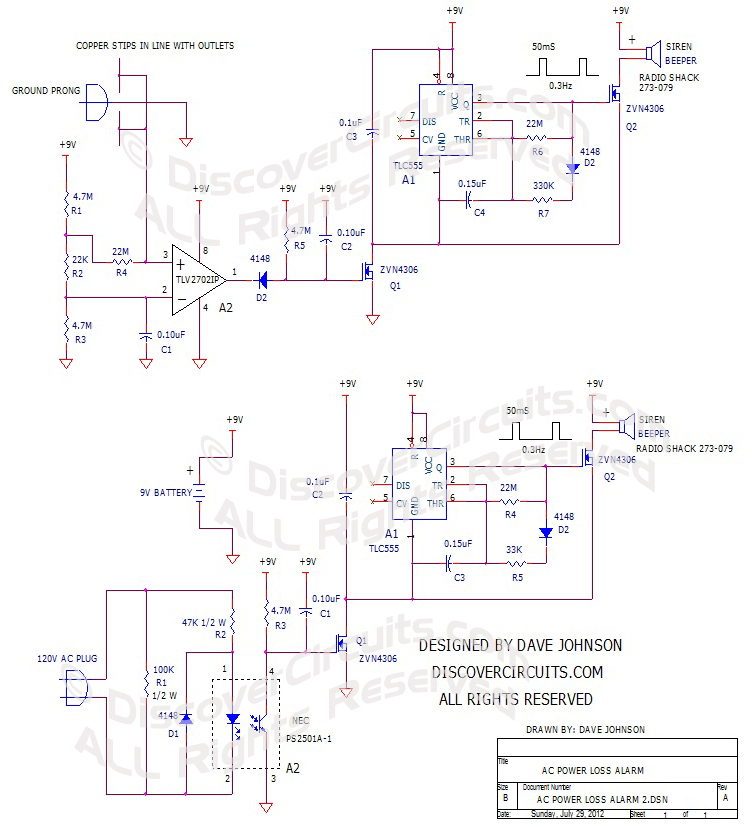
My instant hot water system has been having problems lately. This system uses a small pump to circulate electrically heated water throughout the house. The pump is connected to a ground fault circuit interrupter (GFI) module. Every now and then, the GFI trips, leaving me without hot water. I need an alarm to alert me when the GFI cuts off AC power to the outlet. I think a loud chirping 9V battery-powered buzzer would be suitable for this. The chirping will attract my attention and let me know I need to reset the GFI switch without waking the entire neighborhood. My circuit is shown below.
I have two different methods for detecting when the GFI socket is de-energized. One method uses a small optocoupler, a diode, and a resistor, directly connected to the two power pins of the GFI output. This method brings 120V AC power into the box. This circuit is foolproof but reduces the overall security of the alarm box. The other method is somewhat unconventional. It uses a pair of copper strips inside the box to sense the electric field emitted by the active pin on the socket. I still use the third ground pin of the socket to hold the box to the socket, so that the copper strips are in a predictable position above the socket. Two copper strips are used so that the box can be inserted into either the upper or lower socket. If people have questions about non-contact methods, I have shown both sensing methods in the diagram below. The alarm housing I recommend is a small plastic box with a convenient 9V battery compartment, available from Digikey.
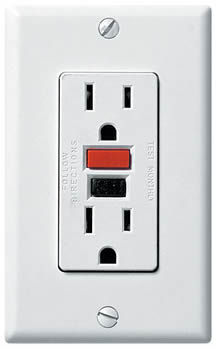
GFI socket

Alarm plastic box
The circuit is powered by a 9V battery and packaged in a small plastic box with a 9V battery compartment. A very popular optocoupler is used to monitor the power line. The n-channel FET Q1 remains off as long as AC power is available at the input. Once power is lost, +9V is switched to the buzzer circuit. I used a CMOS version of a 555 timer to generate a 50ms pulse every 3 seconds. The timer's output drives an n-channel FET, which in turn drives a very loud alarm-type buzzer, available from Radio Shack. The result is a sound maker that is very loud but produces only short chirps. The sound is loud enough to be heard without consuming a large average current from the 9V battery. Using the short 50ms pulses every 3 seconds, the average current during buzzing is reduced to about 2 mA. In standby mode, the current is about 2 µA.
The electric field method uses many of the same components, but employs a low-power voltage comparator to sense the AC electric field from the active power outlet. When power is lost, the device begins to beep.
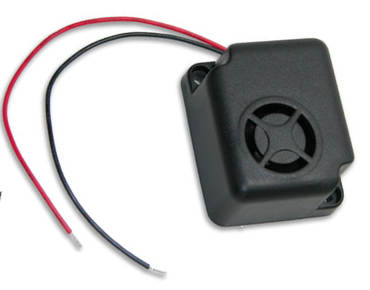
Piezoelectric alarm from Radio Shack
- Resistive switch network audio volume control
- Drain pump controller
- Stepper motor controller
- Low and high tone control circuit
- Solar panel controller
- Wireless security alarm
- Considerations for starting an ACDC power supply with a PMDC motor load (2)
- Create a Smart Brightness Controlled Lamp Using a Motion Sensor
- Analysis of the working principle of KT-1 fog machine
- Comparison of control circuits for reduced voltage starting methods of squirrel cage asynchronous motors
- Egg heating control circuit
- Photoelectric tracking control circuit
- Table printing machine control circuit
- Three-phase stepper motor control circuit
- PLC chain alarm control circuit used in production process
- DK-2 type control box uses AC power electromagnet closing circuit
- Dedicated servo stabilized power supply for power amplifier
- Panasonic servo stabilized power supply (b)
- 60 watt laptop battery charger circuit
- Timing AC power supply circuit diagram that supplies power for 0-1 hour







 京公网安备 11010802033920号