VFD (Vacuum Fluorescent Display) - Desktop Clock Ornament
:
A VFD is a display device developed from vacuum tubes, sharing fundamental characteristics with them. It consists of a cathode (directly heated, commonly called a filament) that emits electrons, a grid that accelerates and controls the electron flow, an anode with electrodes and phosphor printed on a glass substrate, a grid, and a glass cover.
It utilizes electrons striking the phosphor to cause it to emit light, making it a self-emissive display device. VFDs are generally classified into diodes and transistors based on their structure; into digital displays, character displays, pattern displays, and dot-matrix displays based on their display content; and into static driving (DC) and dynamic driving (pulse) based on their driving method. Display light emission forms include dot-matrix and fixed graphic/text displays. Because it can display multiple colors, has high brightness, can be driven with low voltage, and is easily integrated with integrated circuits, it is widely used in various fields such as home appliances, office automation equipment, industrial instruments, and automobiles.
This is a Cyberpunk-style desktop/standing display based on the STC8H8K64U as the main controller, capable of detecting indoor temperature and humidity, as well as date and time.
The screen uses a VFD inverted display from the LG HT503TH high-end home theater system host; the schematic diagram is attached. The
temperature and humidity sensor uses a DHT20 I2C driver, the VFD controller uses a PT6315 serial driver, and the high-precision real-time clock uses the RX8025T I2C protocol. It's a great project for learning and DIY; interested students can try replicating it.
Other materials are relatively easy to purchase. Purchase link for the reverse display screen:
https://item.taobao.com/item.htm?ft=t&id=809234654976
1. Screen Parameters
: Name: VFD
Brand: BOE
Model: VFD16-1002B
PIN: 10GR and 16SG
2. Circuit Peripherals:
DHT20 temperature and humidity sensor
, RX8025T real-time clock,
PT6315 driver IC
3. Circuit Description
: Uses STC8H output PWM to drive an H-bridge chip to generate filament AC.
STC download uses USB protocol for direct download without a programmer. USB uses CDC to simulate a serial port, eliminating the need for a serial port chip and
saving I2C pull-up resistors.
Uses a CUK chip to generate -29V negative voltage (LM2611AMF, domestic lowest price 1.38 per piece).
STC controls the negative voltage boost enable pin.
4. Software Description
: Development Environment Combination:
System: WIN11,
VS Code + Keil
, VS Code with EIDE plugin installed.
Keil compilation of
stcai-isp-vx.xx.exe is configured to automatically execute the download and default reset command after compilation
. The download frequency is set to 24MHz,
with CDC serial port enabled by default.
GitHub source code address: https://github.com/ccy-studio/CCY-VFD-BOE161002B
Project structure:
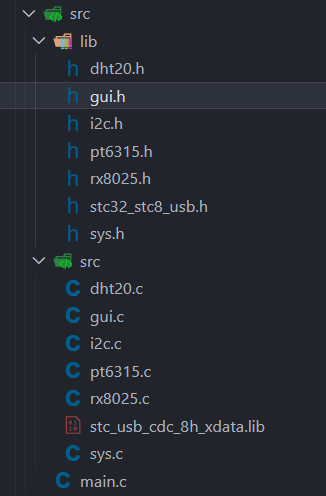
There are two types of I2C communication: hardware I2C and analog I2C. The method can be selected according to macro definitions.
DHT20 implements both CRC and non-CRC detection. Macro definition selection is
available in the doc folder, which contains examples of broken code bitmaps and a simple font library generation tool. HTML files can be opened directly.
Module descriptions:
DHT20 implements the API method for temperature and humidity reading, depending on the I2C file.
I2C implements both analog and hardware I2C implementation schemes.
RX8025 implements the API for reading and setting time, depending on the I2C file.
PT6315 implements the underlying U8 data transmission and register functions. Setting operation API
: GUI application layer encapsulation, implementing control of brightness, text information, icon display, animation, and screensaver functions, depending on PT6315.
sys: GPIO definitions and some peripheral initialization common definitions,
etc. The main function entry point implements key scanning, content display, page switching, etc. ...
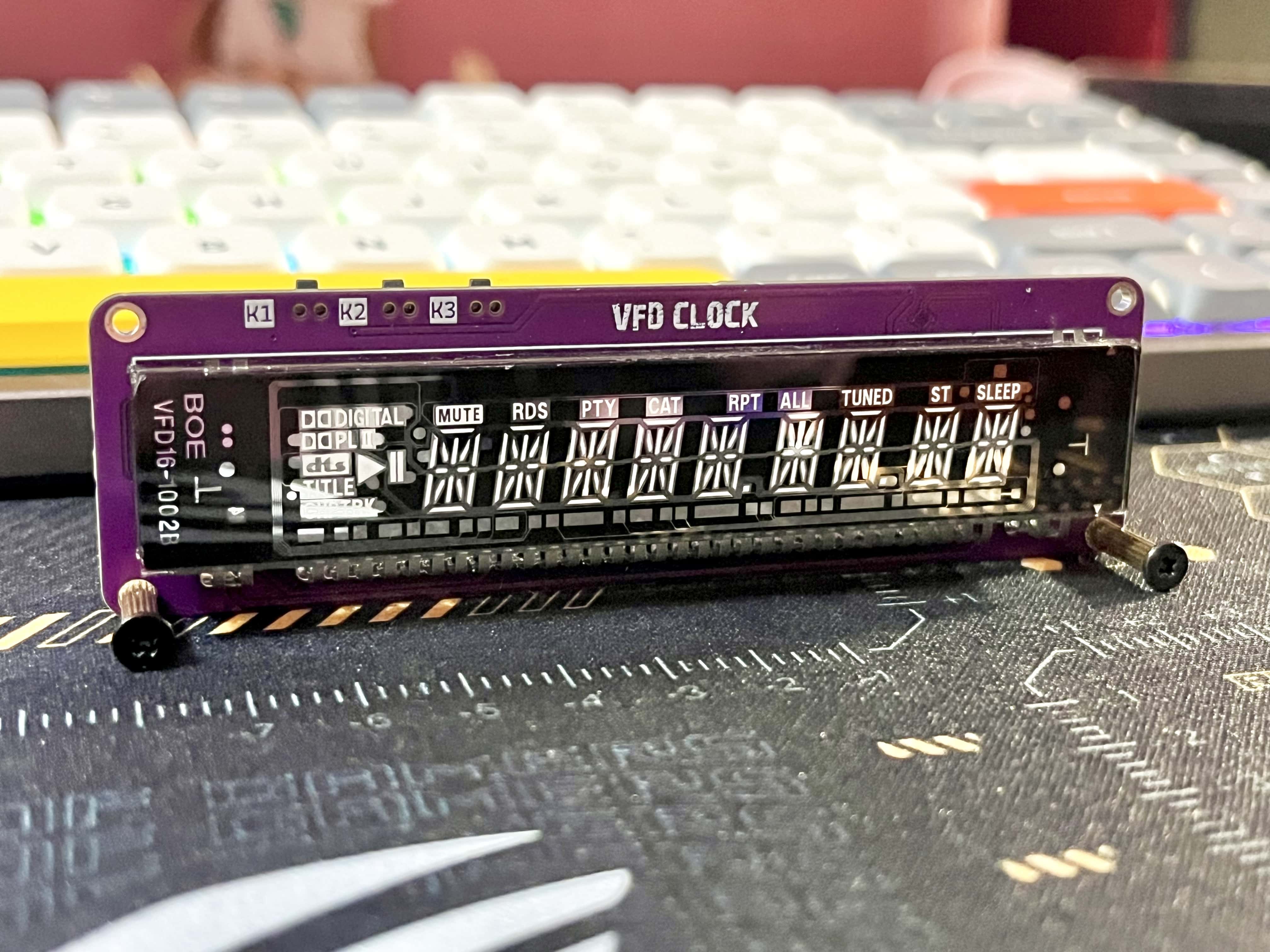
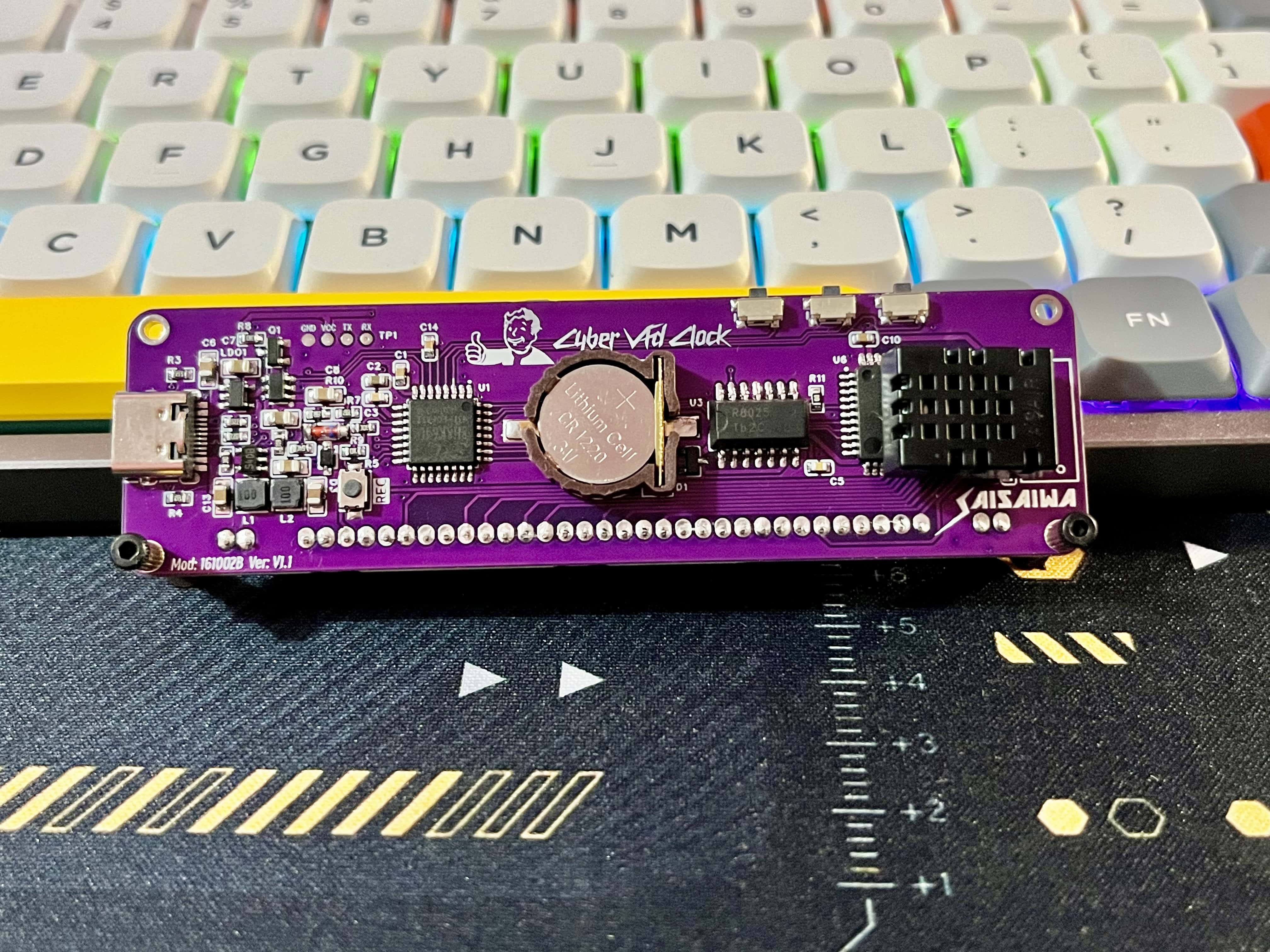
5. Physical Image
1
2









 京公网安备 11010802033920号


 DRD1500666V00A00T



