Project Introduction:
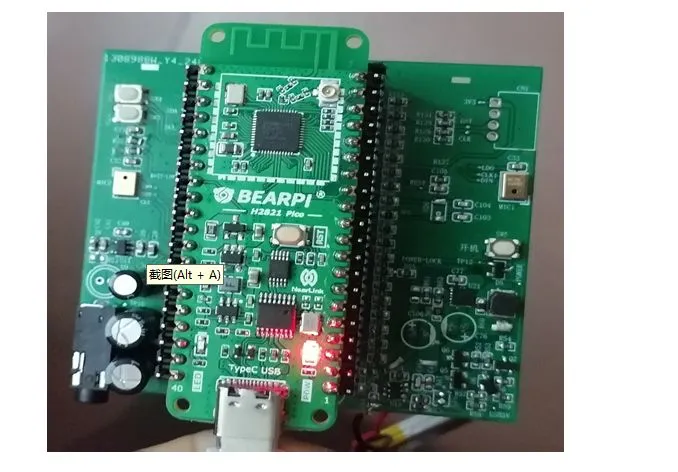
This project involves secondary development based on the "BearPi-Pico H2821 Star Flash Development Board". Having previously worked on wireless products, primarily Bluetooth 2.4G, I've always been interested in related news.
I've also been following Huawei's Star Flash development board, but haven't seen much information about it. In August, I saw BearPi had the Star Flash development board and immediately bought two. After receiving them, I performed some simple tests according to the engineering instructions (I didn't know the difficult ones), and everything went smoothly.
In September, I saw that BearPi had conducted distance tests on the development board, achieving an astonishing 3.3 kilometers! I can only say it's amazing. Previously, using Qualcomm's CC2529+CC8520, the distance was only about 150 meters in good environments, and only about 60 meters in complex environments.
This stark contrast made me wonder if I could also make the BearPi development board into a walkie-talkie mode to test the distance. If the distance is far enough, I believe Star Flash will definitely see better development, and I believe it will provide more and better choices for domestic chip substitution.
The BearPi-Pico H2821 is a core board based on a highly integrated 2.4GHz SoC BLE&SLE as the main control chip. It features flexible digital interfaces, with I/O ports that can be reused for any function. It integrates a high-performance 32-bit microprocessor (MCU), a hardware security engine, and rich peripheral interfaces, including SPI, UART, I2C, PWM, GPIO, USB 2.0, NFC Tag, PDM, I2S/PCM, QDEC, and a KEYSCAN keyboard scanning circuit. It supports 8-channel 13-bit resolution ADCs, and the ADCs can be connected to an audio AMIC. It has built-in SRAM and encapsulated Flash memory, and supports running programs on the Flash memory.
BearPi-Pico H2821 official website: https://bearpi.cn/core_board/bearpi/pico/h2821/
More reviews of BearPi-Pico H2821 can be found here: https://bbs.eeworld.com.cn/thread-1290106-1-1.html#pid3352022
Project Functionality :
The main functional settings are as follows:
1. Add a PCB board to house the components and the BearPi development board.
2. Add a battery and corresponding circuitry to the development board, as it can only be powered by USB. I mainly use it for distance testing, hence the need for a battery.
3. Add two digital microphone inputs and one I2S output for recording and listening to sound, as well as volume adjustment and amplification functions, especially outdoors where sound can be noisy.
Project Parameters
: Specifically, it has two microphone inputs and one audio output. The two boards are identical, similar to a walkie-talkie.
Principle Analysis (Hardware Description)
: The hardware was basically unchanged; I mainly borrowed the BearPi development board, adding a microphone input, I2S output, power-on circuit, and charging circuit.
Software code:
Software is completely foreign to me, but it's a piece of cake for the BearPi experts. I consulted the BearPi assistant, and they'll write a PR to solicit interest in this project—basically, no problem, what can it do? Haha.
So I started making the PCB and purchasing components for surface mount assembly.
After several days of purchasing and mounting, it's finally finished tonight. Currently, only the hardware is working; the voltage and other settings are OK. I'll debug it after the software is finished, and then we can test it. I'll record the process from time to time below. Thank you everyone.







 京公网安备 11010802033920号


 LC1008-391-G