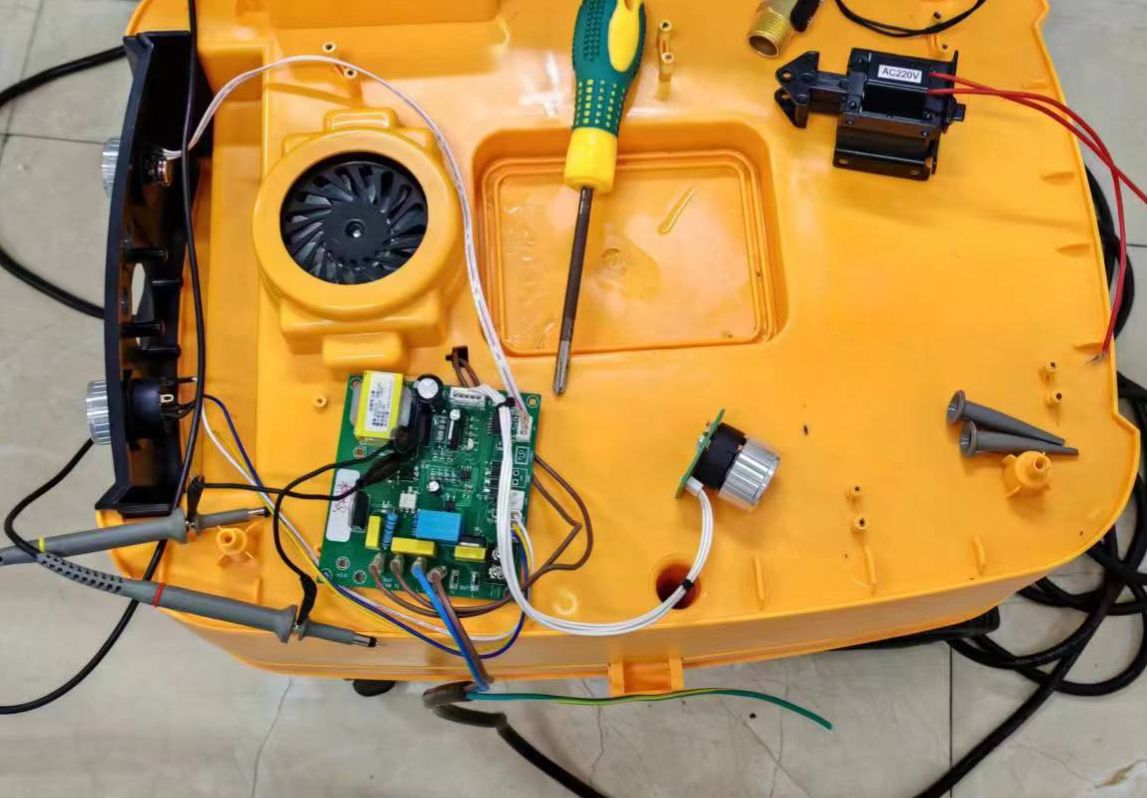
The design of a vacuum cleaner control system is a complex and precise engineering project, integrating multiple key modules and technologies to ensure system stability and reliability while achieving vacuum cleaner control functions. The core components of this system include a control module, solenoid valve control, comparators, optocoupler SCR drivers, optocoupler zero-crossing detection, and AC current rectification, each playing a crucial role.
First, let's look at the control module. This module is the brain of the entire system, responsible for coordinating and controlling the operation of various components. It controls the system through two input paths. The first path involves AC power being stepped down by a transformer, then rectified to output a stable 12V DC voltage, which is then output as 5V DC via an LDO to supply the microcontroller, comparator, and optocoupler. The second path involves AC power being output as DC via a current transformer and rectifier bridge, compared by a comparator, and outputting high/low level signals based on the relationship between the input voltage and the reference voltage. These signals are then input to the microcontroller for processing.
The microcontroller plays a critical role in this system, with two I/O ports for selecting automatic and manual modes. Switching between modes is achieved by connecting a single-pole double-throw switch to ground. In automatic mode, when the microcontroller receives a high-level signal from the comparator, it outputs a low-level signal to control the optocoupler, causing the motor to start working. If the microcontroller does not receive a signal from the comparator, it will detect a signal through a sensor, and the connected diode will also conduct, triggering the optocoupler and motor to work.
Regarding the adjustment of the motor speed and the solenoid valve's vibration frequency, the system utilizes the voltage divider principle of two resistors; the microcontroller can switch and adjust based on the voltage signal received from the I/O port. This achieves precise control of the vacuum cleaner's operating state, thereby improving its performance and efficiency.
In addition to the above functions, the system also includes an optocoupler connection to the solenoid valve for control. By controlling the optocoupler's conduction, the solenoid valve's operating state can be precisely controlled, enabling comprehensive control and management of all components of the vacuum cleaner.
The design of the vacuum cleaner control system not only involves various advanced technologies and modules but also requires careful design and debugging of the collaborative relationships between various components to ensure the system's stability, reliability, and efficiency. This complexity and precision in system design provides a solid foundation for improving vacuum cleaner performance and lays an important foundation for the future development of vacuum cleaner control technology.







 京公网安备 11010802033920号


 KM684000BLGI-7



