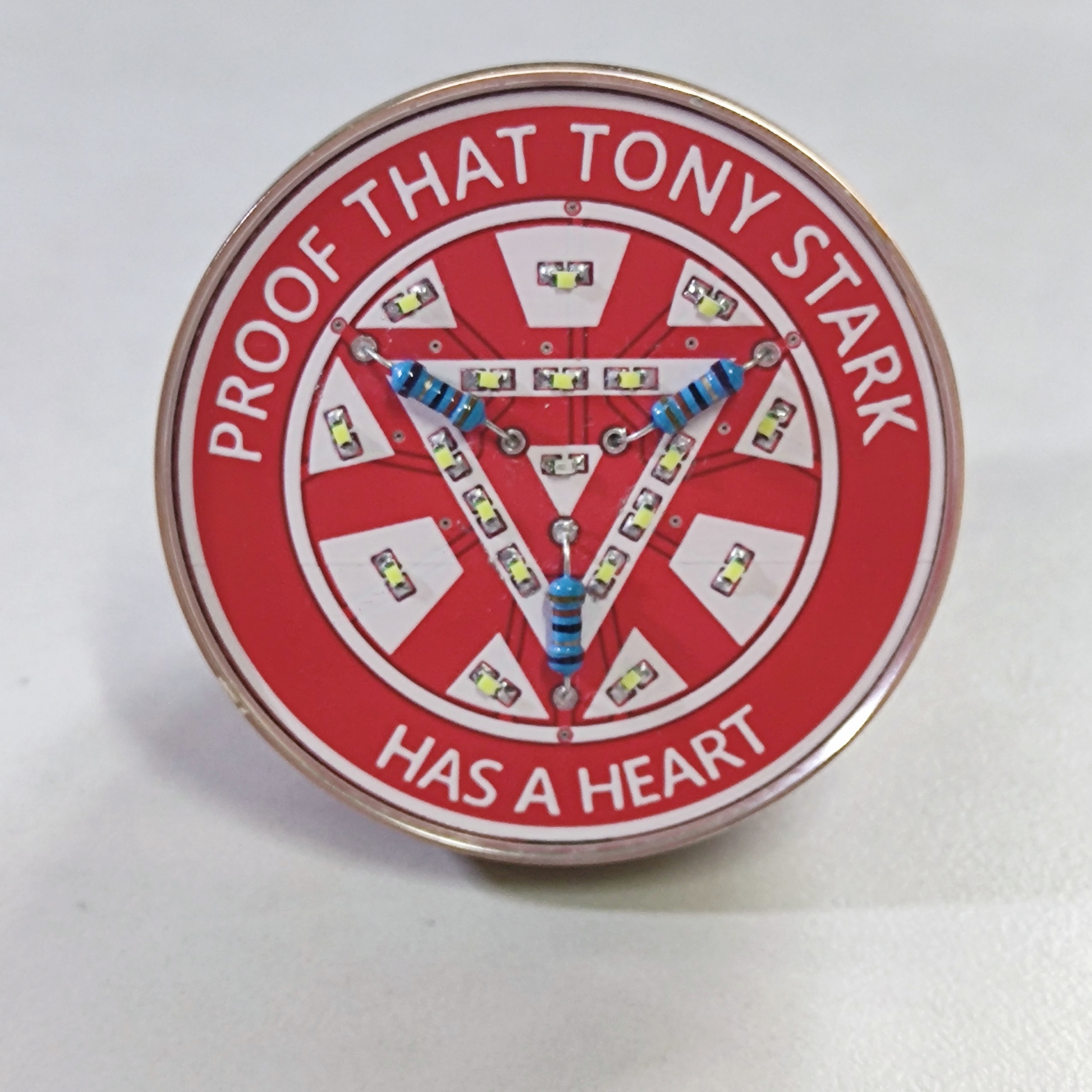
Iron Man 4th Generation Arc Reactor LED Board.
Thanks to the original project by @xiangyang0926. Iron Man Energy Reactor Push - JLCPCB EDA Open Source Hardware Platform (oshwhub.com).
Finished product showcase link: Iron Man 4th Generation Arc Reactor DIY_Bilibili_bilibili.
Waste Utilization
: I had an aluminum alloy lamp shell salvaged from a discarded LED bulb. Because its gold plating looked quite nice, I kept it after disassembling it, but I never knew what to do with it...
(a junk collector).
Inspiration
came from seeing @xiangyang0926's Iron Man Energy Reactor on the open-source platform; it seemed quite simple and suitable.
What engineer's ultimate dream isn't Iron Man, hahaha!!!
The process also referenced the original souvenir (the first-generation Arc Reactor), but the production process was quite complex, involving coil winding, acrylic, etc.
Considering the small size of my lamp housing, I'll just make a simple lamp board for now (after all, it was originally just a lamp housing).
The original souvenir's logo ring + the fourth-generation Arc Reactor
"PROOF THAT TONY STARK HAS A HEART"
were used.
First, the lamp housing size was re-adapted to the original project (the diameter was halved).
Because there was only a 5mm through-hole on the back, two pads were added to the original CR2032 battery holder for hand-soldering the wiring.
The LEDs were reduced in size to 0603 packaged white LEDs (replacing them with a few light blue LEDs might look better).
--- Alternatively, ceramic filaments could be used to replace the central triangle, but the size would need to be modified
. The switch should have a self-locking function or a toggle switch. (Due to the lamp housing size limitations, I used a button battery box with a switch and wiring.)
The layout was rearranged.
The current-limiting resistor calculation
involves 19 White LEDs connected in parallel, each limiting the current by 1mA.
The current-limiting resistor value is approximately (3-2.8)V/(0.001*19)A ≈ 12Ω .
The commonly listed capacity of the CR2032 LED is 210mAh/19mA = 11 hours,
which seems a bit power-intensive. You can adjust and increase the current-limiting resistor, or add a wired USB power supply.
------------Theoretical calculation; actual brightness needs to be verified in the PCB layout--------
The current-limiting resistor uses three through-hole metal film resistors connected in parallel, which also adds a decorative element.
Does adding resistors seem to improve the color reproduction? Or does not adding resistors look better?
However, due to through-hole and space constraints, the through-hole components will interfere with the battery holder. But because my lamp housing limits wiring and I can only run wires, I don't use a surface-mount battery holder, so the impact is minimal.
It is recommended to use a different board without through-hole resistors, or to shorten the leads before soldering and bend the surface-mount battery holder leads with less solder.
PDF_Iron Man Fourth Generation Arc Reactor LED Board.zip
Altium_Iron Man Fourth Generation Arc Reactor LED Board.zip
PADS_Iron Man Fourth Generation Arc Reactor LED Board.zip
97493
STM32-KLIPPER-Toolboard
A Klipper printhead toolboard using STM32F103
A Klipper printhead toolboard using STM32F103, 42 motor size, with ADXL345, TMC2209, two controllable fans, one set of heating head and NTC temperature measurement, two sets of limit switches, and three-wire optional 3.3V/5V touch connector.
WeChat image_20231020134712.jpg
PDF_STM32-KLIPPER-Toolboard.zip
Altium_STM32-KLIPPER-Toolboard.zip
PADS_STM32-KLIPPER-Toolboard.zip
97494
P1Screen
P1Screen
is used as a touchscreen for the Topzhu P1P or P1S.
Solution Summary:
1) Uses an ESP32S3 as the main controller for Wi-Fi and Bluetooth connectivity.
2) Interacts with the Tuozhu 3D printer via MQTT to display device status and control the device.
3) Connects with a Xiaomi temperature and humidity sensor via BLE to display sensor data.
4) Uses a 3.99-inch Huaxian screen.
Program Highlights:
1) Developed using PlatformIO + LVGL.
2) The LVGL interface is developed using Squareline Studio.
Bilibili Discussion: https://www.bilibili.com/video/BV18w411C7WE/?vd_source=2d0391dce6e52ab32733253b9cd095f0
Note: The program is not yet fully completed!
TFT3.99 Box v14.f3d
TFT 3.99 Box v14.3mf
PDF_P1Screen.zip
Altium_P1Screen.zip
PADS_P1Screen.zip
BOM_P1Screen.xlsx
97495
electronic








 京公网安备 11010802033920号


 DT1608C-333



