
A dimming desk lamp that can automatically control brightness according to the environment
Source: InternetPublisher:狂妄火龙果 Keywords: Light control circuit Updated: 2025/06/06
This automatic dimming desk lamp can automatically adjust the light output according to the ambient illumination. When the ambient illumination is weak, the light output will increase; when the ambient illumination is strong, the light output will decrease.
Working principle
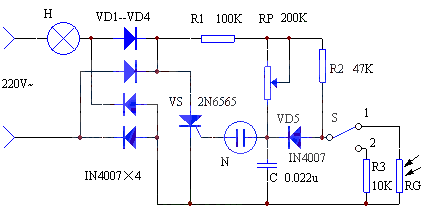
The circuit of the lamp is shown in Figure 1. When the switch S is turned to position 2, it is an ordinary dimming desk lamp. RP, C and neon bulb N form a relaxation oscillator, which is used to generate pulses to trigger the thyristor VS. Generally, the neon bulb glow conduction voltage is 60-80V. When C is charged to the glow voltage, N glows on and VS is triggered to conduct. Adjusting RP can change the charging rate of C, thereby changing the conduction angle of VS to achieve the purpose of dimming. R2 and R3 form a voltage divider to charge C through VD5. Changing the voltage divider of R2 and R3 can also change the conduction angle of VS, so that the brightness of the lamp changes.
When S is turned to position 1, the photoresistor RG replaces R3. When the ambient light is weak, RG presents a high resistance, the potential at the right end of VD5 increases, the charging rate of capacitor C increases, the oscillation frequency increases, the conduction angle of VS increases, the voltage at both ends of the lamp increases, and the height increases. When the ambient light increases, the resistance of RG decreases. Conversely, the voltage at both ends of the lamp decreases and the height decreases.
Component selection and production
The components list is shown in the table below.
serial number | name | model | quantity |
R1 | resistance | 100K 1/8W | 1 |
R2 | resistance | 47K 1/8W | 1 |
R3 | resistance | 10K 1/8W | 1 |
RP | Adjustable resistor | 200K | 1 |
RG | Photoresistor | MG45 | 1 |
C | Polyester capacitor | 0.022uF CL11-400V | 1 |
VD1--VD5 | Rectifier diode | IN4007 | 5 |
N | Neon Bulbs | The on-state voltage is 60-80V, such as NH-416 | 1 |
VS | One-way thyristor | 1A/400V any model | 1 |
S | SPDT Switch | 1 |
During debugging, adjust RP to zero resistance, and S to position 2. Use a multimeter to measure the AC current at both ends of the lamp. It should be above 200V. If it is lower than 200V, you can slightly reduce R1 or increase R3 resistance to meet the requirements. The photoresistor RG should be installed on the side of the lamp base where the lamp light cannot directly shine, to sense the ambient illumination. The bulb of the dimming lamp should be a 40W incandescent lamp. The adjusted circuit can be put into use; S is turned to 2 for ordinary dimming lamps, and RP can be adjusted to select appropriate high density; S is turned to 1 for automatic lamps, and RP is adjusted to select appropriate brightness. When the ambient illumination becomes darker, the brightness of the lamp will gradually become brighter to increase the illumination.
- GPS module time display unit
- LED or light flasher
- Electronic ballast circuit information for common lighting fixtures
- Add digital display to hand-crank pointer winding machine
- Build a Bluetooth-controlled wireless scoreboard
- USB powered portable light
- Low cost LED automatic emergency light circuit
- Practical sensitive light-controlled switch circuit diagram
- Corridor automatic light-off device
- Simple electronic doorbell circuit
- night light lighting circuit
- Street Light Control Circuit No. 12
- Street light control circuit 10
- Street light control circuit 9
- Street light control circuit 8
- Street light control circuit 7
- Street light control circuit 5
- One of the street light control circuits
- Stable and reliable light control circuit
- Full wave light control circuit







 京公网安备 11010802033920号