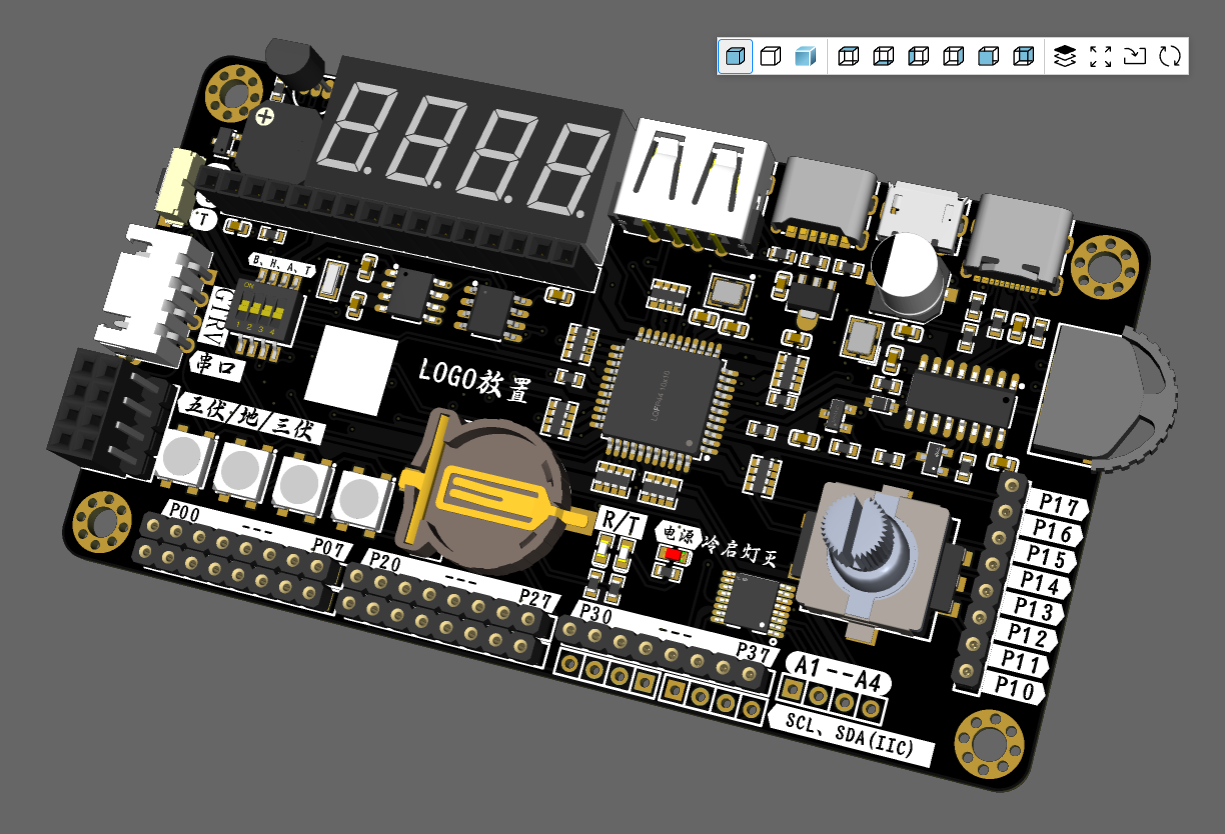
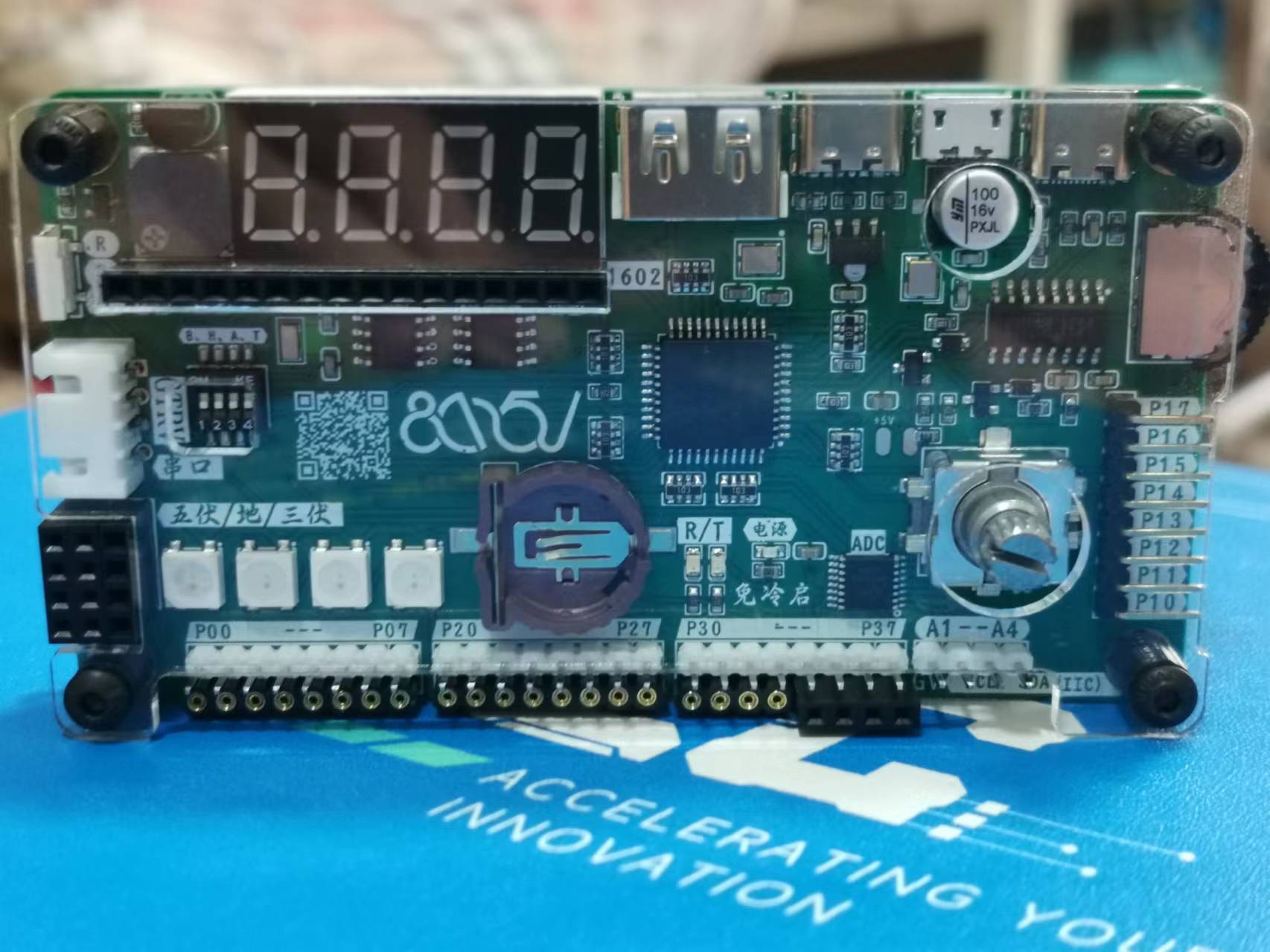
In 1980, Intel launched its first microcontroller, the 8051 (this 8051 may be an internal design number; I haven't found the reason for the name). Subsequently, it released the 8031, 8032, and 8052 series of microcontrollers with the same instruction set as the 8051, thus initially forming the MCS-51 series. In 1984, Intel sold the 51 core. Afterward, thousands of 51 microcontrollers appeared worldwide, including those from Atmel, Philips, Winbond, and domestic companies like Hongjing.
As is well known, since the emergence of ARM, within just a few years, multiple series such as ARM7, ARM9, M3, M4, A8, A9, and A10 have appeared, and their performance has developed rapidly. With its high performance, low price, and low power consumption, it quickly dominated the MCU market, surpassing even the early 51 series. As a 32-bit microcontroller, its performance is undeniable. Even at the same clock rate, a 32-bit microcontroller processes data faster than an 8-bit microcontroller. For example, a 32-bit addition operation requires at least four cycles on an 8-bit microcontroller, while a 32-bit microcontroller can complete it in just one cycle. ARM's advantages lie in its higher processing speed, abundant peripheral resources, and larger data and program storage space. Does this mean the 51 microcontroller has no advantages? Of course not. The 51 microcontroller's advantages lie in its compact core, mature technology (in fact, ARM technology is now also very mature), and bit manipulation. In many applications, we don't need the powerful processing capabilities and speed of ARM; we only need simple control. The 51 microcontroller can fully meet the actual needs. In this case, ARM's advantages become less important. The 51's bit manipulation is something ARM cannot achieve. You might say that ARM can also perform bit manipulation, but if you understand it more deeply, you'll find that ARM's bit manipulation is achieved through shifting, AND, OR, and other operations, while the 51 microcontroller has a bit-addressable space, enabling true bit manipulation. From a learning
perspective , the
standard
for judging whether you've mastered an MCU should be that you understand how your programs execute, down to the registers involved in a specific instruction, and that upon seeing an instruction, you should have a mental understanding of a series of 0-1 operations, not just be able to apply it simply. Although many companies now provide firmware libraries for their new products, allowing engineers to program more quickly, this often results in more hardware engineers becoming purely software engineers. You might be able to program a chip, but you might not understand it. Some might say, "As long as I can use it, why bother understanding it?" This is a misconception. To truly use a chip effectively, you need to understand it, even deeply and comprehensively. Simple hardware modifications can significantly alter system performance. Therefore, to design a good product, you must have a deep understanding of the chip itself.
In this regard, the 51 microcontroller, due to its simple core, is easy to learn and master. Once you've mastered the 51 microcontroller, learning other chips, like ARM, becomes much easier. This is because all microcontrollers share a similar functional architecture; understanding one makes learning another simple. Compared to the complex ARM architecture, the 51 architecture is remarkably simple. You could even say that ARM is essentially a 51 architecture with added functional modules, although their structures aren't truly identical.
A few days ago, I saw someone on a forum advocating for abandoning the 51 and switching to ARM. I think such a person hasn't mastered either; they clearly don't understand the differences and connections between them. Anyone with experience learning both 51 and ARM knows that mastering the 51 and then learning ARM takes only the time it takes to read a chip manual (a slight exaggeration). However, starting with ARM as your MCU entry point requires considerable effort. For someone completely unfamiliar with microcontrollers, the complex ARM manual often feels overwhelming. You could compare it to climbing a mountain in one go, while learning the 51 is like reaching the halfway point. The scenery halfway up isn't as breathtaking as at the summit, but you can still achieve something. And climbing back up from halfway point naturally reduces the difficulty. Regarding complaints that no one hires people who only know 51 microcontrollers, I think we should look at this issue from this perspective: learning 51 and learning ARM are not contradictory. After understanding 51, you can certainly learn ARM.
I believe that even if the application of 51 declines in the future, learning 51 will still be a good starting point, just like computer science students continue to learn x86. I don't object to choosing ARM as a starting point, but I do object to those who, without understanding 51, urge everyone to abandon it. As designers of electronic products, the most important thing is to choose the right MCU from the wide variety available.
Although it's undeniable that 51 microcontrollers are increasingly being replaced by high-end products, especially ARM, I still believe that 51 microcontrollers are not outdated, and learning 51 microcontrollers is not outdated!








 京公网安备 11010802033920号


 1N5527B



