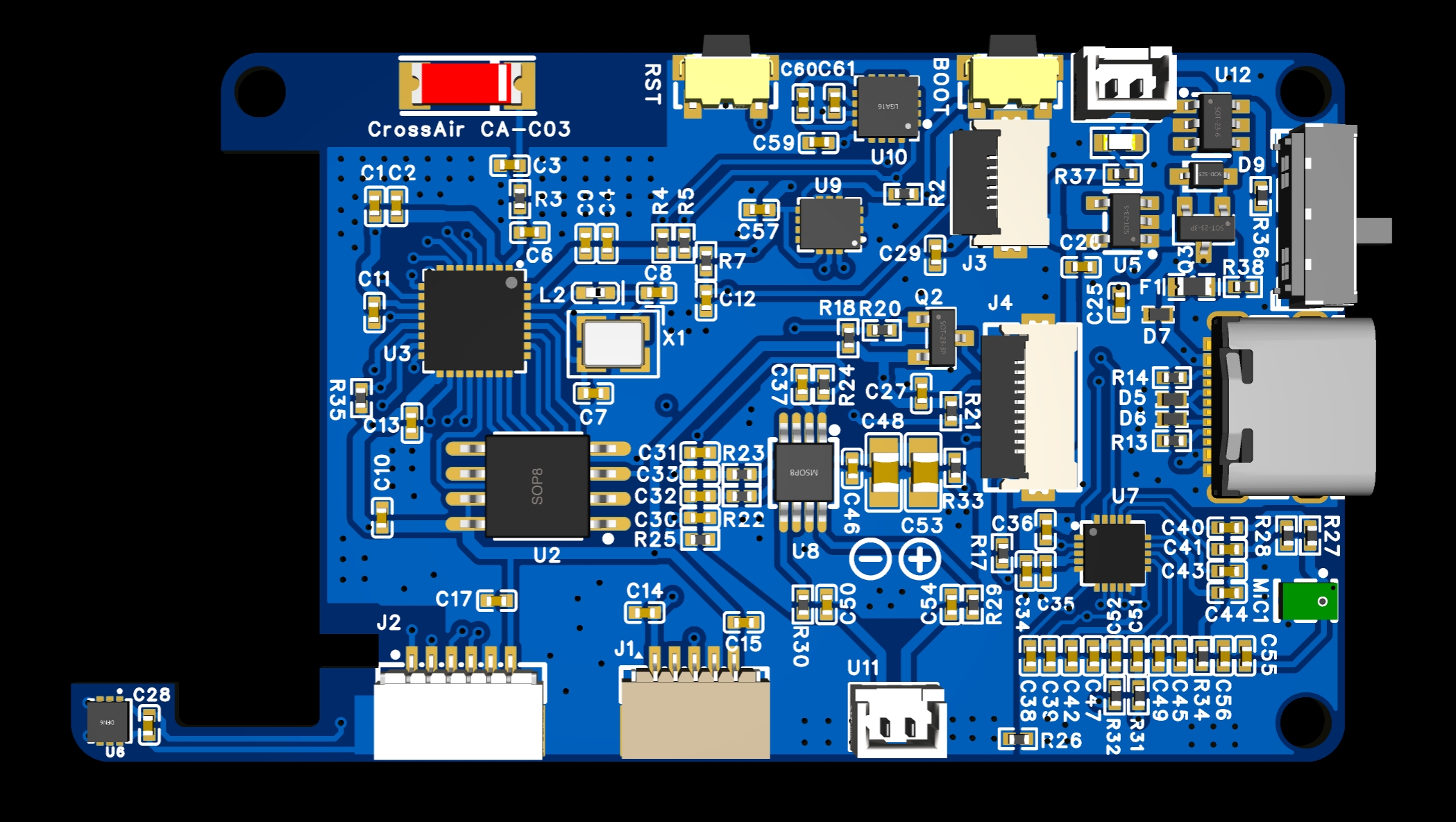
Replace the display screen (SX020HS1003N0, available on Taobao) with an FPC-0.5 6P/10P touchscreen socket. The flip cover is similar to the original.
Add a TP4055 battery charging circuit and switch.
Modify the surface mount switch buttons to 2*4*3.5 side press.
Change the socket to SH1.0 horizontal surface mount 5P/6P. Directly bring out the serial port for easy programming.
Remove the serial port chip and
some unnecessary resistors and capacitors.
e9c49f5e9686f6d6254f866846b233ee.mp4
PDF_LCSC Practical ESP32-C3 Development Board - Modified Version.zip
Altium_LCSC Practical ESP32-C3 Development Board - Modified Version.zip
PADS_LCSC Practical ESP32-C3 Development Board - Modified Version.zip
BOM_LCSC Practical ESP32-C3 Development Board - Modified Version.xlsx
95111
Signal source expansion board
Oscilloscope + signal source analog front-end expansion board for use with H750 core board
This project underwent several revisions, and I still couldn't find the problem. Aside from my own reasons (being a bit lazy), the main reason for the late submission was a problem with the TFT screen interface circuit. I modified the circuit several times, but because it differed from the official version, I finally discovered the root cause was that the TFT interface circuit was drawn backwards. This caused my screen to not display any image, and even burned out one of the screens.
Anyway, I'm finally out of the "black box" (a metaphor for being stuck in a difficult situation). I'll gradually add more details to the project description later; there's still much to learn.
PDF_Signal Source Expansion Board.zip
Altium_Signal Source Expansion Board.zip
PADS_Signal Source Expansion Board.zip
BOM_Signal Source Expansion Board.xlsx
95112
51 microcontroller + Internet of Things for remote control
This project uses 51 microcontrollers and Internet of Things (IoT) technology to enable remote control of equipment.
Engineering Principle: The device is connected to the internet via a 51 microcontroller and an IoT module (such as the ESP8266). Users can remotely send control commands over the network, and the 51 microcontroller receives and executes the corresponding operations, such as controlling LED lights or motors.
Function: Allows users to remotely monitor and control devices via the internet, improving device intelligence and convenience. Users can control the device from anywhere with an internet connection through a mobile application or web interface.
Operating Conditions: Stable power supply: Ensures continuous and stable operation of the 51 microcontroller and IoT module. Reliable network connection: Guarantees the device's ability to connect to the internet for remote control functionality.
PDF_51 Microcontroller + IoT Enables Remote Control.zip
Altium 51 microcontroller + IoT for remote control.zip
PADS_51 microcontroller + IoT for remote control.zip
BOM_51 Microcontroller + IoT for Remote Control.xlsx
95113
electronic








 京公网安备 11010802033920号


 PB251-12CM-H