Objective: To design a feeding vehicle model for dispensing feed.
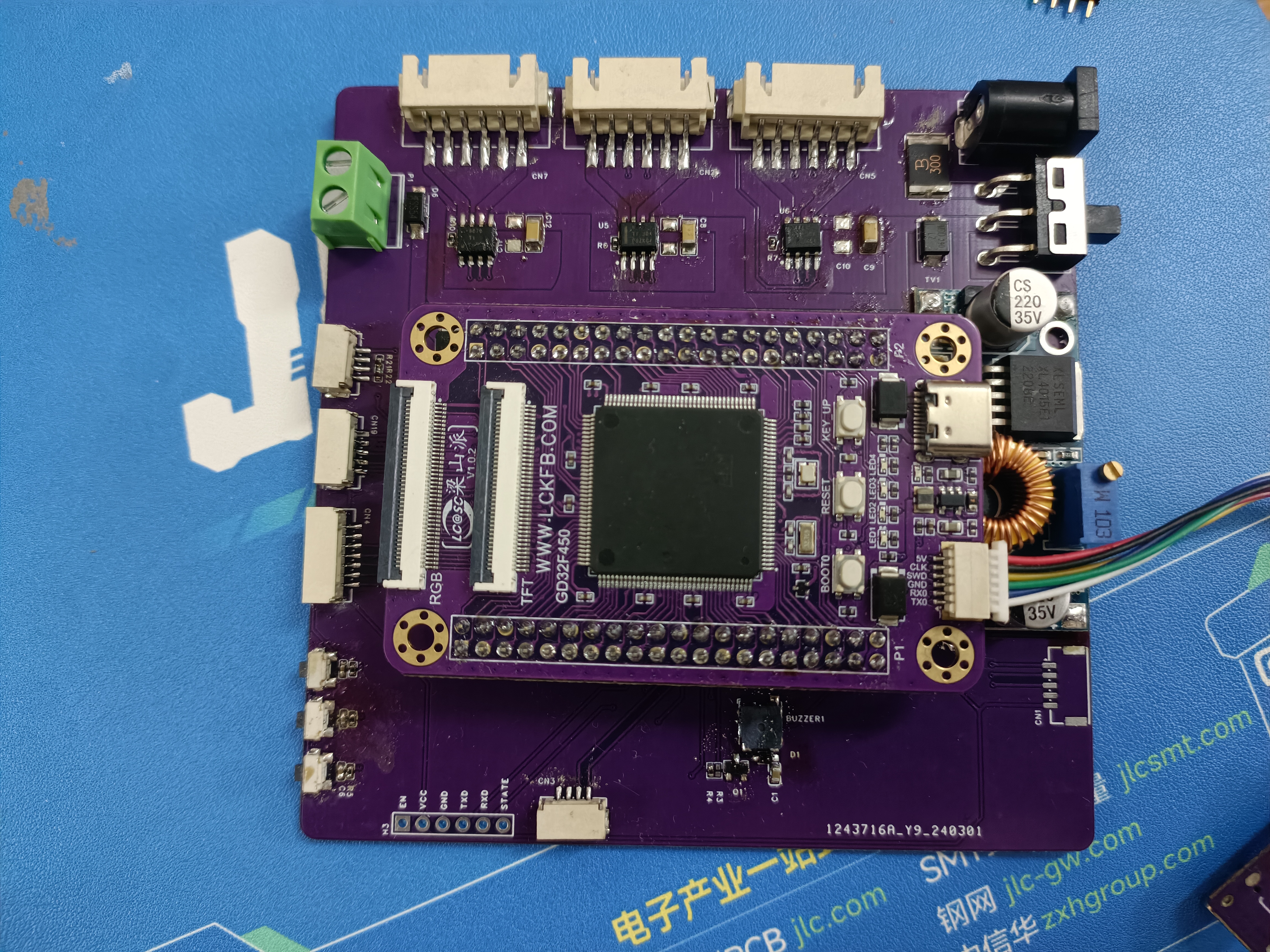
Functionality includes: 1. Three brushed motors driven by three encoders each, and one standard brushed motor driven without an encoder.
2. An ultrasonic sensor interface for obstacle avoidance.
3. A 5-channel grayscale sensor for line tracking, and a K210 interface for both object recognition and line tracking.
4. Three buttons that can be connected to a screen for various user operations. 5.
Includes a voltage detection circuit and three ADCs for user use.
6. An IIC interface for connecting to a servo control board to control multiple servos.
7. A buzzer for the vehicle's horn or low voltage warning.
8. One attitude sensor for detecting the vehicle's attitude (backup)
. **Note: During soldering, I discovered interference between the ultrasonic module and the servo control board, but since the ultrasonic module is not currently used, the hardware has not been modified. Another solution is to bring the ultrasonic module out from the back.** **
![d0e20088e18071d2671ccb032830431.jpg]
Skills Mastery and Project Reflection:
I. What I Learned:
Theory and Practice Integration: I gained a deeper understanding of the connection between theoretical knowledge and practical application. By building an intelligent feeding cart myself, I applied the electronics, programming, and mechanical knowledge I learned in class to practice, deepening my understanding of these concepts.
Problem-Solving Ability: During the project design process, I encountered many unexpected problems. Through independent thinking and consulting relevant materials, I learned how to analyze and solve problems, improving my problem-solving abilities.
Teamwork and Communication: If the project was completed in a team, I learned how to effectively communicate and collaborate with team members to solve problems together, which was a valuable teamwork experience for me.
Project Management: I learned how to plan projects, allocate time reasonably, and ensure that projects are completed on time.
II. Areas for Improvement :
In-depth study of professional knowledge: Although I have mastered some basic electronics and programming knowledge, there is still much advanced and professional knowledge that I need to continue to learn and master in order to be able to handle more complex and advanced projects.
Improving Practical Skills: Although I am already able to complete basic mechanical fabrication and electronic soldering, I still need to continue to improve my practical skills and craftsmanship to ensure the quality and stability of the project.
Enhancing Innovation: During the project design process, I discovered that my innovation ability needs improvement; some circuits were borrowed from others.
III. Problems Encountered and Solutions
: Problem: Unstable Motor Drive
Solution: After inspection, it was found that the problem was caused by insufficient power supply. I reselected the power supply module and optimized the power management circuit, thus solving the problem of unstable motor drive.
Problem: Inaccurate Sensor Data
Solution: I first checked the sensor connections and configurations and found no problems. Then, I consulted relevant documents and materials and found that the sensor parameter settings needed to be adjusted. After adjusting the parameters, the sensor data became accurate and reliable. Problem
: Inaccurate Car Trajectory
Solution: After analysis, I found that it was caused by insufficient precision in the motor control algorithm and a problem with the sensors. I replaced the sensors and rewrote the motor control algorithm, adding PID control to improve accuracy. After the improvements, the car's trajectory became more accurate and stable.
Through this project, I not only learned a lot of valuable knowledge and skills but also improved my problem-solving and teamwork abilities. In the future, I will continue to study and improve my abilities to meet more challenges and opportunities.
Code: I drew the circuit based on this project; the pins used are almost identical to those in this project: https://gitee.com/lcsc/public_bare_medical_car
Since my graduation project is not yet finished, to avoid unnecessary trouble, I will continue to improve this project later.








 京公网安备 11010802033920号


 JR21RCD-10SC



