Text.
Text.
Text.
Text.
Text.
Text.
Text.
Text.
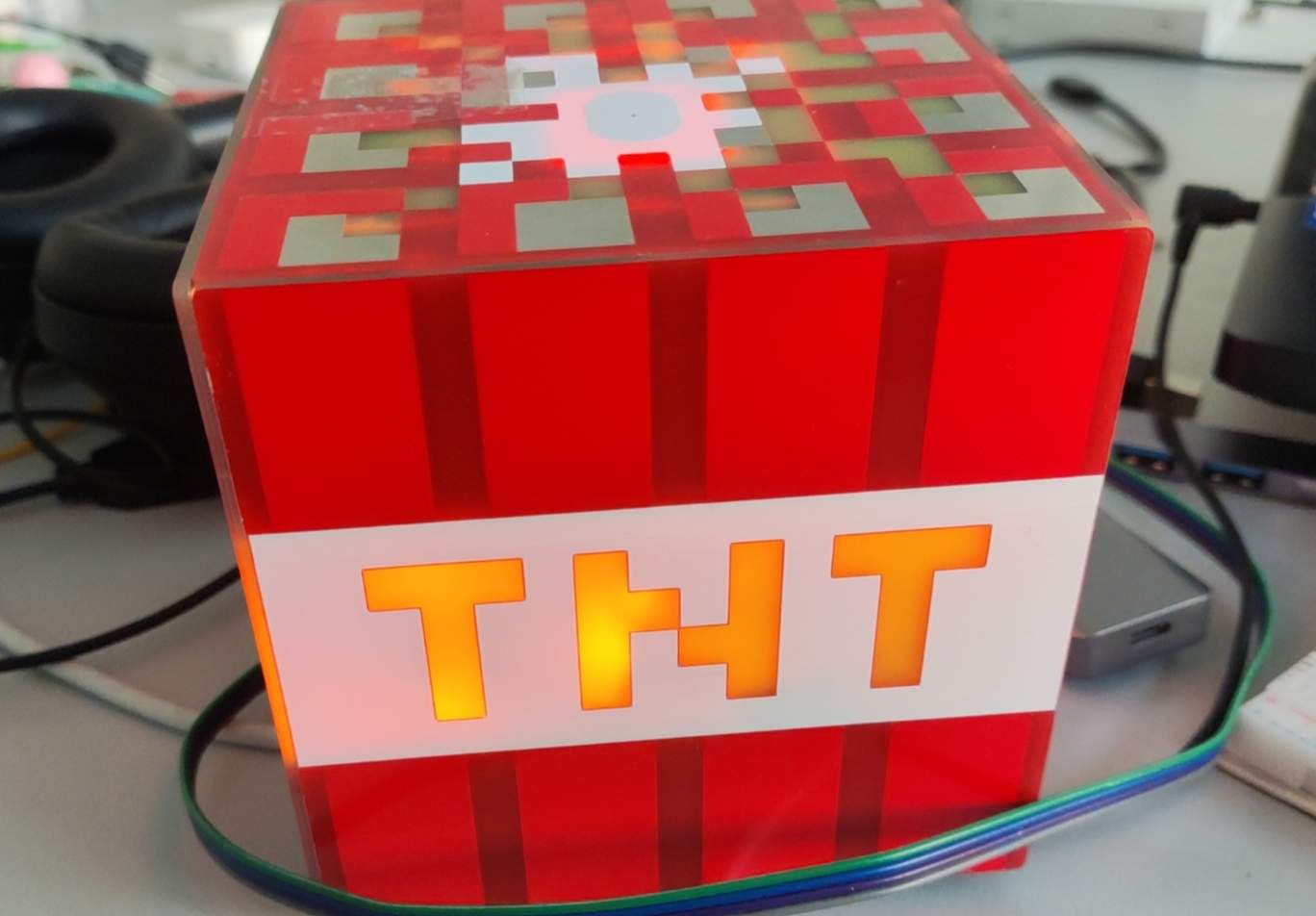
The inspiration comes
from the fact that just turning on the lights with TNT would be too boring, so I added as much of the original Minecraft gameplay as possible. It
was all done from scratch, learning about the sound playback IC and amplifier bit by bit, putting in a lot of time.
I used the original project's appearance design and made many minor modifications to the soldering, making it easier and simpler to solder, and added a rounded corner for safer use.
This project has been in development for 6 months, and the final version is finally complete.
Functionality:
Short press: Turn on light
; Short press: Turn off ; Medium
press: Flash ; Short press: Turn
off; Medium
press: Accelerate flashing
; Long press: Decelerate flashing
; Long press: None (suggestions in comments). Update: Added a timer to turn off the LED ; Medium
press: Breathing light;
Short press: Turn off
; Medium press: Sound easter egg;
Long press: Sound easter egg
; Long press: BOOM
BOOM mode, disables all triggers
and there's an easter egg~~~
Software:
Touch has three durations: long, medium, and short
; Short press: 100ms~800ms
; Medium press: 800ms~1600ms
long press: 1600ms~2400ms.
For extreme power saving, the MCU operates at 1MHz.
After the sound ends, a timer shuts off the sound circuit (HAA2018, WT588, W25Q32).
The PWM breathing light is implemented in software
. Hardware-wise:
TTP233 is used for lower cost, and all functions are implemented by this one touchpad.
The sound function uses WT588, which is inexpensive.
The sound is stored in W25Q32.
The power amplifier uses HAA2018.
The hardware cost is compressed to the extreme.
Why did it take so long and what pitfalls did I encounter?
The biggest pitfall was that the WT588 DAC cannot directly output analog voltage, which caused it to not produce sound after completion. I was stuck here for 3 months! After searching for a long time, I found out that an IR circuit was needed, but the chip datasheet I read for a long time did not mention this! I was so angry!
The SPI programming took many attempts before it could successfully play sound once. Later, I learned that the 20cm cable was too long,
causing the programming timing to be messed up! In the WT588's one-piece serial mode, the SDA output 1 caused voltage to appear in the audio circuit controlled by the AO3401. I initially thought the MOSFET wasn't completely cut off, and I spent a long time troubleshooting for maximum power saving!
For aesthetic reasons, I refused to drill any vias on the front.
Key points for replication:
The charging module uses a TP4560, which is troublesome to solder, so it wasn't integrated, and it's also very cheap.
The speaker uses 4 ohms and 4W.
The code is not yet open source; only binary files are provided. Components
starting with "~" don't need to be soldered
! To be added!
Existing problem:
Poor sound quality; awaiting expert feedback.







 京公网安备 11010802033920号


 NRLFW470M200V22X20F



