I. Design Requirements
(1) Raindrop sensor module: used to detect raindrops; (2) Light intensity sensor module: used to detect light intensity; (3) Infrared receiving module: used for remote control; (4) Stepper motor module: used for window curtain drive.
II. Design Specifications
(1) Automatic mode can be set via infrared remote control and voice;
(2) In automatic mode, the curtains will automatically open when the light intensity is high and automatically close when the light intensity is low;
(3) In automatic mode, the curtains will automatically open when a large number of raindrops are detected, which has a higher priority than light detection;
(4) The curtains can be opened and closed at any time via infrared remote control or voice command, and the automatic mode can be turned off;
(5) After receiving the data, the main control chip will drive the motor to run, realizing the intelligent curtain window system.
III. Module Design Description
(1) Raindrop/Light Sensor Design
The common working principle of raindrop sensors is to determine whether it is raining by detecting the conductivity of water droplets. It uses the change in conductivity between two electrodes to measure the presence of water droplets. There will be an air gap between the two electrodes, which is normally an open circuit. When a water droplet comes into contact with an electrode, the conductivity of the water droplet causes current to flow through the water droplet to form a current loop, thereby changing the resistance value between the electrodes. By measuring the change in resistance value, it can be determined whether a water droplet is present .
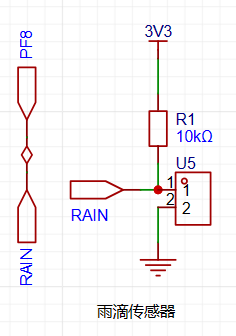
(2) Infrared receiving interface design:
Use an infrared receiving head to receive infrared signals from the controller.
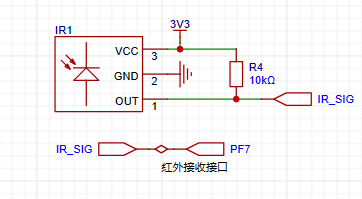
(3) Voice module design:
HLK-V20 is a high-performance pure offline voice recognition module launched by Hailingke Electronics for a large number of pure offline control scenarios and products. It can be widely and quickly applied to smart homes, various smart small appliances, 86 boxes, toys, lamps, industry, medical, Internet of Things, automobiles, security and lighting and other products that require voice control.
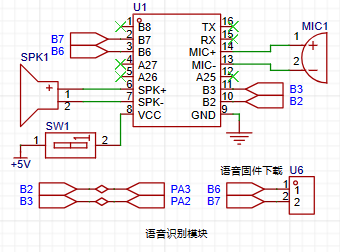
(4) Stepper motor module design:
A stepper motor is an open-loop control motor that converts electrical pulse signals into angular displacement or linear displacement. It is also called a pulse motor. The most important components of a stepper motor are the rotor and the stator.
Stator: The direction of the magnetic field is controlled by the current, and a magnetic force is generated when energized;
Rotor: Surrounded by the stator , it rotates due to the change of the stator's magnetic field (the rotating pointer in the diagram below)
. By energizing the stator, a magnetic force is generated, which attracts the rotor, and the rotor will rotate a small increment; by continuously energizing the stator, the rotor can be made to rotate.
![]()
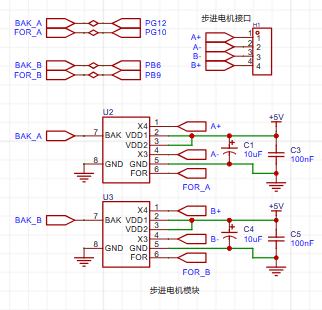
(5) Overall design
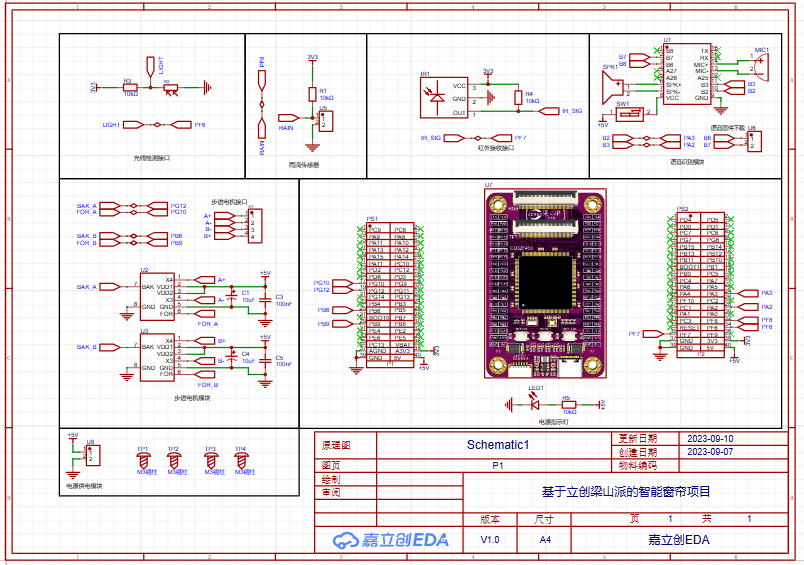
(6) PCB design
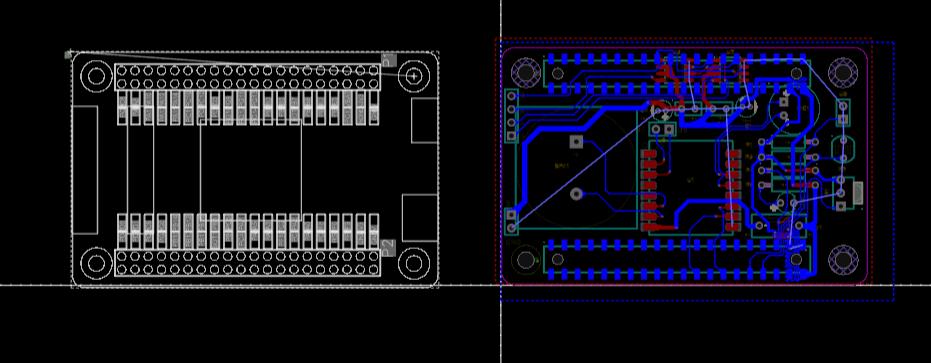
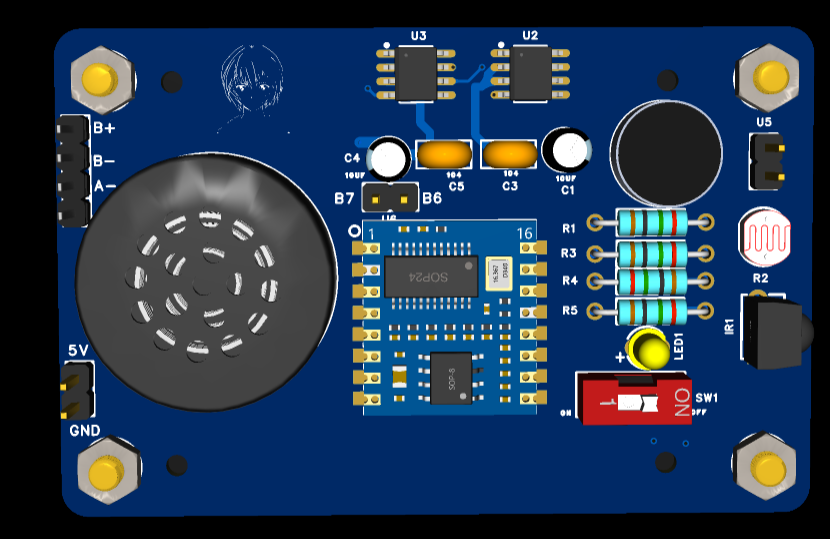
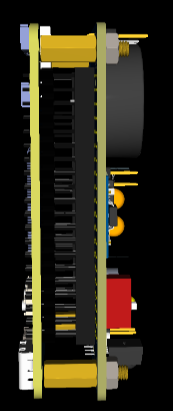
IV. Software design
Since the author is still learning the software part, this part will not be explained in detail. For details, please refer to the official documentation of JLCPCB:
https://lceda001.feishu.cn/wiki/Fv2ewkfwviJ6FOk39DBcg21znod
Product demonstration video:
https://www.bilibili.com/video/BV1k84y1272D/?spm_id_from=333.999.0.0








 京公网安备 11010802033920号


 M24C02-RBN6T



