
Production of energy-saving switching power supply
Source: InternetPublisher:柯南道尔 Keywords: Switching Power Supply Updated: 2025/07/22
As various household appliances are flooding into households, the proportion of standby power in household electricity consumption is increasing. According to surveys, standby power generally accounts for about one-tenth of the power consumption. If this part of electricity can be saved, 14.3 million tons of CO2 can be reduced from being emitted into the atmosphere.
Televisions, monitors, computers, etc. all use switching power supplies.
Its standby power reaches 1W, so it is necessary to improve the commonly used switching power supply and design a new switching power supply with high efficiency and low energy consumption.
In addition, the switching power supply contains a DC conversion circuit. It will generate high-order harmonics in the power supply line, resulting in a low power factor and increased energy consumption of the power supply line. Moreover, the high-order harmonic components in the current may cause the capacitor in the substation to burn out, and cause the rotor of the hydroelectric generator to vibrate at twice the power frequency and be damaged. Therefore, the high-order harmonics generated by the switching power supply must be reduced.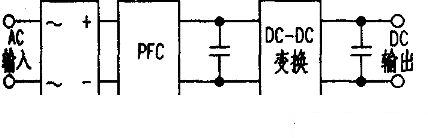
The traditional switching power supply structure is shown in the figure on the right, which connects the power factor correction circuit (PFC) and the DC-DC conversion circuit in series. As a result, the efficiency is low and it is quite difficult to reduce the standby power.
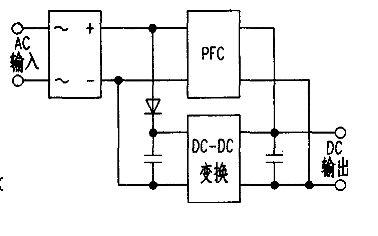
The structure of the switching power supply of this design is shown in the left figure, which can be called a hybrid parallel mode. By adopting an excellent DC/DC conversion IC, supplemented by voltage feedback and measures to increase the conduction angle, this switching power supply is within the power range of 70 to 350W. The efficiency is over 90%, the standby power is only 0.1W, and the suppression of high-order harmonics has also reached Class D of the IEC61000-3-2 specification (applicable to LCD TVs, monitors, and computers).
The conversion IC uses Infineon's third-generation highly integrated power integrated circuit, the CoolSET F3 series product ICE385565P, which combines Infineon's CoolMOS power metal oxide semiconductor field effect transistor (MOSFET) and a new pulse width modulation (PWM) control integrated circuit in a single package. The standby power consumption is 1.3 less than other similar products, which is suitable for designing a more cost-effective and efficient power supply system.
The whole circuit is shown in the figure below. The AC power is rectified by BD1 after passing through the common mode choke coil Lcm; L1, Cl, and C2 form a bamboo filter (the capacity of Cl and C2 is very small, and the waveform is still pulsating after filtering); PT is used to suppress surge current. The pulsating DC voltage after rectification and filtering passes through the primary winding of transformer T1 and diode D3 and is turned on and off by the field effect tube in ICl. The pulsating DC voltage is output from the secondary winding of T1 through D7.
The other DC voltage obtained after filtering by D2 and C3 is turned on and off by the field effect tube through the primary winding of T2. The DC voltage is output from the secondary winding of T2 through D8 and D9.
As a result, the pulsating DC voltage and the DC voltage are added and output, which makes the output waveform have large ripples, but the ripples disappear after adding feedback. The 6t coil, inductor L2 and diode D1 are specially designed in the circuit to suppress high-order harmonics.
A π-type filter composed of C10, L3, and C11 is added to the output end of the circuit. When the transformer secondary voltage exceeds the voltage on the filter capacitor, the current waveform flowing through the inductor and the diode becomes a triangular wave. After being averaged by the π-type filter, it is equivalent to expanding the conduction angle, reducing the peak current, and thus suppressing high-order harmonics.

- LM317 overvoltage protection
- 50V 3A regulated power supply (using 2N3055)
- Full-range adjustable power supply
- 5V power supply with overvoltage protection
- Dual-channel adjustable power supply
- LM317 Adjustable Regulated Power Supply
- USB-powered AA NiMH/NiCd battery charger
- A classic linear 5V power supply using a 6.3V AC transformer.
- Lithium-ion and lithium-polymer charger circuits
- Simple MOSFET switch
- LED drive circuit based on switching power supply
- Ultra-low quiescent current ZXSC100 application circuit analysis
- Power supply circuit diagram of single wire electronic switch
- DNC-X50E special switching power supply
- Practical switching power supply circuit
- Switching power supply high voltage constant current source circuit diagram
- Switching power supply thick film control circuit and application-actual circuit
- Three-terminal PWM switching power supply-PWR-TOP200 series and applications 04
- Three-terminal PWM switching power supply-PWR-TOP200 series and applications 03
- Three-terminal PWM switching power supply-PWR-TOP200 series and applications 02







 京公网安备 11010802033920号