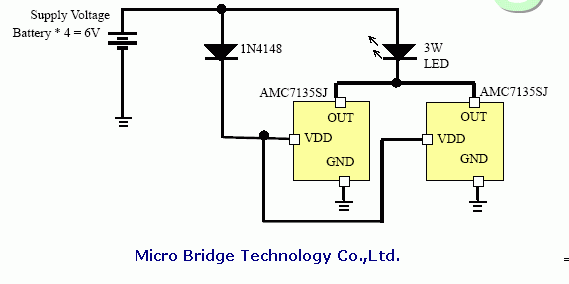
The flashlight driver uses 7135 chips in 4, 6, and 8 configurations.
Each 7135 chip provides 350mA of current. The more 7135 chips connected in parallel, the greater the current provided.
Four chips provide approximately 1.5A, which has been verified. The PCB design for 6 or 8 chips is unverified.
A Schottky diode or switching diode can be used on the PCB to prevent reverse connection and ensure the battery is installed correctly. The diameter is 17mm, and the recommended thickness is 1.6mm.
PDF_7135-LED flashlight driver.zip
Altium_7135-LED flashlight driver.zip
PADS_7135-LED Flashlight Driver.zip
BOM_7135-LED Flashlight Driver.xlsx
95010
New 1C1A desktop charger based on IP6520 and IP6505 standards
The new 1C1A desktop charger, based on IP6520 and IP6505 standards, adds fast charging and power status indicators compared to the old version. It supports DC input of 7.1V-32V, with 13V-24V recommended, and features adaptive input polarity.
This project is an upgrade of the old desktop charger!
IP6520 Introduction:
The IP6520 is a step-down converter with integrated synchronous switching, supporting multiple fast charging protocols, Type-C output, and USB PD2.0/PD3.0 (PPS) protocols, providing a complete solution for car chargers, fast charging adapters, and smart power strips. The IP6520 has a built-in power MOSFET, an input voltage range of 7.1V to 32V, and an output voltage range of 3V to 12V, providing a maximum output power of 25W. It can automatically adjust the output voltage and current according to the detected fast charging protocol. Typical output voltages and currents are: 5V/3A, 9V/2.5A, and 12V/2A. The IP6520's PD output has CV/CC characteristics. When the output current is less than the set value, it outputs in CV mode with a constant output voltage; when the output current is greater than the set value, it outputs in CC mode with a reduced output voltage. The IP6520 features automatic overcurrent point adjustment. After a successful handshake with the high-voltage SCP and fast charging protocol, it supports a maximum output of 10V/2.5A. When the device connected to the IP6520's Type-C interface supports high-voltage SCP, it prioritizes high-voltage SCP output, resulting in higher charging power compared to PD output. The IP6520's output voltage includes line compensation; as the output current increases, the output voltage increases accordingly to compensate for voltage drops caused by connection line impedance. The IP6520 has a soft-start function to prevent inrush current from affecting the stability of the input power supply. The IP6520 supports Type-C interface output, integrates various fast charging protocols, and can automatically identify the fast charging protocol supported by the connected device via CC1/CC2 or DP/DM, then automatically adjust the output voltage and current accordingly. The IP6520 supports the following fast charging protocols: DCP (Apple and BC1.2), Qualcomm QC2.0/QC3.0 (class A), Huawei's FCP and HVSCP fast charging protocols, and Samsung's AFC (MAX 12V) fast charging protocol. The IP6520 supports USB PD2.0/PD3.0 (PPS) output protocols. The IP6520 has multiple protection functions, including input overvoltage and undervoltage protection, and output overcurrent, overvoltage, undervoltage, and short circuit protection.
The IP6520 uses an ESOP-8 package.
It supports DCP/QC2.0/QC3.0/FCP/HVSCP/AFC/MTK PE/PD3.0/PPS up to 25W (IP6520-C-65W20V, maximum 68.25W).
The IP6505
is a buck converter with integrated synchronous switching, supporting 11 fast charging protocols and providing a complete solution for car chargers, fast charging adapters, and smart power strips. The IP6505 integrates a power MOSFET, with an input voltage range of 4.5V to 32V and an output voltage range of 3V to 12V, providing a maximum output power of 24W. It can automatically adjust the output voltage and current according to the detected fast charging protocol. Typical output voltages and currents are: 4V@3.6A, 5V@3.4A, 7V@3A, 9V@2.5A, and 12V@2A. The IP6505 boasts a buck conversion efficiency of up to 97%. The IP6505's output exhibits CV/CC characteristics: when the output current is less than a set value, it outputs in CV mode with a constant output voltage; when the output current is greater than a set value, it outputs in CC mode with a reduced output voltage. The IP6505 features line compensation, increasing the output voltage as the output current increases to compensate for voltage drops caused by connection impedance. It also has a soft-start function to prevent inrush current from affecting the stability of the input power supply. The IP6505 integrates various fast charging protocols, automatically identifying the supported fast charging protocols of connected devices via DP/DM and adjusting the output voltage and current accordingly. Supported fast charging protocols include: DCP (Apple, Samsung, and BC1.2), Qualcomm QC2.0/QC3.0 (class A), MTK PE1.1/2.0, Huawei FCP/SCP, Samsung AFC, and Spreadtrum SFCP. The IP6505 offers multiple protection functions, including input overvoltage and undervoltage protection, and output overcurrent, overvoltage, undervoltage, and short-circuit protection.
The IP6505 is packaged in an ESOP-8 package.
Supports DCP/QC2.0/QC3.0/MTK PE1.1/PE2.0/FCP/SCP/AFC/SFCP up to 24W.
For this project
, PCB1 should be made of FR-4 material, and PCB2 (empty board) should be made of aluminum substrate. A frosted acrylic panel is recommended.
Required components include 4 M2 screws (5mm long), 4 M2 double-ended knurled screw posts (11mm long), 8 M2 single-ended knurled screw posts (3mm thread, 3mm body), and one 3.5mm thick thermal pad.
Installation instructions are omitted here.
For the IP6520 model, the IP6520-C-65W20V option is available (this model supports 20V; pay attention to capacitor voltage rating).
This project is an upgrade of the old desktop charger.
Update Log
2024-04-29: Fixed LED1 polarity error; thanks to @hmjb888 for pointing out the error.
IP6505_datasheet.pdf
IP6520_datasheet.PDF
PDF_New 1C1A Desktop Charger Based on IP6520 and IP6505 Solutions.zip
Altium's new 1C1A desktop charger based on IP6520 and IP6505 standards.zip
PADS New 1C1A Desktop Charger Based on IP6520 and IP6505 Standards.zip
BOM_New 1C1A Desktop Charger Based on IP6520 and IP6505 Solutions.xlsx
95012
XT30 CAN splitter
RoboMaster uses a power distribution board
Note: This is a KiCAD project! Please
ensure
it is used with the baseplate. The bottom copper layer is VCC, and exposed solder joints without covering pose a short circuit risk.
The project drawing shows the effect without a vertical mounting interface. The GH1.25 socket can be directly replaced with either a horizontal or vertical mounting. Therefore, this is for photography purposes.
Note that
the hole positions are consistent with the DJI C-board, and the dimensions are consistent with the official DJI ESC center board.
The vertical XT30 uses a wire-bonding type, and
the horizontal XT30 uses a board-bonding type.
The CAN interface is a GH1.25 2P interface
. Attachments:
KiCAD original project
baseplate SLDPRT file,
baseplate STEP file.
power_deliever_xt30_can.zip
Base plate.SLDPRT
Base plate.STEP
PDF_XT30 CAN Splitter Board.zip
Altium_XT30 CAN Splitter Board.zip
PADS_XT30 CAN Splitter Board.zip
BOM_XT30 CAN Split Board.xlsx
95013
electronic








 京公网安备 11010802033920号


 M500218TDK



