
FM radio using TDA7000
Source: InternetPublisher:qH39x Keywords: TDA7000 FM radio Updated: 2026/03/20
FM radio using TDA7000
This project is an FM radio based on the TDA7000 and LM386 integrated circuits. The unique aspect of the TDA7000 integrated circuit lies in its operation. It's a standard FM superheterodyne receiver with a typical local oscillator, mixer, intermediate frequency amplifier, limiter, and phase detector. The difference is that it only has one tuning circuit: the local oscillator. Similar to pulse-count receivers, the TDA7000 relies on a low intermediate frequency (IF), so ordinary operational amplifier circuitry can handle the gain and bandpass characteristics. The TDA7000 only uses an IF of 70 kcal/s. Now, you might recall that the deviation of a broadcast FM signal is +/- 75 kcal/s. Therefore, a fully modulated signal would sound quite distorted. So, how does this IC work?
Simply put, Philips calls it a frequency-locked loop. Essentially, the local oscillator is offset based on the detector output, ensuring the mixer output bandwidth never exceeds +/- 15 kc/s. It effectively compresses the frequency range of the modulated signal.
The mute or suppression function is, to say the least, novel. While it works like any other mute circuit, the TDA7000 provides an artificial noise generator so that the receiver still sounds active when tuned away from the radio station. If you don't need this function, simply remove the .022uF capacitor at pin 3. Not all Philips datasheets show this, but connecting a 10K resistor from the power supply to pin 1 will disable the suppression function.
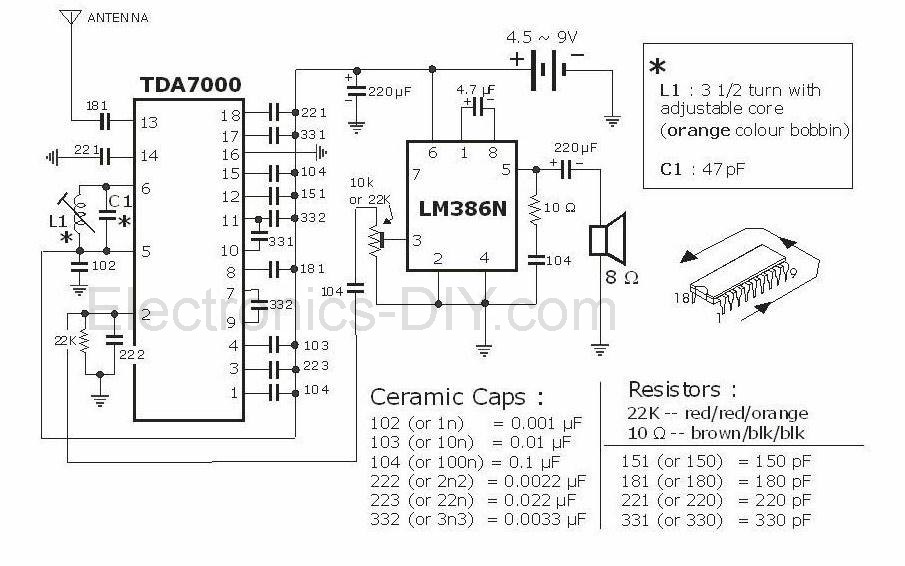
Block diagram of the TDA7000 used in a typical FM receiver. The audio output is approximately 75mV.
At this point, I recommend you check out Philips' application notes. They provide good background on the design and use of this IC. Out of curiosity, check out the application notes on narrowband FM here. If you think low IF is suitable for NBFM receivers, you're right. Note that the TDA7000 is not suitable for feeding into a stereo decoder.
Interestingly, it's worth speculating why Philips didn't make this IC into a pulse counting receiver. After all, low-IF frequencies are ideal, and pulse counting technology has been around for some time.
The TDA7000 started a new series!
Philips not only released the TDA7000 in an 18-pin DIP package, but also the TDA7010T, a surface-mount version. It comes in a 16-pin SMD package. What happened to the other two pins? Well, the artificial noise generator has been removed, as has the connection to an IF filter capacitor. The latter is a bit odd; I'm not sure if it was entirely possible to remove it, or if they managed to integrate it inside the chip. Aside from that, the datasheets for both chips are identical.
Next is the surface-mount TDA7021T, which is also surface-mount but is stereo compatible. Finally, there's the surface-mount TDA7088T, which is mono but features search-tuning and operates at 3V.
The TDA7000 is one of those ICs, like the 555, a well-designed and versatile IC that never really made it into a commercial product. Instead, it seems to have survived in kits and other homemade devices. I've never seen the TDA7010T or TDA7021T used in any commercial product or even a kit. However, the TDA7088T does exist in some recently popular miniature keychain FM receivers.
Unfortunately, by early 2004, when I was writing this, the TDA7000 was no longer in production, having ceased production in December 2003. In fact, that's a fairly long production run, considering it had just over 20 years of production life. So, if you want to play with this IC, keep in mind that there won't be any new stock. The last TDA7000 I bought a few months ago was manufactured in 1994, so I assumed there would be plenty of stock for a while. Who knows; it might be cloned by other companies like the ZN414.
However, not everything is lost, as the TDA7010T is electrically identical. But this means you'll have to be able to make a PCB with the track close enough to accommodate surface mount. You might be able to use it on an existing PCB by connecting it to the pins with thin wires, or even mounting the TDA7010T in an 18-pin header. This IC, along with the TDA7021T and TDA7088T, is still currently in production by Philips. The TDA7021T can also be used; you don't have to use it for a stereo receiver. The TDA7088T can also be used with a regular variable capacitor, if you prefer. If you want to avoid surface mount, there's another IC that works on the same principle: Sanyo's LA1800. This IC can directly drive headphones and also includes an AM receiver section, which is a simple TRF circuit like the ZN414 or MK484.
Building a TDA7000 receiver
I bought my first TDA7000 IC in 1988 and tried to build a receiver on a matrix board. Here, I learned my first important lesson: layout and ground planes are crucial for using this IC. Philips' datasheet provided the PCB layout, which shouldn't be changed too much. Of course, my matrix board receiver didn't work properly.
Purchased from Tandy in Chatswood; like all their components, the packaging is overly extravagant. Includes an abbreviated reprint of the Philips AN192 application notebook.
Shortly after, Electronics Australia published an article (June 1988) using the TDA7000 and LM386 for audio. So, I bought the PCB and built only the TDA7000 portion. I didn't like the LM386 (and still don't), so I made a dual-transistor Class A amplifier on a separate PCB. Another change was using BB809 varactor diodes for tuning. I didn't like EA's idea of using trimmer capacitors.
The receiver is working, of course, but the "1.5uV" sensitivity seems questionable. Also, the suppression function works a bit strangely. Aside from that, the sound is excellent.
TDA7000 receiver operated by mains power
Around November 1990, I built my AC-powered TDA7000 receiver. It used an EA PCB but fed into a 6AV6 and 6DX8 amplifier in a plastic box. A 6x4 half-wave rectified AC power supply was used, with the filament powered by my original DSE2155 transformer. Of course, as a powered chassis device, precautions were taken. The external screws were nylon, the output transformer used an AC-grade transformer, and the antenna was connected using a 400V isolation capacitor. A few years later, I removed the 6AV6 stage because the audio gain was far higher than required. I initially drew 5V from the cathode of the 6DX8 pentode and the varactor diode for the TDA7000. However, drift was a problem, and I found that the 6DX8 cathode current was only about 20mA, barely enough to power a 7805 regulator, making the TDA7000 barely function. I simply half-wave rectified the 6.3V filament power supply to solve this problem.
The appearance is very plain, but the functions are complete. On the left is the filament transformer, in the middle is the output transformer, and on the right is the PCB with the TDA7000. Also note the yellow ceramic antenna isolation capacitor.
Silicon Chip's TDA7000 receiver, released in November 1992.
I built this receiver in 1995 and used it on trains for several years. The circuitry is very typical, using an LM386 for the audio stage. The LM386 is a very noisy IC, and I certainly didn't like it.
Initially, I built it in a plastic case with a speaker, but wanting to make it smaller, I made a new housing out of aluminum with a Lexan cover (January 2004). I didn't bother including a speaker because I rarely used it. However, once I did, the performance seemed very poor. The sensitivity was really bad. Eventually, I noticed that there seemed to be some kind of stray oscillation occurring. Bridging the negative battery terminal directly to the housing brought a huge improvement and permanently fixed it by connecting the PCB ground plane directly to the chassis instead of just relying on the headphone jack. This perfectly illustrates how picky things are in the VHF band.
I mounted four AA batteries on the PCB, where the Silicon Chip was originally intended to house the speaker. No suppression switch was used; instead, suppression was permanently disabled. The telescopic antenna extends 75 cm, which is a quarter wavelength.
performance
How does it perform? It works very well for strong local radio stations, with excellent sound quality. Sensitivity is good... I hesitate to agree with Philips' claim of 1.5uV... I'm more inclined to agree with Elektor's 7uV. I should mention that Elektor's article includes an RF amplifier, which supposedly increases the sensitivity to 0.5uV.
The first significant limitation is the very wide acquisition range due to the AFC circuitry. It is quoted as +/- 300 kc/s. This makes it impossible to receive weaker stations on frequencies close to those of stronger stations. For example, at my home, I have 2ONE at 96.1 Mc/s, about 5 km away, and I cannot receive 2WL at 96.5 Mc/s, about 90 km away. Nova at 96.9 Mc/s from Sydney (50 km away) makes the situation even worse.
The worst feature is on weak signals. It's not just noisy, there's also terrible distortion. Super-regenerating and pulse-counting receivers sound much better on weak signals.
Tuning the receiver is crucial, despite what Philips says in their application notes. In fact, it's better to enable suppression during tuning, because you'll only hear a signal when the receiver is properly tuned.
Mentioning these limitations is by no means a negative criticism. All receivers are ultimately limited in some way; I'm merely assessing the performance of the TDA7000. The average listener won't use the receiver the same way I do. In this respect, the TDA7000 performs no worse than most commercially made portable FM radios. In fact, it performs much better than some I've tried.
My suggestion is to use a speed reduction drive to lower the tuning control, or use a potentiometer with a varactor diode. Keep suppression enabled, or at least have a switch to disable it if you wish. Don't expect it to perform like a super DX receiver. As with all types of receivers, give it a decent antenna!
I highly recommend this IC for use in situations where sound quality is important but the user is not technically skilled. In itself, and due to its ease of use, it makes for an excellent FM receiver.
Parts list
IC1: TDA7000 FM Radio Integrated Circuit
IC2: LM386 Audio Power Amplifier Integrated Circuit
18-pin socket (for TDA7000)
8-pin socket (for LM386) Ceramic capacitor:
0.001 microfarads (#102 or 1n) x 1
0.01 microfarads (#103 or 10n) x 1
0.1 microfarads (#104 or 100n) x 4
0.0022 microfarads (#222 or 2n2) x 1 unit
0.0033 microfarads (#332 or 3n3) x 2
0.022 microfarads (#223 or 22n) x 1
150 picaf (#151 or 150) x 1
180 picaf (#181 or 180) x 2
220 picaf (#221 or 220) x 2
330 picaf (#331 or 330) x 2
Electrolytic capacitor: (minimum 10V)
220 microfarads, 470 microfarads, or 1000 microfarads - x 2
4.7 microfarads - x 1
Preset
10K (or 20K or 22K) (fine-tuning potentiometer)
C1 - Ceramic capacitor (see schematic diagram)
L1 - Adjustable coil, used for tuning radio stations.
resistor
10 ohms 1/4W or 1/6W - x 1
22K 1/4W or 1/6W - x 1
Miscellaneous:
2-foot wire (antenna)
8-ohm dynamic speaker
9V battery clip
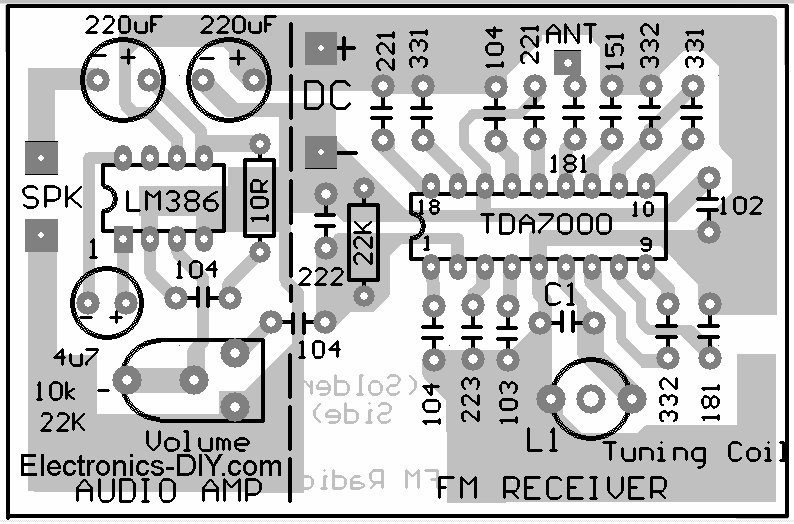
- FM radio using TDA7000
- 8W Broadband FM Radio Frequency Amplifier
- Remote FM transmitter circuit
- Mobile FM transmitter
- 2SC9018 FM Transmitter
- TDA7012 Single-chip FM receiver
- The simplest FM microphone circuit diagram (wireless microphone circuit diagram)
- Principle block diagram and circuit diagram of seven-tube AM radio
- RF Power Monitoring Circuit
- TDA7000 single-chip FM radio circuit diagram
- USB communication circuit
- Indoor unit communication circuit
- Integrated AM and FM radio circuits for household appliances
- High quality AM/FM radio circuits
- AM/FM radio circuit using three integrated circuits
- Can type FM radio circuit diagram
- Two-way communication circuit circuit diagram
- can FM radio
- Long distance serial communication circuit
- Circuit diagram of stock information receiver modified from ordinary FM radio







 京公网安备 11010802033920号